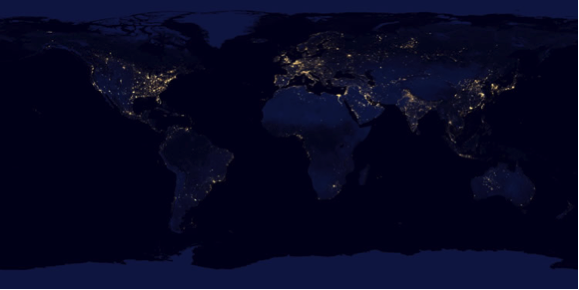
- Source: NASA Image
Take a look at this famous NASA image, a satellite photo of the Earth at night. This map shows the geographic pattern of night time electricity consumption, but it also clearly shows the geographic distribution of cities and population. Lights are bright in South Korea, but most places are in dark in North Korea; within the US, the east coast is brighter than the rest. Likewise, the lights are brightest around Paris and London in Europe. While there are still lots of dark places in China, we must ask ourselves, as urbanization continues in the country, what will this map look like for China in 2020, and where will the brightest lights be?
1. Strategic plan for China 2020 should incorporate future urbanization landscape—“go deep” vs. “go wide”
Every Western multinational needs to ensure they look at China’s urbanization as a major driver for the future consumption-led economy. FSG’s analysis is a starting point to assess the clusters in which multinationals already operate, and more importantly, what the best plan for the future should be—“going deep” vs. “going wide.” A clustering approach uncovers synergies, which are necessary given the scale in China and therefore an important input into the game plan for China 2020. My next blog will provide more details on which clusters I’m referring to.
2. Managing profitable growth in China
Concentrating resources on certain clusters brings the opportunity to exploit scale more quickly, because companies can leverage the synergies in sales force, distribution partners, supply chain, and marketing efforts across a wider geographical scope than by managing on a single city basis without sufficient regional scale.
3. Future organizational design is tilting toward decentralization
Multinationals will have to assess the possibility of decentralizing their Chinese sales headquarters by branching out sales centers to other hub cities to get closer to local business—for instance, using Beijing as the northern China headquarters, Guangzhou as the southern China headquarters, and Chongqing as the western China headquarters. MNCs can also consider breaking down functional responsibilities into different clusters by leveraging the clusters’ specializations—for instance, building a logistics center in Wuhan because of its favorable geographic location, establishing an e-commerce hub in Chengdu, and incubating R&D innovation in Suzhou.
4. Western multinationals need to monitor the industry clusters very closely
The government is and will continue building numerous industry clusters across the country that will help build the ecosystem around them. High-skilled and high-tech industry value chains are gradually taking shape. For example, a few biotechnology companies set up their administrative operations and R&D centers in Shanghai, while locating manufacturing in neighboring cities such as Suzhou or economic zones such as Kunshan or Zhanjiang Industrial Park. MNCs can leverage the formation of mature industry clusters to screen out horizontal suppliers and customers, as well as monitor the vertical competitive environment.
5. Multinationals need to keep an eye out for key signposts that will evolve over time; everything may not be rosy
China’s urbanization program will cost approximately US$ 6.8 trillion. From 2015 to 2020, more than US$ 100 billion of new, related professional services and biddable infrastructure contracts are estimated to be available every year. However, local governments are already deeply debt-ridden, given that China’s total local government debt in mid-2013 ballooned to 17.9 trillion RMB. The gap between the urbanization rate and urban “hukou” rate has widened over time. The high levels of local government debt will make it difficult to provide provisions for adequate public services, including healthcare and education, to new migrants.
This article is part one of a three-part blog series on China Urbanization called Trace the Lights. Check back next week for part two.
For a full report on evolving consumer base and urbanization in China, FSG clients can visit the client portal. Not a client? Contact us for more information.
Speak Your Mind