
Following up from my last blog post on China’s blueprint for developing 19 city clusters by 2020 from the New National Urbanization Plan, FSG has gone one step further and analyzed the clusters beyond the policy level to help MNCs craft a cluster-based go-to-market strategy. My recently published piece on China’s evolving customer base and urbanization is not an academic treatise on urbanization policy or a primer for governments. Instead, it is a commercially focused wake-up call for multinationals under pressure to grow profitably.
With the rise of cities and city clusters in China representing the largest commercial growth in the decades ahead, most business decisions pivotal to the 2020 game plan should be made based on the commitment to winning in these cities/clusters with magnitude and well-defined strategies.
Where to Play:
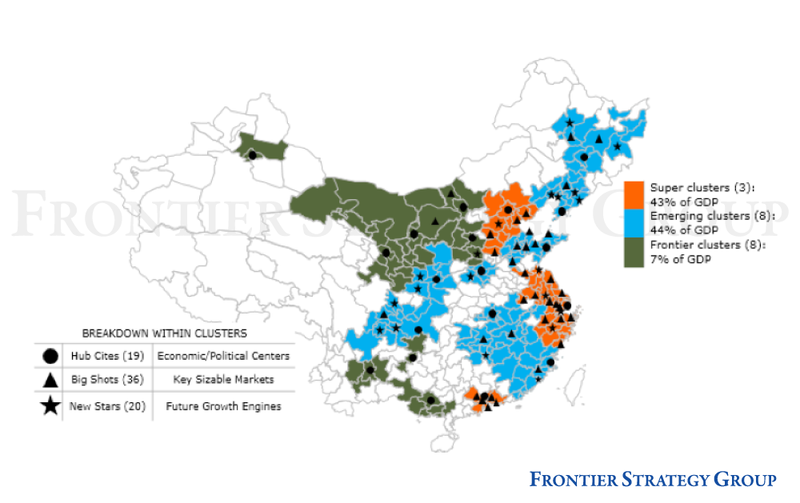
First, FSG divided each cluster into three categories: hub cities, big shots, new stars, and other surrounding cities for multinationals to use for resource prioritization. Hub cities are defined as super metropolitan cities and regional economic capitals. Big shots’ GDP exceeded over 300 billion RMB (US$ 48.4 billion) in 2013. New stars are promising, small and midsized cities ranked by FSG’s city index.
FSG lists the top 20 Chinese cities that may provide high market potential by 2020 based on analysis of 10 indicators, including both quantitative macroeconomic indicators and forward-looking investment indicators (e.g., the government’s high speed railway development plan and “hukou” reforms). Multinationals can use “hub cities” as a springboard to penetrate the whole cluster. To seek national coverage, companies can further penetrate “big shots” with a large market base to capture significant opportunities. After establishing scale in hub cities and big shots, companies should ramp up scale in the “new stars,” which are expected to lead market growth by 2020.
How to Play:
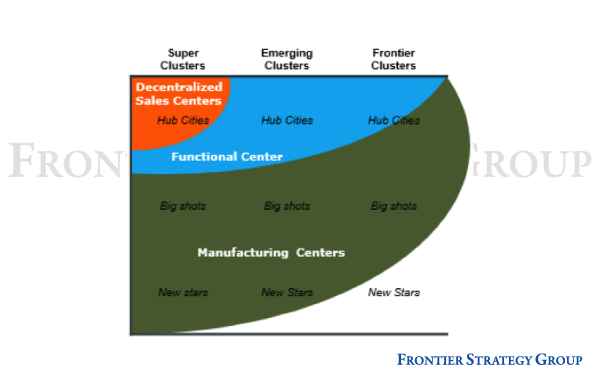
Second, after addressing the question of “where to play,” the most important question is how these urban clusters will impact MNCs’ organizational decisions regarding channel strategy, organization strategy, talent strategy, and product strategy. For example, multinationals will have to assess the possibility of decentralizing their Chinese sales headquarters by branching out sales centers to other hub cities to get closer to local businesses—for instance, using Beijing as the northern China headquarters, Guangzhou as the southern China headquarters, and Chongqing as the western China headquarters.
Breaking down functional responsibilities into different clusters by leveraging the clusters’ specializations—for instance, building a logistics center in Wuhan because of its favorable geographic location, establishing an e-commerce hub in Chengdu, and incubating R&D innovation in Suzhou—will have to be mapped out in the process.
This article is the final piece of a three-part blog series on China Urbanization called Trace the Lights. View part 1 here, and part 2 here.
For a full report on evolving consumer base and urbanization in China, FSG clients can visit the client portal. Not a client? Contact us for more information.
It was a smart move made by FSG to create three cluster categories. Even other countries can learn to group their cities by implementing the same model to successfully divide functional responsibilities among them. A nice, highly informative read!