The recent events in Iraq naturally heighten concerns surrounding higher oil prices given the country’s position as OPEC’s second largest crude producer. However, despite a spike in oil prices over the last week due to the expansion of a broad based coalition of Sunni insurgents, led by ISIS, in northern Iraq, this volatility is likely to be short-lived. For MNCs, this means that it may be too early to adjust plans to account for a sustained spike in global energy prices.
Here are the reasons why:
1) Most of Iraq’s oil production and exportation is in the south
The seizure of oil fields appears to be a strategy of ISIS in general, as it has performed similar operations in eastern Syria to generate revenue by selling oil. However, it is important to remember that most of Iraq’s large producing fields and refineries are in the south, an area that has been largely unaffected by militant activity. Iraq’s northern oil exports used to amount to 300,000 bpd prior to March this year, but have since been shut off due to attacks on the pipeline to Turkey. However, this figure still remains low in comparison to the 2.58 million b/d (as of May this year) that are exported from the country’s southern terminals.
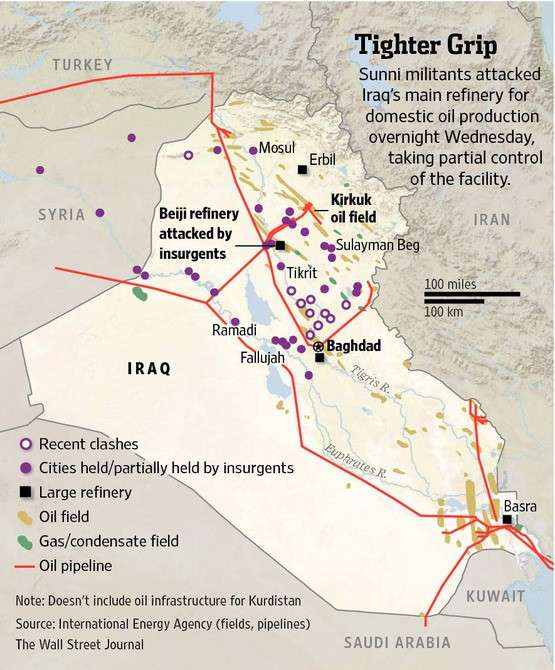 Map showing oil fields and pipelines: the most important are most are located in the south away from the fighting (Source: WSJ)
2) The expansion of territory gained by Sunni insurgents is unlikely to continue at its current pace due to the potential of foreign involvement
In particular, both the US and Iran have shown willingness to assist the Iraqi army fight the insurgency. Although Baghdad would be a natural next target for the groups, the capital is heavily fortified and any advancement on the city could trigger foreign military intervention, such as US aerial attacks. Furthermore, Iraqi Shi’ite volunteers are being recruited in large numbers to counter the ISIS advancement and any attack on Shi’ite pilgrimage sites would almost certainly lead to Iranian military support
3) While fighting at the Baiji refinery is domestically disruptive, the facility does not export any oil
The refinery accounts for one third of the nation’s refining capacity (up to 310,000 b/d at full capacity) but it mainly supplies northern Iraq and Baghdad and does not export any oil products. Three quarters of Iraq’s oil production is in the southern part of the country so the danger to oil exports from fighting at the facility is low
4) The short-term volatility of global oil prices is likely to be mitigated by the thawing of relations between Iran and West
This is because both have an interest in curbing the expansion of Sunni insurgents, and better relations could eventually lead to a boost in Iranian crude exports to global markets which would offset the potential fall in Iraqi production. Just this week, UK Foreign Secretary William Hague announced that the British embassy in Iran will reopen and both the US and Iran have expressed a willingness to collaborate to curb the ISIS advancement
For more analysis of the recent violence on energy prices, FSG clients may access the report here.
Speak Your Mind