Iraq Crisis: Reacting Rashly to Instability Could Hurt Your MENA Business

Spencer Platt, Getty Images

Right now all eyes are on the conflict in Iraq. However, political instability is the regional norm, as seasoned senior executives can attest. Companies must avoid making rash decisions in response to regional volatility. Otherwise, there is a danger of cannibalizing long-term prospects for MENA growth.

Senior executives must be proactive in controlling the conversation with their corporate office to counteract the steady stream of negative media attention that is focused on the region. Despite the terrible human toll from the Iraq crisis, and increasing links to the devastating Syrian civil war, only 11% of MENA GDP is derived from markets that are highly exposed to spillover from the conflicts.

Senior executives should assess how deteriorating stability in Iraq impacts their MENA strategy, but a measured response is required. FSG suggests considering three actions for your regional business:

1. Course-correct your MENA strategy, but do not waste resources on a complete overhaul.

Risk-tolerant companies can gain long-term market share as others freeze investments or pull out of Iraq and surrounding countries. At the same time, MNCs can focus on a profitability-driven strategy in stable countries such as Saudi Arabia and the UAE. Our clients can use FSG’s market prioritization tool to aid in reassessing where to concentrate regional resources. They can also track signposts in our Iraq report and updates from FSG’s MENA Monthly Market Monitorto help decide when changes are appropriate.

2. Leverage local partners to maintain a foothold in affected areas in the MENA region.

Risk-averse companies can maintain a foothold in unstable markets by relying on local partners to reduce financial and security risks. It will be important to work with partners to monitor changing regional perceptions of Western brands if there is a sustained Iraq conflict in which foreign intervention is possible. Clients can review FSG’s Managing Distributors in MENA for additional strategies.

3. Count on de facto or de jure Kurdish independence, which brings opportunities and risks.

Kurdistan’s capture of oil-rich Kirkuk puts it on an accelerated path toward de facto or de jure independence. Kurdistan could become even more of an investment destination as a result. But manage expectations, as there are new challenges, including potential fuel shortages as a result of disruptions to the Baiji oil refinery and Erbil’s exposure to a rise in terrorist attacks. Clients can read our Iraq Frontier Market Access report for more on Kurdistan and use our monthly MENA report to track developments.

(Image courtesy Getty Images, Scott Platt: A Kurdish soldier with the Peshmerga keeps guard near the frontline with Sunni militants on the outskirts of Kirkuk, an oil-rich Iraqi city on June 25, 2014.)

Emerging Market View: What Our Analysts Are Reading

Emerging Market View What our analysts are reading

Much like the US soccer team advancing in the World Cup despite a loss to Germany in yesterday’s game, Brazil’s economic outlook (regardless of the economic angst in recent years) seems to be catching a break as well - and it’s about time.

“Brazil still offers a significant amount of untapped opportunities in most sectors, especially in relatively faster-growing regions in the North and Northeast. Successful multinationals stress the need to focus on the long-term,” according to Pablo Gonzalez, Senior Analyst for Brazil after reading an article published by the FT.

FSG’s clients are encouraged to read further on how to make the case for Brazil, our latest report which identifies the opportunities and long-term factors that continue to make Brazil a good bet for multinationals. Also in the news lately is the rising cost of energy, a topic of recent concern given the unrest in the Middle East. The Wall Street Journal reports that higher oil prices are casting a shadow over emerging markets.

“Higher energy prices disproportionately affect emerging market consumers and economies. The increase in oil prices as a result of the rising political risk premium from the conflict in Iraq could spell trouble for emerging markets that are large importers of oil or already experiencing decelerating growth,” says Sam Osborn, Associate Practice Leader for FSG’s global analytics.

An example of impact follows Turkey’s recent decision to cut interest rates again.

“The interest rate cut will be helpful to local businesses but will fuel inflation. Rising energy prices because of the situation in Iraq are already affecting transportation costs, and the central bank will struggle to contain them with lower interest rates. As a result, MNCs can expect consumers to be squeezed for at least several more months,” says Martina Bozadzhieva, Head of EMEA Research at FSG.

However, Iraq is not the only concern:

FSG clients should review more analyses of rising energy prices here.​

Four Reasons Why Iraq’s Impact on Oil Prices is Overstated

Written by: Fadi Khalife, Frontier Strategy Group Intern, EMEA

The recent events in Iraq naturally heighten concerns surrounding higher oil prices given the country’s position as OPEC’s second largest crude producer. However, despite a spike in oil prices over the last week due to the expansion of a broad based coalition of Sunni insurgents, led by ISIS, in northern Iraq, this volatility is likely to be short-lived. For MNCs, this means that it may be too early to adjust plans to account for a sustained spike in global energy prices.

Here are the reasons why:

1) Most of Iraq’s oil production and exportation is in the south

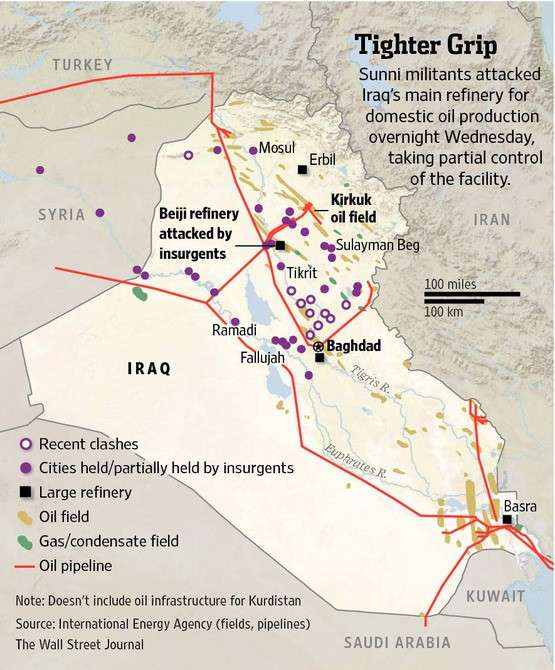
The seizure of oil fields appears to be a strategy of ISIS in general, as it has performed similar operations in eastern Syria to generate revenue by selling oil. However, it is important to remember that most of Iraq’s large producing fields and refineries are in the south, an area that has been largely unaffected by militant activity. Iraq’s northern oil exports used to amount to 300,000 bpd prior to March this year, but have since been shut off due to attacks on the pipeline to Turkey. However, this figure still remains low in comparison to the 2.58 million b/d (as of May this year) that are exported from the country’s southern terminals.

iraq mapMap showing oil fields and pipelines: the most important are most are located in the south away from the fighting (Source: WSJ)

2) The expansion of territory gained by Sunni insurgents is unlikely to continue at its current pace due to the potential of foreign involvement

In particular, both the US and Iran have shown willingness to assist the Iraqi army fight the insurgency. Although Baghdad would be a natural next target for the groups, the capital is heavily fortified and any advancement on the city could trigger foreign military intervention, such as US aerial attacks. Furthermore, Iraqi Shi’ite volunteers are being recruited in large numbers to counter the ISIS advancement and any attack on Shi’ite pilgrimage sites would almost certainly lead to Iranian military support

3) While fighting at the Baiji refinery is domestically disruptive, the facility does not export any oil

The refinery accounts for one third of the nation’s refining capacity (up to 310,000 b/d at full capacity) but it mainly supplies northern Iraq and Baghdad and does not export any oil products. Three quarters of Iraq’s oil production is in the southern part of the country so the danger to oil exports from fighting at the facility is low

4) The short-term volatility of global oil prices is likely to be mitigated by the thawing of relations between Iran and West

This is because both have an interest in curbing the expansion of Sunni insurgents, and better relations could eventually lead to a boost in Iranian crude exports to global markets which would offset the potential fall in Iraqi production. Just this week, UK Foreign Secretary William Hague announced that the British embassy in Iran will reopen and both the US and Iran have expressed a willingness to collaborate to curb the ISIS advancement

For more analysis of the recent violence on energy prices, FSG clients may access the report here.​

MNC Insight: Five things I learned during my 10-day visit to Dubai

I met with more than a dozen Dubai-based senior executives from multinational companies across several sectors. Five important issues emerged during our conversations:

1. Improving performance in Africa is the focus of MEA strategic planning

During my visit to Dubai, 70% of the companies that I met were focused on improving their performance in Africa. Interestingly, most of the companies use Dubai as a hub for Sub-Saharan Africa. The UAE is already an established regional hub for the Middle East, because of the advanced commercial infrastructure, air travel links to rest of the world (Gulf flights can reach 2/3 of world’s population in 8 hours), access to skilled, albeit expensive expatriate labor, and relative ease of anticipating local costs.

2. MNCs are frustrated increasingly by the procurement process in Saudi Arabia

Many executives cited an extended and unclear procurement process as an obstacle to business growth. There are new procedures and staff in many ministries, in part to ensure compliance, and this has led to more delays in the approval process. SAGIA, Saudi Arabia’s investment agency, recently announced a new fast-track option for processing foreign investor applications and I will investigate how it is being implemented during my upcoming visit to the market.

3. Executives are still mystified by MENA’s frontier markets, particularly Algeria and Iraq

In Algeria, companies often work through a local partner, but have underperformed due to a difficult operating environment. Many are watching whether President Abdelaziz Bouteflika’s fourth term will usher in an era of growth or support stagnation. In Iraq, most companies do not have enough info to navigate the market appropriately and find it difficult to make the case for resources given dramatic headlines that appear in Western news outlets every day.

4. Investment in Iran is still a taboo topic for many despite the market’s huge potential

Iran has the 2nd largest population in MENA and among the largest oil and gas reserves in the world. Yet the market opportunity still seems too far off for many MNCs, especially those with US headquarters. Interestingly, I met with a consumer-oriented Danish company that is trying to get expansion plans approved by their board. The executives are worried about rising competition from American companies if a nuclear deal is reached in July.

5. Companies are not worried enough about MENA’s vulnerability to a Chinese slowdown

China’s growth trajectory was not a concern for many executives until I connected the dots to the overall health of MENA economies. The Middle East supplies nearly 50% of China’s oil. Strong Chinese demand drove an oil price surge that increased GDP in GCC countries by $1 trillion between 2003 and 2013. In addition, 15% of MENA exports go to China and Chinese-based companies are major foreign investors in the region. As a result, executives need to factor into their strategic plans how a slowdown in China (below 7% annual growth) would hurt economic activity in MENA.

Five Political Events that will Impact your MENA Business in 2014

My last post focused on an overlooked topic in the MENA region: business opportunity. This post covers a more popular regional theme: political risk. MNCs must prepare for how the following political events could impact their MENA business performance in order to be successful in 2014:

1. The next round of Iran nuclear talks beginning on February 18

  • Why it matters: A deal would lead to the opening of MENA’s largest untapped market, while failed talks would shake business and consumer confidence throughout the region.
  • Political context: It is unclear whether a final deal involving Iran’s nuclear program can be reached this year. Decades of an uncoordinated international sanctions policy would be difficult to roll back even with a final agreement, particularly if the process is made into a campaign issue ahead of US congressional elections later this year.
  • Business impact: Companies without a local presence should manage expectations regarding the pace of market entry if a final nuclear deal is reached; the sanction rollback process could take quite a long time and economic recovery will take longer. Established companies would have a head start against rapidly rising competition, but do not expect an immediate easing of restrictions on critical business activities like repatriating funds.

2. Algeria’s presidential election, which is scheduled for April 17

  • Why it matters: Algeria could become a major FDI destination if critical economic reforms are implemented after the election.
  • Political context: Companies should monitor whether President Abdelaziz Bouteflika announces that he will run for a fourth term. While the ruling National Liberation Front (FLN) could field another candidate who would win, Bouteflika’s absence from the election would be seen as a shakeup in the political order, leading to political uncertainty.
  • Business impact: If President Bouteflika decides to run for a fourth term, it could signify his desire to usher in a new economic era that would enshrine his legacy. Economic reforms are badly needed, particularly to ease the process for foreign investment and market entry. Some economic reforms could be aimed at encouraging local production in important sectors such as pharmaceuticals, as the government seeks to reduce its import bill and reorient spending toward local investment.

3. The Iraqi parliamentary election, which is scheduled for April 30

  • Why it matters: An election accompanied by significant violence would lead to another year of high business costs and frequent transportation disruptions. However, a modestly successful election could encourage stability and boost substantial business potential.
  • Political context: Politically disaffected Sunnis (and some Shiites) are not motivated to seek change through the ballot box, because they feel excluded from the political process. Low voter turnout and significant violence would further undermine political cohesion and fuel ongoing instability. On the other hand, if the federal government and Sunni tribal leaders cooperate to combat militants in the Anbar province, this could act as a building block to ease tensions ahead of the election.
  • Business impact: An election that is widely seen as a failure will lead to more violence and necessitate companies to ensure contingency plans protect staff and local partners. On the other hand, if the election is seen as a modest success, it could slow down the momentum of ongoing violence. Companies would be in a better position to establish a foothold to build market share and to expand geographically with a sustained improvement to political stability.

4. The expiration of the 6-year term of Lebanese President Michel Suleiman in May

  • Why it matters: A new government must be agreed upon before President Suleiman’s departure from office or a worsening security situation would hurt business locally and across the Middle East.
  • Political context: To limit instability, it is critical that a new government is formed before the expiration of President Michel Suleiman’s six-year term in May. Without a functioning government, it has been difficult for Lebanon to contain rising instability since mid-2013. Last Saturday’s car bombing in Hermel, which killed four and injured 30, is the latest example of spill over from the Syrian civil war. The deteriorating security situation cannot be improved without a new government.
  • Business impact: Companies should brace for escalating violence, especially if there is no move towards political consensus. The volatile environment will continue to undermine consumer confidence, depress foreign investment, and raise the cost of doing business. Regionally, ongoing instability contributes to rising competition in the stable GCC region. In addition, if Lebanon becomes more enveloped in the Syria conflict, it threatens to disrupt transportation across the Middle East given the integral role played by the Port of Beirut for accessing nearby markets.

5. The announcement of any new Saudi labor regulations during 2014

  • Why it matters: Senior executives rely heavily on the Saudi market for overall MENA growth. Tighter labor regulations could slow down business enough to threaten MENA performance targets in 2014.
  • Political context: The government could tighten labor regulations without more private sector hiring of Saudi nationals, which increased only 4.6% between 2010 and 2012. The labor market must absorb 100,000 Saudi graduates per year and the government is willing to accept short-term economic pain in exchange for a long-term rebalancing of the job market. Official figures indicate that Saudi Arabia has deported up to 1.25 million of 9 million foreign workers since 2013.
  • Business impact: As a result of the imbalance created by the mass deportations of foreign workers, some construction firms are struggling with higher costs and worker shortages. As a result, banks must deal with an increase in late payments and non-performing loans. More stringent labor regulations would exacerbate this situation and lead to tighter credit conditions, undermining consumer spending and business activity in 2014.

Uncovering Opportunities in the Middle East and North Africa

Despite news headlines highlighting political instability in the Middle East and North Africa (MENA) region, business continues as usual. FSG estimates that only 14% of the region’s GDP, which is expected to surpass US$ 4 trillion by 2017, comes from unstable markets. With private consumption forecast to grow more than 7% in MENA and spending power nearly 50% higher in GCC markets than in Central and Eastern Europe, there are plenty of investment opportunities for foreign multinational companies.

Three market developments to watch in 2014

  1. Iraq: This is your last chance to stay ahead of competition in Iraq. Devastating violence deservedly draws media attention, but it does not preclude the emergence of significant business opportunities. Iraq has the fifth-largest oil reserves in the world and funds are already being spent on infrastructure upgrades in education, healthcare, housing, IT, and retail. Iraq is expected to have MENA’s second-largest youth population within a decade, providing future customers to consumer-oriented companies. Many companies are working with local partners to capture these opportunities, while minimizing security and operational risks. First-movers are positioned to build customer loyalty, establish relationships with key government officials, and gain market share. FSG clients should read Frontier Market Access: Iraq to learn about strategies for entering the market, finding local partners, and navigating the difficult regulatory environment.
  2. Iran: Oil analysts estimate that global crude prices could drop by up to 15% following an international agreement involving Iran’s nuclear development program. Companies should expect lower oil prices to provide some relief to oil-importing countries in North Africa and the Levant, plagued by dwindling currency reserves, and as a result, currency volatility since 2011. Sanction rollbacks will also lead to more companies assessing Iran as a frontier market. Still, senior executives should manage expectations for Iran. Even if a deal is reached, it will be complicated to undue decades of an uncoordinated sanctions policy.
  3. Saudi Arabia: The recent crackdown on illegal labor is designed to provide long-term economic benefits. And while Saudi Arabia remains the top MENA market for many companies, senior executives should plan for higher inflation, which could impact consumers and small businesses, and project delays at least through the beginning of 2014. Close to one million migrant workers left Saudi Arabia this year. Some small businesses, such as bakeries and grocery stores, were forced to close after losing workers. Costs are up for electricians, mechanics, and plumbers. Foreign companies should allocate additional resources for recruiting and developing Saudi nationals due to mounting pressure from the government. FSG clients should read the Saudi Quarterly Market Review Q3 2013 report for strategies to overcome labor challenges.

Download the podcast or access the entire FSG iTunes library here.

Monthly Regional Insights: Middle East & Africa

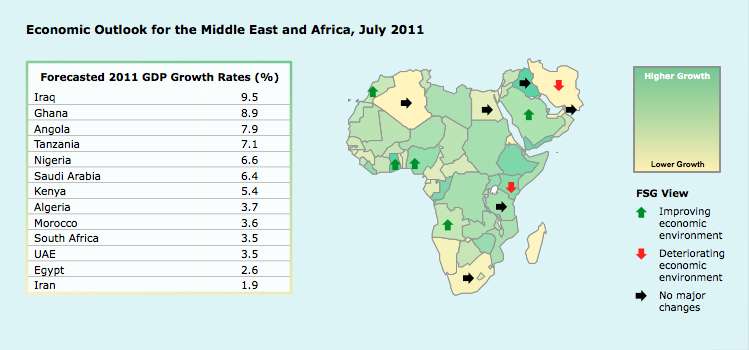
Consumers are struggling with higher food and fuel prices across the emerging markets of Middle East and Africa as external factors such as high commodity prices and regional unrest combine with internal factors including strong domestic demand. Next month, Ramadan will heighten the upward pressure on prices in countries with large Muslim populations, which may lead governments to consider interest rate hikes to bring inflation under control

Algeria: A desire for stability will trump any motivation for political change in the short term

Angola: Moody’s and Fitch signaled that Angola’s investment climate is improving, but several threats could derail recent progress

Egypt: The new budget plan fails to address how Egypt will emerge from its post-revolution struggles, but cautious optimism remains for 2012

Ghana: Politically stable Ghana has made huge strides recently in local enterprise stimulation and resource manufacturing potential

Iran: The rollback of subsidies is sustaining inflation at high levels, which is hurting Iran’s economy more than sanctions

Iraq: Investment opportunities in Iraq are growing rapidly, but the security situation remains precarious in the medium term

Kenya: Economic potential is restricted by high commodity prices, which are contributing to inflation growth and a weakening currency

Morocco: Relative stability should hold for the short term, but fallout from the constitutional referendum should be monitored closely

Nigeria: The development of the healthcare sector may be a slow process, but its untapped potential is huge

Saudi Arabia: Pace of government transactions slows, but private consumption spike will provide opportunities for consumer-oriented companies

South Africa: The investment climate received a boost with the approval of Wal-Mart’s entry, but familiar challenges still threaten the economy

Tanzania: Massive infrastructure plan hinges on willingness of private investors to take a risk on Tanzania

UAE: The government is getting ready to launch a key industrial zone just as companies revisit the UAE as a long-term export base

Each month Frontier Strategy Group releases monthly market reports to its clients. These concise, executive-friendly reports highlight key developments and market trends in a particular region.