


Outlook for North Africa Post Gaddafi


The death of former Libyan ruler Muammar Gaddafi marks the symbolic beginning of a new era in North Africa and transitioning states are keen to attract foreign investment. Companies should avoid being paralyzed by uncertainty, and must begin planning to re-engage and expand in the region to capture medium to long-term opportunities.

Investment opportunities exist across sectors though key considerations differ by country

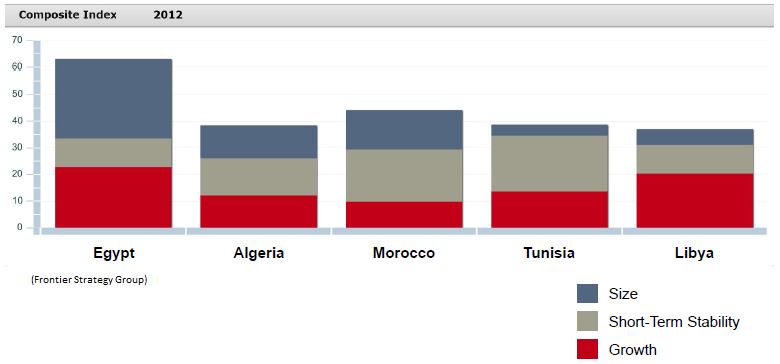
  • Consumer Goods: Egypt’s market size and strong sector growth, especially in cities, make it an attractive investment, while relative stability in Morocco and Tunisia will support a healthier outlook (see MarketView screenshot above)
  • Industrials: Ongoing public and private investment in oil and gas will support Algeria’s desirability as an investment destination in related sectors. Rebuilding opportunities and an effort to bring oil production back online will mean strong growth in Libya
  • Technology/Telecommunications: Size and growth underpin the outlook in Egypt, where plans could be revisited to become an outsourcing hub, while ICT services make Algeria’s B2B market an attractive investment target
  • Healthcare: Tunisia’s market does not offer robust size or growth, but it is a safe bet due to previous investment in the healthcare sector. Conversely, Libya’s healthcare infrastructure suffers from years of neglect, but the country is a wildcard for future growth due to high GDP per capita among a small population

Emerging markets – decoupled from the crisis?


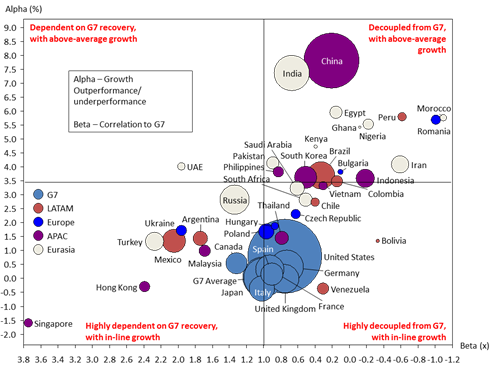
Frontier Strategy Group built a proprietary model in 2008 to test the assumption that “emerging markets are decoupled from western economies (G7)”. We found that certain markets such as Nigeria and Peru were not only decoupled but provided multinationals with consistently high growth opportunities. Conversely, growth in markets such as Turkey, were highly dependent on a recovery in western economies.

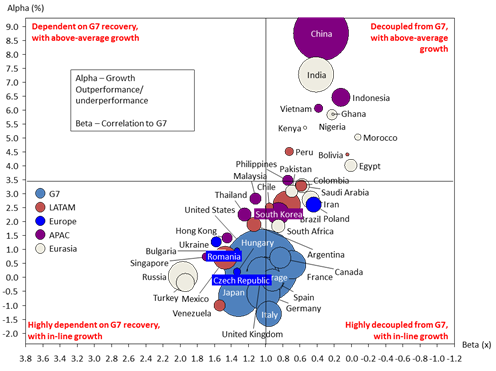
Surprisingly, in 2011, our model shifted to indicate that emerging markets are no longer thought to be as decoupled as before. Very few markets such as Morocco and Indonesia provide above average growth opportunities with less dependence on the status of western markets.

In 2008 we built a model to understand the global impact of a recession:

2011 data shows markets are more coupled than before

MENA Insulated from Global Economic Shocks for Now


Because of close trade ties, US foreign aid to the region, and American thirst for oil, S&P’s downgrade to the US credit rating a few weeks ago is surely a harbinger of doom for economies in the Middle East and North Africa, right? Not exactly.

After the S&P downgrade, stock markets fell across the MENA. Investors are understandably concerned about increased risk. However, FSG does not expect this to shift the regional risk profile significantly. The region should be less susceptible to economic shocks in the short term as many economies have already taken a beating due to revolutions, transitions, and ongoing political uncertainty associated with the Arab Awakening. One potential impact would be an uptick in inflation growth in the Gulf. This is because five of six GCC currencies are pegged to the US Dollar. If the US Federal Reserve decides to begin a third round of quantitative easing, then it would place upward pressure on the price of importing goods in the region.

What unfolds in Europe and Asia for the rest of the year is likely to have a more profound impact on the investment outlook for the Middle East and North Africa going into 2012. A deepening Euro zone crisis threatens countries with close trade ties to the EU. Morocco and potentially Egypt could see their currencies weakened, while Turkey could be squeezed by a slowdown in exports and foreign investment.

Hydrocarbon economies like Kuwait, Qatar, Saudi Arabia, and the UAE are fairly insulated because their respective budgets factor in oil prices averaging a range from $55 (Qatar) to $85 (Saudi Arabia) per barrel on the year. Oil has already averaged well over $100 per barrel and we are approaching the last quarter of 2011. Gulf oil exporters can draw on excess crude revenue to sustain aggressive public spending and economic diversification programs in 2012. Still, a European recession combined with a trade slowdown in Asia would represent a serious blow to oil demand and impact prices as a result. This could lead to a delay in public sector projects and place an increasing burden on the private sector to create more jobs locally.

Overall, FSG does not expect global instability to impact the Middle East and North Africa in the short term. However, a deepening euro zone crisis combined with a slowdown to Asian demand could prove to be a toxic cocktail for the region in the medium term. The silver lining in this type of double-whammy scenario would be reduced global demand for commodities and lower food and fuel prices in the region. This would be particularly important for countries impacted by the Arab Awakening as they look to rebuild their economies.

Monthly Regional Insights: Middle East & Africa


Consumers are struggling with higher food and fuel prices across the emerging markets of Middle East and Africa as external factors such as high commodity prices and regional unrest combine with internal factors including strong domestic demand. Next month, Ramadan will heighten the upward pressure on prices in countries with large Muslim populations, which may lead governments to consider interest rate hikes to bring inflation under control

Algeria: A desire for stability will trump any motivation for political change in the short term

Angola: Moody’s and Fitch signaled that Angola’s investment climate is improving, but several threats could derail recent progress

Egypt: The new budget plan fails to address how Egypt will emerge from its post-revolution struggles, but cautious optimism remains for 2012

Ghana: Politically stable Ghana has made huge strides recently in local enterprise stimulation and resource manufacturing potential

Iran: The rollback of subsidies is sustaining inflation at high levels, which is hurting Iran’s economy more than sanctions

Iraq: Investment opportunities in Iraq are growing rapidly, but the security situation remains precarious in the medium term

Kenya: Economic potential is restricted by high commodity prices, which are contributing to inflation growth and a weakening currency

Morocco: Relative stability should hold for the short term, but fallout from the constitutional referendum should be monitored closely

Nigeria: The development of the healthcare sector may be a slow process, but its untapped potential is huge

Saudi Arabia: Pace of government transactions slows, but private consumption spike will provide opportunities for consumer-oriented companies

South Africa: The investment climate received a boost with the approval of Wal-Mart’s entry, but familiar challenges still threaten the economy

Tanzania: Massive infrastructure plan hinges on willingness of private investors to take a risk on Tanzania

UAE: The government is getting ready to launch a key industrial zone just as companies revisit the UAE as a long-term export base

Each month Frontier Strategy Group releases monthly market reports to its clients. These concise, executive-friendly reports highlight key developments and market trends in a particular region.