



Latin America

FT beyondbrics Feature - EM distribution: try DIY?


FT Original Image

Frontier Strategy Group’s latest research on channel management in emerging markets was featured on the Financial Times’ beyondbrics blog on January 23, 2013. Please find the article below:

With major EM economies slowing in 2012, regional heads of multinational companies are increasingly having to focus on their margins. As new research from the Frontier Strategy Group shows, many are considering boosting them by running some of their own distribution operations.

In a survey of 136 executives from 82 multinationals operating across emerging markets, FSG found their respondents to be none too happy with their distributors. On average, EM distributors take a 25 per cent cut of revenue, and nearly two thirds of respondents said they were planning to work towards a better deal.

Joel Whitaker, head of global research at FSG tells beyondbrics that MNCs moving into emerging markets have conventionally “focused on capturing opportunities as broadly as possible as quickly as possible, leading them to rush into relationships which give considerable power to local distributors.”

You might think that with an in-demand product and a good brand, an MNC should hold the whip hand. However, due largely to their lack of local knowledge, 94 per cent of companies surveyed used indirect distribution channels, so switching between channels is not always easy.

Healthcare, for example, says Dan Kornfield, FSG’s director of strategic research, is “usually defined by a set of big distributors with relations with government. This creates an odd balance of power, where the middle man may be more picky than the supplier.” In more high tech enterprises, such as chemical engineering, the time taken to train distributors can be an additional bind.

Russia stands out in the survey as a particularly hard place to manage distribution. Of the four Brics it stands out as having the lowest average number of distributors per company at just five, compared with 174 in China, 39 in Brazil and 70 in India. It also has the largest average cut taken by distributors at 31 per cent – compared with 25 per cent in China and Brazil and 19 per cent in India – and the highest levels of dissatisfaction with distributor transparency, at 80 per cent.

Russia is defined, says Martina Bozadzhieva, a CEE researcher at FSG, “by a lot of small distributors with great local knowledge but insufficient resources to cover large distances, and a few very large distributors which can”.

The latter companies will often be handling goods from competitors too and consequently, Bozadzhieva says, “are touchy partners to work with. They give you fast geographic access, but they are hard to incentivise, and would not mind if you dropped out.”

Overcoming this could entail DIY distribution: 43 per cent of survey respondents said they were planing to move into direct distribution in at least one of their market segments, and 18 per cent said they were planning to acquire at least one of their distributors.

Alcoholic beverage companies in Latin America, FSG say, have demonstrated how it can be done successfully. “They have mapped out the networks, they know the logistics, they know what it takes to hire the right people – they have realised they can cut out the middle man,” says Kornfield. This comes not only with extensive experience of the local market, he says, but with a strong brand to wield.

When this experience is lacking, though, high risks are involved. Where choice of distributors is limited, causing offence can be costly, and what causes offence can vary from place to place.

“There is huge variation geographically around how easy it is to disengage with distributors”, Whitaker says. “Business in India tends to be more transactional, and that is very familiar to companies from western markets, a lot of their toolkit works well there.

“But a company in Indonesia that tries to rip up a distribution relationship is going to find it much more difficult. The consequences can be quite severe as it’s seen as a more personal relationship.”

And then of course, it might be all too easy to look enviously at the cut being taken by distributors and assume it would be easy to replicate.

“We had a client in consumer goods in Nigeria who was dissatisfied with its distributors. Getting the goods into market was very slow and costly, and because they had the resources they thought they’d go direct”, Bozadzhieva says. “They found it was very challenging, the cost increased, their competitive position deteriorated, and eventually they had to re-enter from scratch with a new distributor.”

Austerity, The “Death Tax”, And How US Debt Ceiling Negotiators Could Learn From Europe


Austerity

The United States media has an interesting relationship with the word “austerity”. Apparently for the US media, austerity measures are a hot-topic in Europe. US publications such as The Wall Street Journal and New York Times have published articles analyzing the austerity measures implemented in regard to budgetary issues in the PIIGS (Portugal, Ireland, Italy, Germany and Spain). Economists from Paul Krugman to Mario Draghi have debated the effectiveness and scope of austerity measures in the processes of fiscal reconsolidation and deficit-cutting. The most recent IMF World Economic Outlook also offers a more quantitative econometric approach on assessing the effects of fiscal consolidation (their opinion was that estimated fiscal multipliers have been systemically too low, essentially saying that the negative short-term effects of fiscal cutbacks have been larger than expected).

Sentiment from FSG executives continues to reaffirm this growing aversion to the word “austerity”, and what it implies. Cost-cutting as the primary strategy for balancing budgets discounts the obvious economic advantages of pursuing a more equalized approach. In some emerging markets that exhibit tremendous growth potential, regional executives are worried that corporate budget-tightening and a laser-like emphasis on profitability is yielding the same short-term negative multiplier effect that the Eurozone just experienced. Harsh austerity to budgets is leaving regional executives with little room for flexibility, and with top-line revenue growth readily available, emerging markets could easily reap huge rewards for executives that are determined to not implement standardized austerity across the board. While spending clearly needs to be reined in, a bit of leeway should be extended in emerging markets where this “multiplier” could provide the biggest benefit to the company as a whole.

Along similar lines, Ernst and Young published a report estimating that banks will need to write down another $175 billion, as bad loans are forecasted to increase to 7.6% in 2013 from 6.8% in 2012. In FSG’s view, the austerity cycle creates deeper recession, weakening the banks further, and propagating this vicious cycle.

However, multinational corporations are not the only entity failing to grasp the insight here. The US Democratic Party is missing a big opportunity to leverage these recent developments in their favor. Many citizens remember the proliferation and media scrutiny of the so-called “Death Tax” before the 2008 general elections, made famous by Frank Luntz. The seemingly innocuous estate (or inheritance in UK) tax was successfully morphed into a diabolical government plot by Republican political strategists. Instead of an accepted status-quo, the estate-tax was used as a political rallying cry. As if this strategy needed further validation, Luntz’s best-selling book is actually titled, “Words That Work: It’s Not What You Say, It’s What People Hear”.

In the United States media, debt-ceiling negotiations have rarely been covered at their most fundamental level, which is the question of “Austerity or Stimulus?” As I have just covered, the word austerity and negative connotations associated with it are capable of triggering powerful images in the mind of the public (Greek protests and rioting anyone?). If democratic strategists begin to pivot their tactics to emphasize the ramifications of austerity, as opposed to spending their time defending the benefits of entitlement programs, then maybe, just maybe…we won’t end up like Greece after all.


PODCAST: Data Reveals Significant Room to Improve Distributor Performance


Podcast

Frontier Strategy Group recently surveyed 136 executives from 82 unique multinational companies (average global revenue, $18.1 billion) on their channel management strategy in emerging markets. The data shows significant room for improvement in distribution performance in 2013. The data also reveals the need to handle channel transitions with rigor and care, yet not shy away from them. A 2-page executive summary of the report can be found here. Dan Kornfield, FSG’s Director of Strategic Research recently discussed key findings from the survey on an exclusive Emerging Market Insights Podcast.

To listen to or download the podcast, click on this link to access the iTunes store.

Introducing the New FrontierStrategyGroup.com


FSG.com

Visit the new Frontier Strategy Group homepage to learn more about our current offering, in addition to the latest insight from our emerging market community.

PODCAST: Innovation in Emerging Markets - Expert Interview


Podcast Blog

In this podcast, Frontier Strategy Group Expert Adviser Brandi Moore shares her expertise on building a strong culture of innovation in emerging markets. In the business press, stories of successful emerging markets-led innovation from companies like GE and Unilever dominate headlines, but most companies struggle to achieve similar results. Brandi shares her view on why, and offers practical solutions.

To listen to or download the podcast, click on this link to access the iTunes store.

————————————————————————————————————————————————————

Bradi MooreiBrandi Moore has been solving challenging business problems in India since 2004. She has worked in India with Wipro, Infosys and other top outsourcers building processes to span learning gaps between Indian concepts and Western business models. She has extensive experience developing methodologies for US executives managing Indian employees, leading India-based projects and negotiating with Indian executives.

Brandi has negotiated with foreign governments, large corporations and inside India with stakes as high as $200 million. She is trained in the 5-D Hofstede model and executes negotiations based on culture as well as formal negotiation strategy.

3 Reasons Why Emerging Market Executives Need To Contingency Plan Now


Regional FDI Chart

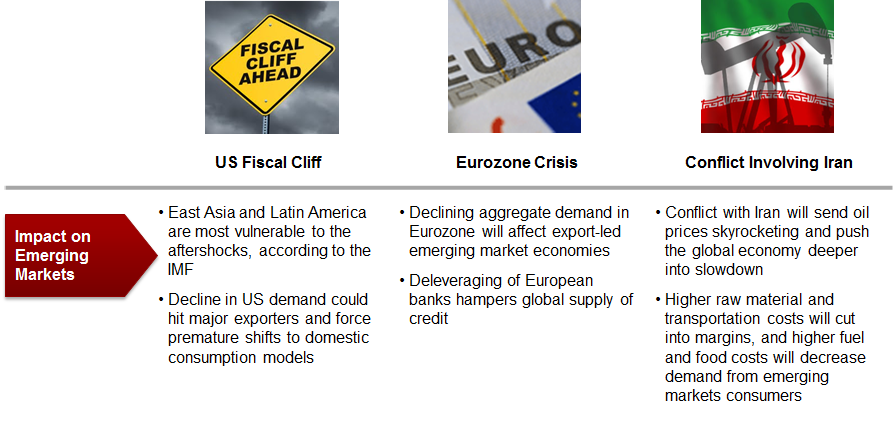
Global uncertainty is increasing. The back-and-forth negotiations surrounding policy decisions on the US Fiscal Cliff, Eurozone crisis, and potential conflicts in the Middle East may be intriguing for political scientists, but for global business executives, they are cause for major headache. These policy decisions don’t just affect the upcoming elections; the anemic growth of the global economy is at stake. Any escalation of one of these major drivers of global risk could seriously thwart hard-earned recovery, and plunge the globe into another recession.

With that said, emerging markets continue to show promise for 2013, even in the face of increased global risk. By focusing on economies that are better positioned to withstand the major influencers of uncertainty, and mitigating exposure to economies that are highly susceptible, growth can still be achieved. For example, economies in: Asia Pacific, Sub-Saharan Africa, and parts of Latin America are relatively well insulated. In the near-term, countries such as: Indonesia, Nigeria, Philippines, and Colombia exhibit the necessary growth fundamentals to withstand some of these potential negative shocks. However, looking at the growth fundamentals alone is not enough. Let’s take a closer look at the three big reasons why emerging market executives need to prepare contingency plan as soon as possible.

1. US Fiscal Cliff – How will you plan for a sharp decline in global demand?

The primary determinant of exposure to the US Fiscal cliff is the amount of exports emerging market regions send to the US. However, the ripple-through effects of the US falling over the fiscal cliff (or probably more appropriately, sliding down the fiscal slope) are much more far-reaching. A reduction in US demand will reduce manufacturing as export-led economies rebalance to reach new market equilibriums. This decline in manufacturing will also reduce demand for the input-commodities, adding downward pressure onto commodity prices. Executives that are caught off-guard by the susceptibility of some economies in their portfolio will find themselves playing catch-up in attempting to rebalance their resource allocation.

2. Eurozone Crisis – Are you prepared for a sudden reversal of foreign direct investment flows?

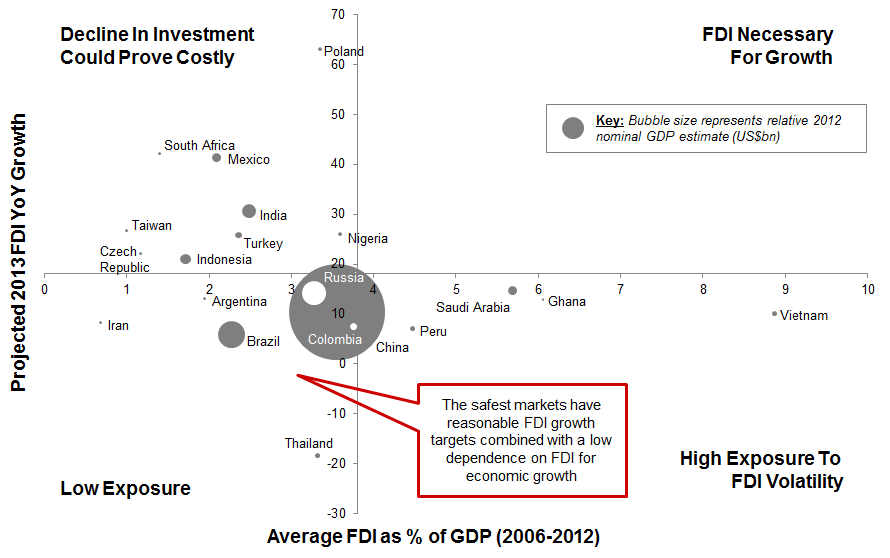
Trade and financial linkages are the fundamental transmission channels of an intensified Eurozone Crisis. A weakening Eurozone economy, combined with heightened perceptions of global risk, could undermine the foreign direct investment inflows that are currently expected to moderately increase for emerging market economies in 2013. Economies that are dependent on advanced economy capital flows for growth could see a major source of investment dry up.

3. Conflict in Middle East – What happens if there is a major oil shock?

Any conflict in the Middle East could result in a major decline in global oil supply, prompting a spike in oil prices. Higher oil prices would reduce sluggish growth and raise production costs (eroding profitability), while upward pressure on inflation could trigger a reassessment of credit supply in emerging markets. All of these factors combined could cripple indebted economies and threaten a liquidity crisis. The susceptibility and flexibility emerging markets have in dealing with this scenario depends on their adequacy of reserves, and their potential to shift production to exports to enhance their repayment capacity. For example, countries such as Ukraine and Poland are in major danger of a liquidity crisis if economic tensions rise due a reduction in global oil supply.

Only by fully understanding the implications and impacts of these events on business can companies appropriately react to the downside possibility. Executives that plan for the worst will find themselves a step-ahead of the competition if any of these risks materialize. In a highly competitive environment, that extra advantage can be the difference between exceeding and missing performance targets.

PODCAST: Integrating Acquisitions in Emerging Markets


Podcast Logo

In this podcast, Frontier Strategy Group Expert Advisor, David Hodge, shares his experiences and best practices in the realm of post-merger integration. David was a key member of the transaction team for Amcor’s 3 largest acquisitions, and has completed M&A transactions in 10 separate countries. He highlights four of the most common pitfalls to avoid, and shares a “strategic growth framework” for capturing the most value.

To listen to or download the podcast, click on this link to access the iTunes store.

Emerging Markets Are Clouded By Increasing Global Uncertainty


Global Mosaic

Uncertainty in the global economy, primarily a result of questions surrounding policy decisions in the Eurozone and United States as well as the potential for conflict in Iran, is affecting global economic growth prospects. Growth projections for 2013 continue to fall as worries over fiscal consolidation, financial weakness, and high levels of public indebtedness in advanced economies put downward pressure on global growth. In emerging markets, activity has been slowed by weaker demand from advanced economies, policy tightening in response to capacity constraints, and country specific factors. However, emerging markets are now better positioned to be resilient in the face of crisis compared with 2008, due to policy improvements in the fiscal and monetary space.

As financial markets continue to react to the re-election of Barack Obama, emerging markets globally have a keen eye on the developments surrounding the upcoming US Fiscal Cliff. The impacts of automatic spending cuts and tax increases would be seen worldwide, as declining US demand would affect export-dependent economies across the globe. Lower aggregate demand would also yield downward pressure on commodity prices as global manufacturing decelerates, further damaging economies that are dependent on commodity exports. FSG predicts that emerging market oil exporters could witness drastic reductions in real GDP growth, as much as a .8% decline in 2013.

Even with all of the uncertainty in the global economy, FSG has identified a number of emerging markets countries that nonetheless are expected to exhibit strong growth in 2013. These markets tend to fall into one or more of the following buckets:

Improved political stability

  • E.g. Vietnam, Thailand

Ample fiscal cushion

  • E.g. Angola, Qatar

Relatively insulated from the Eurozone

  • E.g. Philippines, Malaysia

Large domestic populations with a booming middle class

  • E.g. China, India, Indonesia

In my next post, I’ll discuss some of the implications of the Eurozone debt crisis and a potential conflict involving Iran on emerging markets growth prospects for 2013.

PODCAST: MNCs Look at Mexico for Stable Growth in Latin America


EM Insights Podcast

Consistently solid economic performance in 2012 has led companies to believe that Mexico’s role within their portfolios is to offer safe, dependable top-line growth. However, progress on structural reforms and bottom-up changes to Mexico’s corporate landscape are creating conditions for the country to assume a more ambitious place in multinational’s regional portfolios. In our latest podcast, Richard Leggett, CEO of Frontier Strategy Group interviews Latin America Senior Analyst, Antonio Martinez on the business outlook for companies doing business in Mexico in Q4 2012. Martinez discusses the following three trends FSG is currently tracking:

  1. US fiscal cliff presents the single largest downside risk for Mexico in early 2013
  2. Labor legislation signals increasing consensus for reform in Mexico
  3. Multinationals have adapted to the poor security situation in Mexico

To listen to or download the podcast, click on this link to access the iTunes store.

PODCAST: Anticipating Channel Transitions in Emerging Markets


FSG Podcasts

Exiting a distribution relationship is often a very painful process, resulting in lengthy disputes, lawsuits and reputation damage. Diminish your exposure to this pain by anticipating a channel transition well ahead of time, allowing you to signal to distributors that change is coming. Identify your position on a 4 stage channel maturity path and consider reviewing your channel strategy annually. Learn how leading multinationals are anticipating channel transitions in this podcast from Dan Kornfield, FSG’s Director of Strategic Research.

Next Page »