Are MNCs looking to expand in the Philippines?


Senior executives are increasingly answering “yes” as they seek to diversify operations in Asia beyond Greater China.

-Its small size has kept it off the radar screen of many executives, but as corporate mandates increasingly emphasize profitability, the Philippines is a market that executives need to pay attention to

-Despite its small size relative to its regional peers, the Philippines can offer fairly high and stable returns for strategically targeted investments.

  • Its fiscal prudence has already led to a credit rating upgrade this year with another upgrade expected to bring the nation to ‘investment’ status by 2013.
  • More than 60% of the population falls between the ages of 14-65 thus providing for a large and one of the fastest growing consumer bases in the region
  • President Benigno’s government has started making slow but essential progress on anti-corruption reforms and building up infrastructure

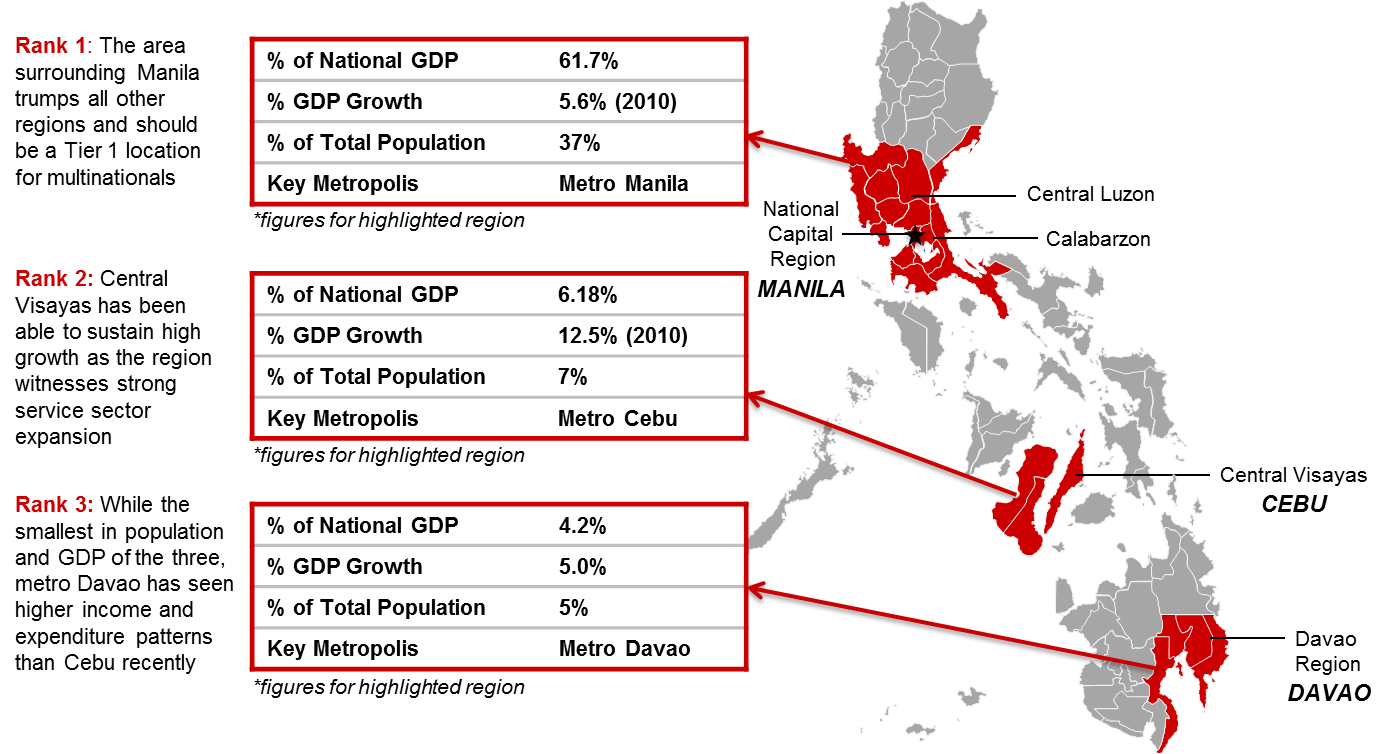
-Given the small size of opportunity, executives should focus their investment efforts into three main areas of the Philippines (see map), with the major focus on Luzon, which has the highest concentration of wealth and population. Companies looking for high-growth opportunities beyond Luzon should consider Cebu and Davao in order to keep their efforts concentrated on these more developed and business friendly metropolitan areas

Philippines

2 Issues to Tackle When Operating a Business in India


1. Fragmentation:

Multinationals have to move out of the traditional Tier-1 cities in order to adapt to India’s unique urbanization trend:

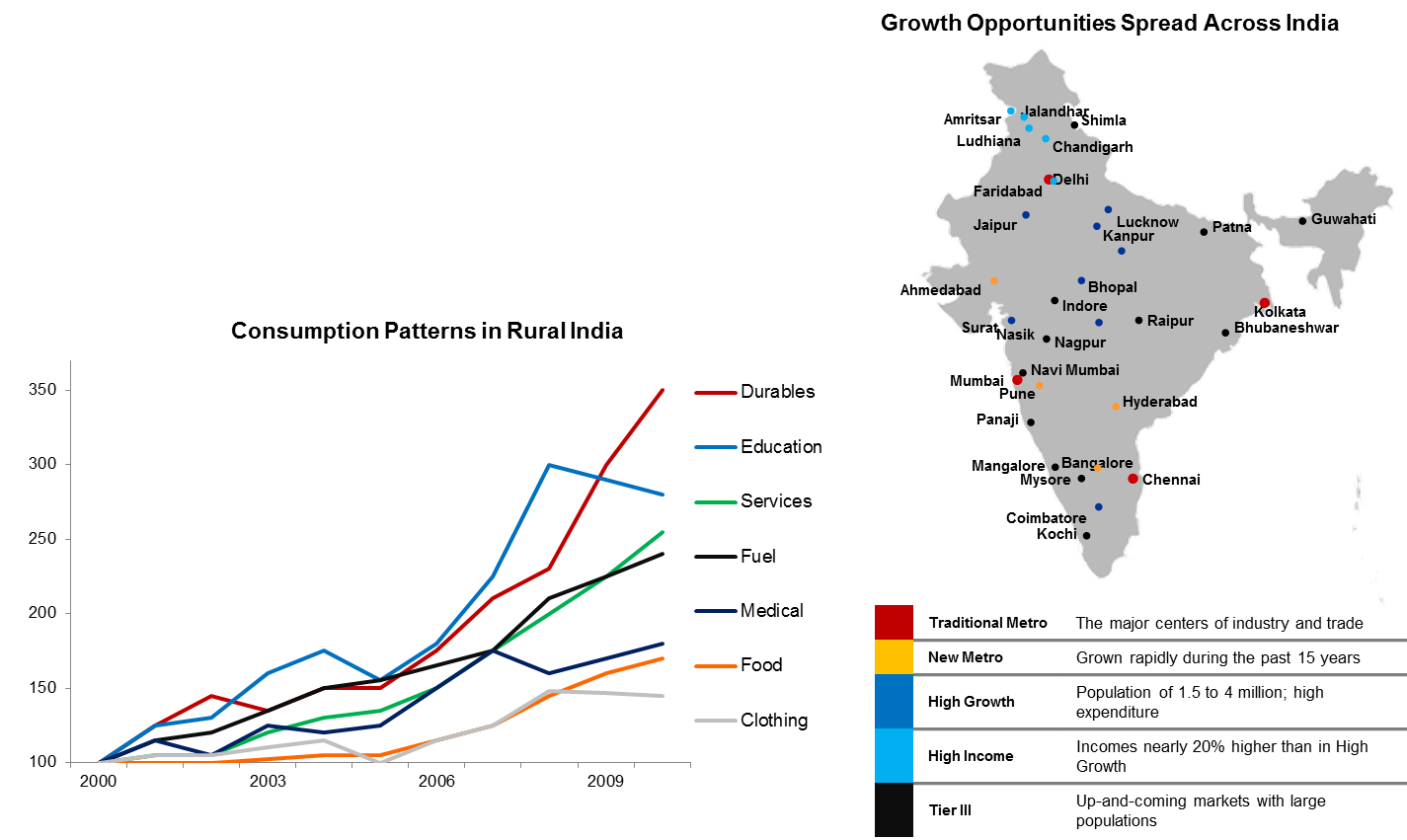
The rise of manufacturing in rural India has led to robust job and wealth growth, which means a lot of the rural population, is not interested in moving to large-cities but instead, we can expect small villages to turn in to small towns, then big towns and eventually into large cities. This means that as a multinational- you will have to go to your end customers, and not the other way around- waiting for them to come to the traditional metro cities

Towns simply grow into densely populated cities, as opposed to a conventional migration of people from towns to cities

Expenditure on durable goods, education, consumer services (entertainment, transport, etc.), and fuel have grown faster than the average over the last 10 years

India distribution

2. Infrastructure Issues:

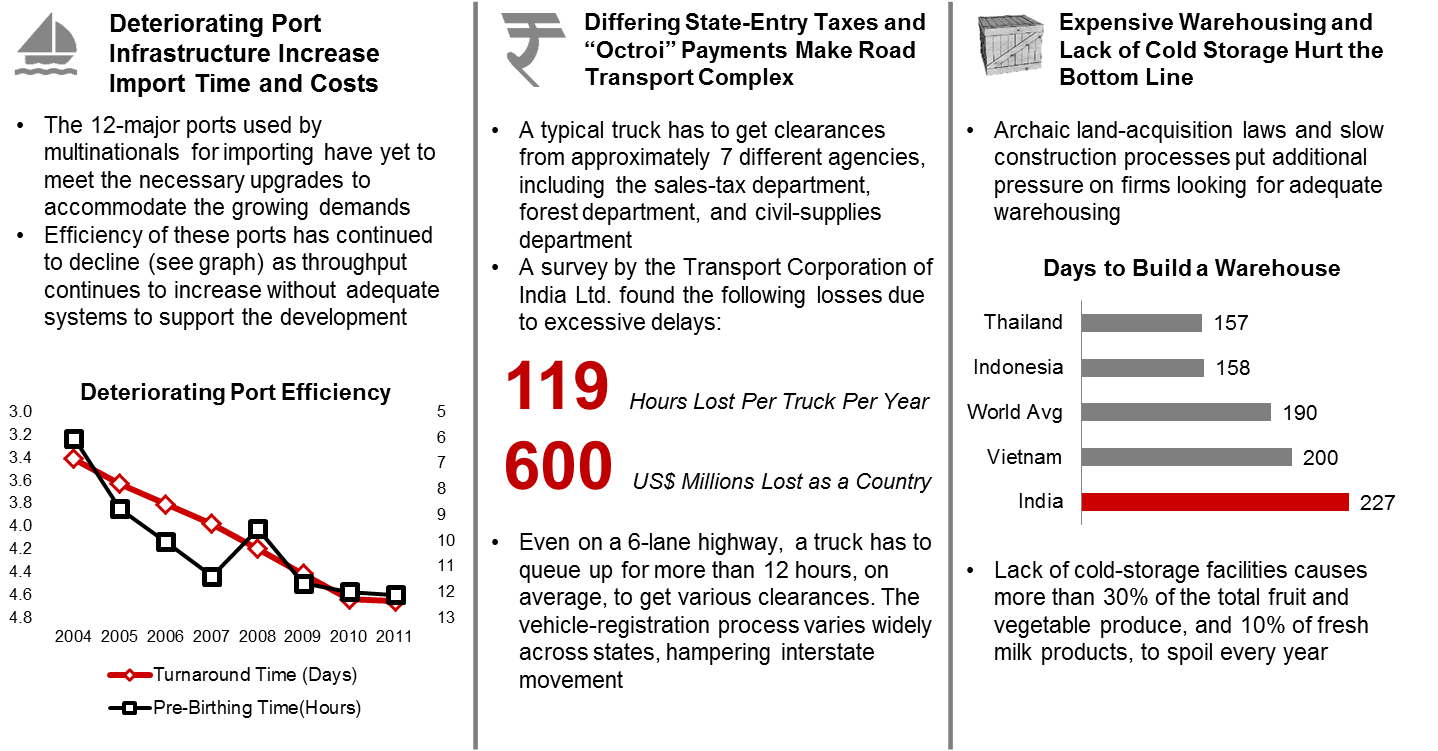
India’s consistent underinvestment in infrastructure, lack of regulatory reforms, and generally unstructured style of conducting business adds an additional layer of complexity for multinationals operating in the country:

Stay tuned for the next blog-post on distributor sophistication in India and FSG’s assessment criteria to identity gaps in your channel strategy


Avoid ‘Premium Market Captivity’: 8 Strategies to Capture the EM Middle Class


Product Localization

Despite the uncertainty surrounding the European debt crisis, geopolitical tensions in the Middle East, slowdowns in China and Brazil, and other external headwinds, multinational executives face aggressive 2012 emerging markets growth targets. Frontier Strategy Group’s clients tell us that their 2012 targets are in line with 2011 performance, despite the fact that 2011 enjoyed more favorable tailwinds.

In the past, Western consumer products companies have been able to rely on higher-income consumers to drive growth. These consumers often have tastes and preferences in line with those of Western consumers, and place a premium on the cachet of Western brands. And, given the relatively early stage of market maturity, there was plenty of white space for first-movers to take advantage of.

Looking into the future, Western companies will face a new paradigm characterized by more competitors fighting for share of a decelerating premium market. White space will shrink as more companies enter and expand in emerging markets in search of growth to offset the slowdown in the West. Concurrently, growth of the premium segment in key markets such as China will plateau. To achieve their targets in such an environment, executives will need to consider more innovative and aggressive strategies.

A new paradigm in emerging market customer dynamics

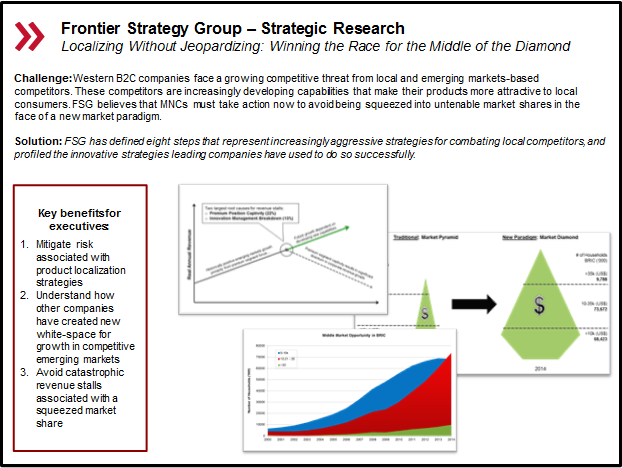
The changing dynamics of a softening and increasingly competitive premium market demand a new approach in how executives should think about emerging markets. Aggregated across the BRICs, middle tier households (as measured by annual household income) will actually surpass lower-tier households in sheer quantity by 2014. What this means is that the traditional market segmentation of the market pyramid will soon morph into what we like to refer to as the “Market Diamond”. As executives are thinking about emerging markets, the Market Diamond represents the idea that the middle market will be so compelling that both local competitors and multinational companies cannot afford to ignore such a large market opportunity.

A race to the middle

The only way to fight the inevitable market squeeze (competition and lower growth at the top-end, and increased local competition from the bottom-end) is to prioritize product localization strategies and move down the diamond into this huge opportunity. Growing into new market segments is not an easy task, and choosing the right strategies depends in part on executive tolerance for risk.

FSG has identified two key root challenges that are preventing companies and executives from implementing these eight middle market strategies: 1) corporate risk aversion, and 2) organizational misalignment. To provide a framework for overcoming these challenges, FSG has defined eight steps that represent increasingly aggressive strategies for penetrating the middle market, and profiled the strategies and tactics leading companies have used to mitigate the risks associated with each strategy:

  1. Redefine metrics of success
  2. Operational efficiency
  3. Adjusting price
  4. Distribution strategy
  5. Branding strategy
  6. Adapting products
  7. M&A
  8. Reverse innovation

The best companies are acting now

Mounting evidence suggests that emerging market based companies will continue to develop new capabilities and increase in levels of sophistication. Local competitors are increasingly following their current low-income customers into the middle market as those customers’ tastes and preferences evolve, and if multinationals fail to act now, they may find that they are arriving to the game too late. As the world economy continues to globalize, sophisticated emerging market based companies are no longer anomalies, but are more frequently becoming the norm. This trend illustrates that companies we now consider “local competitors”, might soon in the future become just “competitors”.

*Sam Osborn, Senior Analyst at Frontier Strategy Group contributed to this piece.

Austerity Measures, Weakening Growth in Central and Eastern Europe in 2012


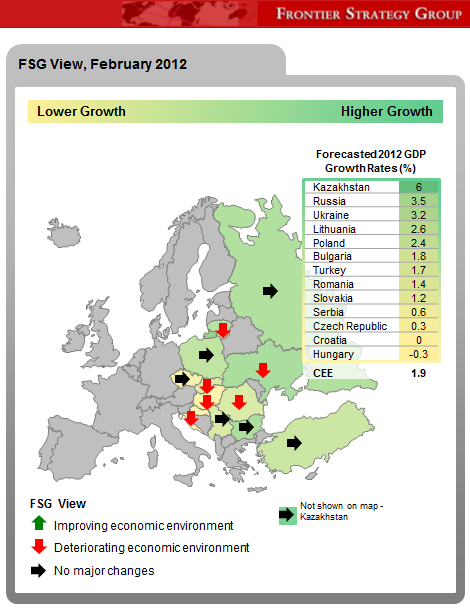
CEE View

As exports and consumer demand slow and regional governments seek to reduce spending, growth is weakening across the region and a difficult year is ahead for both B2B and B2C MNCs. GDP growth forecasts will likely be revised further down as CEE economies struggle with continuing volatility and recession in the eurozone. Kazakhstan and Russia continue to benefit from high energy prices, but remain vulnerable to an oil price decline

  • Bulgaria: The economy will slow in 2012, but a conservative budget will act as a buffer against an external macroeconomic shock
  • Croatia: Croatia is in for a challenging 2012 that will bring austerity measures, pain for local consumers, and possibly a recession
  • Czech Republic: Avoiding a deep recession in 2012 is possible if there is clear progress on the eurozone crisis and the German economy remains strong
  • Hungary: The government will struggle to regain investor confidence as its controversial policies are undermining market trust in Hungary
  • Kazakhstan: MNCs can expect continuity in government policies and populist measures in 2012
  • Lithuania: The liquidation of a major local bank threatens to offset the budget this year and may mean more austerity measures
  • Poland: MNCs pursuing investments in Poland are well-positioned to capitalize on the country’s undervalued currency
  • Romania: Romanian consumers remain deeply pessimistic about the economy’s prospects, a trend that will impact consumer goods MNCs
  • Russia: Economic performance will slow only moderately as the government will support high consumer spending ahead of the elections
  • Serbia: The key driver for Serbia’s growth this year remains the economic performance of the eurozone
  • Slovakia: The consumer outlook remains negative through 2012 as any new government would have to cut public spending
  • Turkey: Economic growth will slow gradually over the next several months
  • Ukraine: Growth will slow this year and could decline sharply if commodity prices drop as a result of the recession in the eurozone

Brazil’s Government Bets on Decreasing Inflation


Trend

Recent policy choices indicate that political considerations are being placed ahead of sound economic management

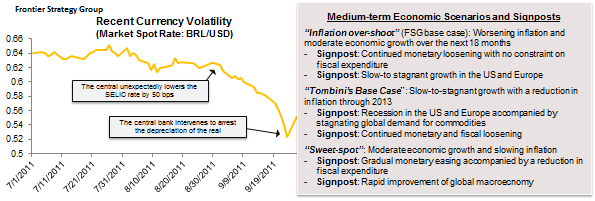
The central bank’s decision to cut interest rates, despite high inflation and employment, and subsequent intervention to arrest the depreciation of the real has created a tremendous amount of volatility

Industrial policy has become paramount as protectionism leaps into the fore, jeopardizing long-term competitiveness

Import taxes and foreign ownership laws are worsening regulatory uncertainty, leading some companies to rethink investment decisions

By choosing to shelter local producers rather than cut red tape and invest in infrastructure and human capital, the government is further distorting market incentives

Drivers

The government is betting that inflation will decrease as the global economy cools, making growth a higher priority

Financial markets are pricing in an additional 100 basis points worth of cuts to the SELIC rate by the end of the year

Political pressure to address the currency has been building ever since the Dilma administration took office

Dilma is hemmed in by a governing coalition and constitution that makes it difficult to enact long-term reforms to boost competitiveness

Frontier Strategy Group View

The recent spate of pro-inflationary policies poses serious risks to the Brazilian economy, especially given recent demands by workers to raise wages in 2012. If the global economy fails to deteriorate as much as Brazilian officials are expecting, a scenario that is not currently FSG’s base case, inflation could become a major problem

B2C companies selling to low and lower-middle income consumer segments should be wary as inflation reduces the purchasing power of these demographics the most


Interview: Arezki Daoud on challenges faced by a post-Gaddafi Libya


To gain a better understanding of the impact of recent events in Libya, I spoke with Arezki Daoud who is editor of The North Africa Journal.

In a post-Gaddafi Libya, what issues will the government need to focus on through next year for a successful transition?

This weekend’s events were predicted. We forecasted a protracted conflict, one that would end with the slow extinguishing of the regime in the manner that we have been witnessing. In essence, despite the bloody outcome, the terrible loss of life and wholesale destruction of the country, what’s coming could potentially be a more difficult period for the Libyans. Their fight against Gaddafi was a unifying factor. Now that that factor is gone, differences are likely to emerge on a host of issues, starting with drafting a constitution, establishing institutions, empowering political leaders to take proper action within a new framework of a proper rule of law, etc. But more importantly, the challenge for the Libyans would be to avoid falling into the trap of tribalism. In this conflict, many won, a few have lost and those who have lost could pay dearly if the spirit of revenge takes over.

In addition, we are assuming in the short term that rogue elements will operate under the radar to undermine any progress on the political front. They will work hard to pit tribes against other tribes. The use of shadowy agents is common practice in the Arab world. We have seen it in Tunisia, Egypt, Syria, etc and we believe Muammar Gaddafi has developed some of the strongest underground destabilization networks in the Arab world.

So in terms of what to do, it is critical that security be under the control of a single authority and that a process starts quickly to establish a constitution.

Do you expect the transition timeframe to last longer than in Egypt or Tunisia due to Libya’s lack of government institutions?

The likely scenario is one that looks at a much longer transition period for all the reasons mentioned above. But in a virgin territory where there has been no supreme law, there is also a slim likelihood of a faster political transition. We should assume that political stabilization could take more than one year.

What does this mean for regional stability? Do you think this will lead to a significant decrease in global oil prices?

The market may respond positively purely on the news of the end of Gaddafi, but the impact of Libyan oil in the world’s supply system will be limited given the economic crises affecting consuming markets. Even without Libya, oil prices have been dropping with the weakening global economy, therefore we expect the end of this crisis will have limited impact on the oil sector.

What types of challenges do you see for foreign businesses in a post-Gaddafi Libya?

Corporate executives hate uncertainty and so the lack of clarity around the existence of central authority could be a major inhibitor to foreign investments at this stage. Executives we talk to often say they will take a wait-and-see approach and will move into the country as soon as a strong authority is in place, which would create the right conditions for operating in the country. Libya has many experts that could help shape up future business legislation, but this is too premature to speak of such business environment as the political environment remains volatile.

What types of opportunities do you see for foreign businesses in a post-Gaddafi Libya?

Business opportunities are likely to arise within 6 months after the official end of the hostilities. Given the Western support to the insurgents, Western companies are likely to be the first to take advantage of the reconstruction, modernization that the country will undergo. This would positively impact the obvious sectors, namely infrastructure, oil and gas but also services as tens of thousands of foreign workers left the country and now a foreign workforce will be required to bring services back. Other industries, from consumer goods to pharmaceuticals will have to wait yet the country will likely resort to import, providing opportunities as well.


Transition in Libya - What MNCs Need to Know


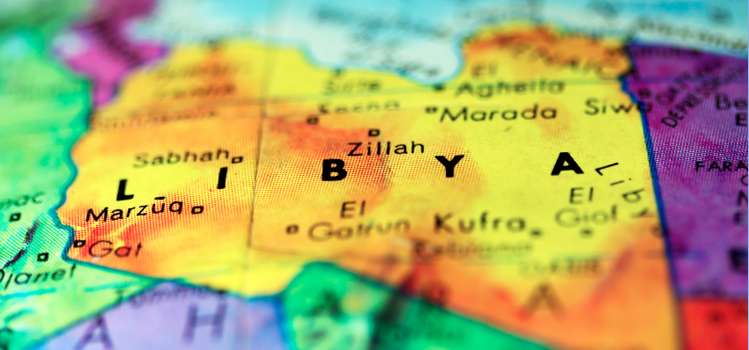
Muammar Gaddafi’s 42-year grip on power is slipping away as rebel forces fight to gain control of Libya’s capital Tripoli. This bloody conflict has taken a heavy toll on Libya’s economy and its people, but more challenges lie ahead as the country will soon focus on rebuilding and a political transition.

While it is too early for most foreign companies to return to Libya, firms should start to assess major players in the National Transitional Council (NTC) for a future government relations strategy. A transitional leadership already exists and new political players will emerge as prospective candidates start to jockey for position ahead of elections that will take place within the next year.

The NTC is speaking in a conciliatory tone regarding how former regime associates will be treated during the transition. This is not surprising considering the number of officials that have defected in recent months. However, foreign MNCs should still evaluate local partner ties to the past regime, especially if there are tribal connections to Gaddafi. As we are seeing in Egypt, Tunisia, and around the region, companies can experience a significant slowdown in business if the government targets their local partners for corruption investigations. There are serious reputational issues to consider as well.

Because many government institutions will need to be built from scratch, companies should keep a close eye on efforts to write a new constitution. This will likely mean significant changes to a post-Gaddafi business environment, which could lead to much greater transparency in the long term.

The hydrocarbon sector is still critical to Libya’s development, but there is already talk that it will take 18 to 24 months to return oil production to pre-February 2011 levels. Libya will continue plans to diversify its economy away from hydrocarbons and there will be a need to (re)build infrastructure- both physical and institutional- which will provide long-term opportunities to B2B companies in the construction, IT, cement, and transportation sectors.

GDP per capita is among the highest in Africa due to Libya’s oil and gas resources and a small population though little of this money has flowed to the majority of the population in the past. If the government implements new policies to address this critical flaw, then it could lead to a plethora of new opportunities for B2C companies.