PODCAST: Integrating Acquisitions in Emerging Markets


Podcast Logo

In this podcast, Frontier Strategy Group Expert Advisor, David Hodge, shares his experiences and best practices in the realm of post-merger integration. David was a key member of the transaction team for Amcor’s 3 largest acquisitions, and has completed M&A transactions in 10 separate countries. He highlights four of the most common pitfalls to avoid, and shares a “strategic growth framework” for capturing the most value.

To listen to or download the podcast, click on this link to access the iTunes store.

China’s channel challenge


The slowdown impacting China could get worse before it gets better for business-to-business companies. Demand from the US and Europe for Chinese exports will remain depressed until issues such as the eurozone crisis and US fiscal cliff are resolved. Investment is constrained by the heavy debt burden of local and provincial governments in China, and existing overcapacity. China’s forthcoming leadership transition only adds an extra layer of uncertainty for Western companies attempting to grow their foothold in the Chinese market.

It was against this backdrop that FSG brought together eight senior-most China executives from leading technology, healthcare, and industrial companies to discuss best practices for managing the channel and driving growth despite the headwinds. Our discussion over breakfast in Shanghai yielded insights into three aspects of the vendor/distributor relationship: 1) structuring effective contracts, 2) building long-term relationships, and 3) minimizing the pain of transitioning away from an under-performing distributor.

For this post, I’ll touch on contracts. I’ll address the other two points in a future post.

The key takeaway I took from the discussion on contracts was seemingly counter-intuitive. Every executive around the table acknowledged that there is little chance of any Chinese partner strictly adhering to the letter of contracts, but despite the apparent futility of these documents, all of the executives agreed that the best practice is to more heavily invest in the negotiation, preparation, and enforcement of contracts. Local Chinese partners are more likely to view a contract as a roadmap than a strict and binary agreement. And, every executive in the room could share his own horror stories of partners violating contracts (or setting up new legal entities to skirt inconvenient agreements). Although it may seem counter-intuitive to over-invest in contracts when there is little guarantee that partners will strictly adhere to them, a strong argument was made that investing the time and energy to structure a detailed contract can pay dividends, and furthermore, these contracts should be negotiated annually.

Companies should take a modular approach to structuring contracts, that links specific distributor activities to points of margin. This accomplishes two things. First, it sets clear expectations for the distributor of what capabilities they are expected to bring to bear with a direct link to their incentives. Secondly, it allows the vendor to “take back” activities in the future, either because the distributor is underperforming, or because the vendor has built some of its own internal direct capabilities but does not wish to sever distributor relationships entirely.

We spent quite a bit of time discussing the ins and outs of building and eventually transitioning distributor relationships in China; I’ll share some highlights of this discussion in my next post.


Asia CEO Insights: Investing in the Strategic Planning Process


Over the past few weeks, I have been posting some of the key takeaways from a recent Executive Breakfast on the topic of strategic planning in emerging markets. The event, hosted by Frontier Strategy Group in Singapore, was attended by a group of nine senior Asia-based executives. In this third and final post (you can find part one here, and part two here), I wanted to touch on some of the highlights on the topic of investments – both in terms of financial capital as well as human capital – in the context of strategic planning.

Incentives were discussed as a possible tactic for countering short-term thinking by local teams. Many companies have considered using “plan accuracy” as a KPI for evaluating managers’ variable compensation, but one executive from the pharmaceuticals industry felt that this led to managers being overly conservative in their planning and execution in order to ensure that targets could be consistently met, which could result in missed opportunities and lost market share. Another executive shared that he has found success in providing highly attractive long-term incentives to instill long-term thinking, as well as to fight attrition. For example, one general manager on his team received a bonus equivalent to a full year’s salary for developing and then successfully executing an aggressive four-year strategic plan.

Beyond the question of human capital, financial capital was naturally a key topic of discussion. For many executives running an emerging markets portfolio, operations often do not yet have the scale necessary to self-fund new initiatives, so the case must be made to corporate headquarters for additional investment. FSG has recently profiled The Coca-Cola Company’s approach of creating a global opportunity fund (as distinct from an emergency fund), contributed to equally by each business unit, to which requests for funding could be submitted via a rigorous and competitive application process.

Another approach, used by several companies attending our discussion, is to ask managers to submit “layered” plans, consisting of baseline plan supplemented by one, two, or more layers of “what if” scenarios. For example, local managers are asked to provide details into the specific investments that would be made, and incremental opportunities captured, if corporate were to invest $1 million above the baseline plan, $2 million above baseline, and so forth. The downside risk discussed to this approach is whether such a methodology encourages managers to submit overly optimistic plans as they make the case for additional resources. Here again, the group came to consensus on the need for a high degree of discipline to checking progress against plan milestones on a frequent and structured basis.

Although having the right capabilities in place is necessary to achieve success, capabilities alone are not sufficient. The right incentives and adherence to processes are also key to ensuring that time spent planning is time well spent.

Asia CEO Insights: Incorporate Local Market Dynamics into the Strategic Plan


CEO Takeaways

“Knowledge of local markets should not reside only in local markets. Institutionalizing knowledge is critical in light of the high attrition of local talent in Asia.” –Head of Asia, Food & Beverage Company

Last week, I shared the first post in a small series on key takeaways from the recent Executive Breakfast hosted by Frontier Strategy Group in Singapore. I had the opportunity to join nine senior APAC executives for a robust discussion on managing the strategic planning process despite the volatility and distance from HQ that characterize doing business in emerging markets.

One of the most important capabilities for multinational companies to possess is an effective and efficient process for capturing the insights and wisdom of front-line managers when formulating strategic plans. In Asia, the fact that highly capable local managers are so difficult to retain for more than a few years before they leave for a big pay increase being offered by a competitive firm, or that many managers have relatively little multinational work experience, adds an extra layer of complexity to an already thorny challenge.

Furthermore, we discussed the fact that constantly churning local teams may lack a sense of ownership of plans developed by predecessors. And, that when employees expect to have short tenure with the organization, it can be hard to incentivize them to invest in developing and implementing long-term plans that may not maximize short-term personal benefits.

A leading packaged food company in attendance of our discussion has responded by attempting to institutionalize local market knowledge at the regional and corporate headquarters (where employee tenure tends to be longer and strategic capabilities tend to be more consistent) by developing a strategic planning Center of Excellence within each business unit to own the process of long-term planning, and gives local teams ownership (and accountability for) short-term planning and execution.

Another executive, from the fashion/retail space, chimed in to mention that his company has used a similar Center of Excellence strategy, with the added tactic of segmenting focus by channel as well as business unit. Some of the executives in attendance questioned the obvious drawback of not involving local teams directly in long-term planning, but acknowledged that this approach may be a realistic compromise in markets suffering from particularly high attrition.

An executive from the medical devices industry has shrunk the planning horizon for country teams to just two months; longer-term planning is done at the regional level. In his view, the key to executing in this type of bifurcated planning environment is a highly structured discipline of communication between regional and country teams, and strict accountability to meeting mutually agreed upon strategic milestones.

Another important consideration when it comes to managing the human element of planning is of course incentives. I’ll touch on some of the highlights of our discussion on that front in my next post.


Can strategic plans survive in emerging markets?


“One of our senior corporate strategic planners just took on a general management role in India. Now he gets it!” –Head of Asia, Healthcare Company

In the late 19th century, Prussian military officer Helmuth von Multke famously remarked that, “no plan survives first contact with the enemy.” Many managers in emerging markets might agree with Multke. Strategic planning is often a frustrating and time consuming process, which is complicated in emerging markets by heightened volatility, scarcity of data, and front-line communication hindered by distance and time zones. These three challenges often converge and result in strategic plans that do not last for more than a few quarters before being scrapped or forgotten.

Multke, however, was actually a meticulous planner. He developed a planning process that considered a wide range of variables and potential outcomes in order to provide front-line officers with a framework to guide battlefield decisions, despite rapidly changing and unpredictable front-line developments. As a general manager in emerging markets, your mandate is similar: to implement a planning process that results in plans that 1) guide day-to-day decisionmaking of employees, 2) are robust enough to withstand volatility, and 3) are reflective of local market dynamics despite the scarcity of granular data and the fog of distance.

Last week, I met with a group of nine senior Asia executives from a range of industries over breakfast at the Fullerton Bay Hotel in Singapore to discuss their best practices for strategic planning in emerging markets. Much of the conversation centered on recognizing and responding to the capabilities and constraints of local teams relative to corporate teams. We spoke a bit about incentives. And, we touched on the question of how to best make the case for investment and additional “plus plan” funding.

I’d like to take a few blog posts to share some of the key takeaways of our discussion in the coming weeks. Watch this space.

3 Proven Strategies for Improving Employee Alignment to The Strategic Plan from NACCO


Naaco


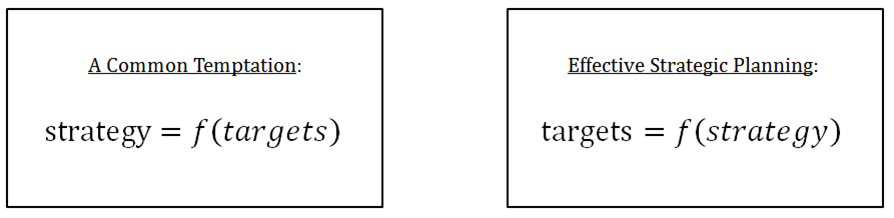
A simple mathematical function can help describe the root-cause behind many companies failed efforts at strategic planning.

It is a common pitfall that companies first create their targets and budgets, and then develop their strategic plan around that foundation. In essence, the strategic plan becomes a function of targets. In this type of strategy, promoting accountability becomes almost impossible in volatile and unpredictable emerging markets. With the budgets and targets setting the direction and path forward instead of the strategic plan, many companies become victims to their own financial urgency and end up laying the groundwork for their own demise.

A subtle yet clear swap from the first model results in a much more reliable strategic plan, and NACCO’s Managing Director of Asia Pacific Andrew Satterley is one of the few bright minds capable of distinguishing this difference, and changed his company’s planning into the more effective model. In this model, the strategic plan exists as its own entity, and targets are derived from the pre-established and overarching growth strategy. Andrew was willing to sit down with Frontier Strategy Group and share three of his best practices for ensuring that his employees buy into the strategic plan, can execute on the initiatives, and manage results on an ongoing basis

1) Know where you stand

With NACCO’s Asia Pacific headquarters managed from Australia, Andrew recognized that they were losing touch with core marketing leads in different countries due to lack of contact. One of Andrew’s first steps was to not only localize the regional headquarters closer to the region, but to do a thorough examination of NACCO’s local business. He spent months observing organizational structure and sales processes, and also implemented external surveys of customers as well as staff to understand how they were perceived in market. Afterwards, Andrew used the results to create a robust SWOT analysis and develop a vision for their plan of attack in the future.

AS: “We decided we needed to document where we are, where we want to be, and how we want to get there. A lot of the times it’s always about the next sale etc, but I need to understand our overall objectives, numbers should be an outcome of our strategic direction”

2) Give employees the strategic plan…literally

For Andrew, every single person in the organization gets a copy of the strategic plan, from the head of a business unit to the person working a factory line job at 4am. Every single person gets walked through the plan and the why/where/when/how, going through the relevant details line by line. This has led to tremendous amounts of idea-generation through employee feedback.

AS: “I take them through why we are sitting down, what we expect, and depending on who I am talking to we will take them through the relevant parts of the plan (accounting gets accounting, warehouse manager gets warehousing). When I listen to my front-line people react, I have heard some fantastic ideas”

3) Improve succession planning, transparency, and visibility

Employees who only receive cascaded down information often struggle to make the connection between their purpose and corporate objectives. Andrew realized that a mandate-down approach doesn’t yield the desired employee alignment, so he made a concerted effort to give employees a clear view into why changes were being made. By improving employees understanding of the strategic plan, how they fit in, and how they can grow with the company, Andrew was able to achieve improved employee engagement and alignment.

AS: “Some of the best ideas come from people on the floor, when I speak with someone who is in it every day it can really change the thinking. A lot of it [employee alignment] is improving succession planning and training. We want to give them as much information as possible to that they have confidence in not just the company but also themselves”.

India Aims to Introduce Landmark Goods & Service Tax in H2 2012


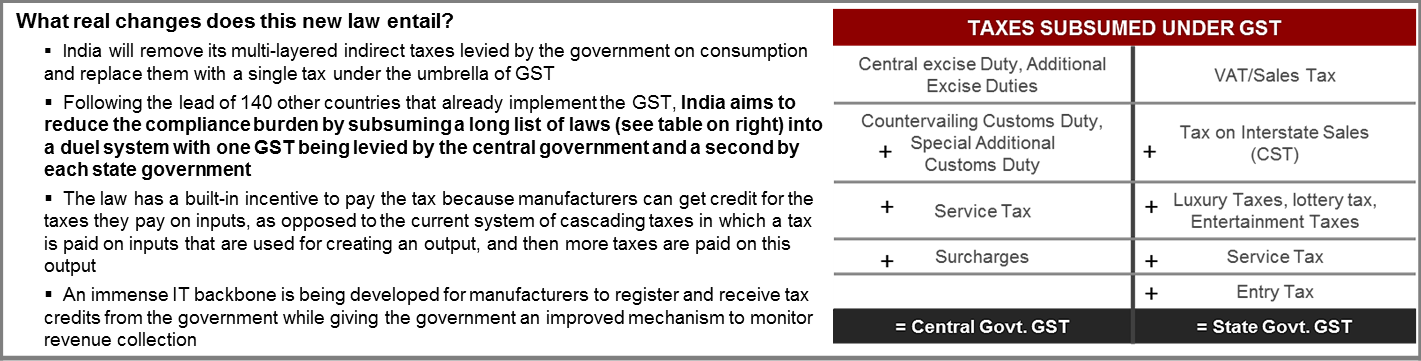
The India government has proposed the launch of the landmark Goods and Services Tax (GST) bill during H2 2012 in order to reduce the compliance burden for companies and meet international consumption tax standards

  • With the law meeting international standards and signaling the government’s attempts to simplify the process of doing business in India, FDI is expected to rise as well
  • Initial studies show that it will add about 1.5% to the GDP due to the lower compliance burden, more competitive exports, and higher tax revenues

Frontier Strategy Group View:

Companies can expect the law to be delayed due to the bargaining that will take place between the state and central governments in terms of revenue sharing and level setting

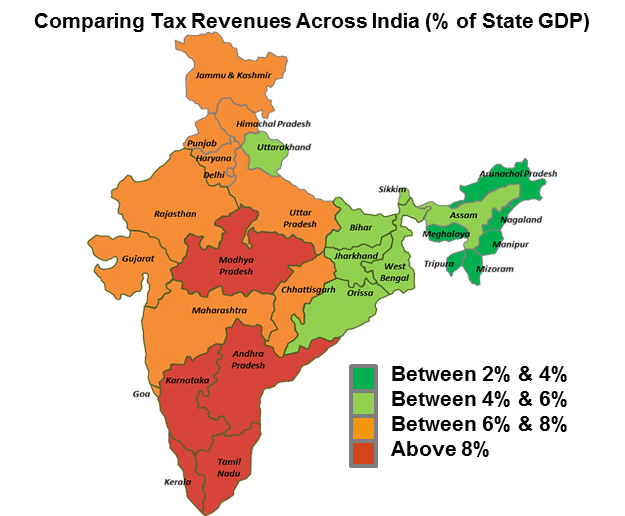
The 28 state governments have vastly differing interests; those with higher revenues are more unlikely to share their wealth with the central government (see map below)

While the reform is headed in the right direction, companies will bear the cost of inefficient resource allocation and more expensive logistics as the differing state GSTs will continue to divide the Indian market into several sub-markets.

India Map

India Policy


Executives Continue To Increase Investments in China


China Survey

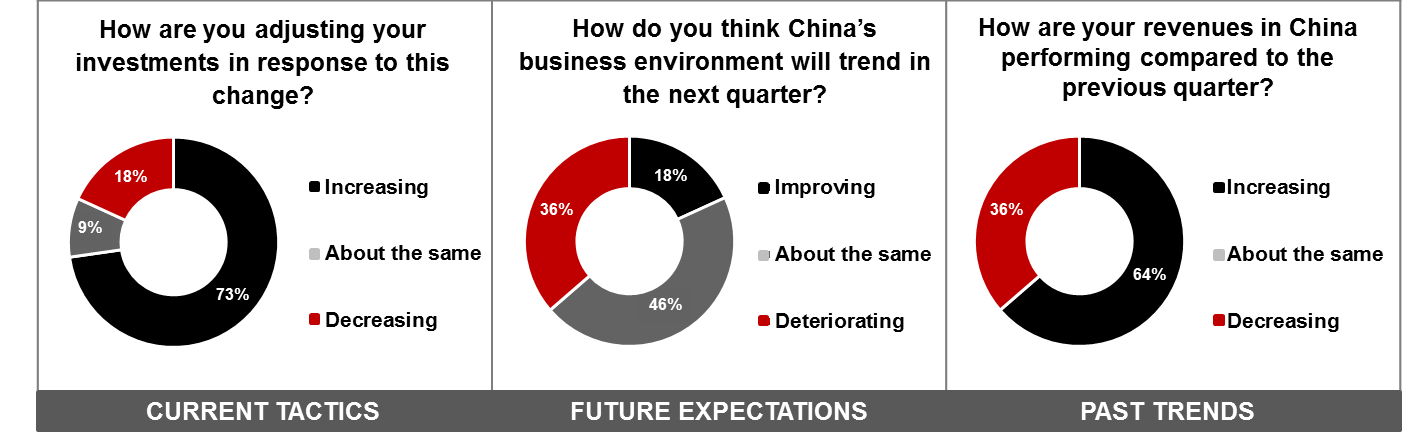
Executives operating in China plan on increasing their investments even though most are expecting the business environment to worsen in the upcoming quarter. Frontier Strategy Group’s recent Senior Executive Poll revealed that more than 80% of the companies expect China’s business environment to remain the same or worsen in Q3. However, almost 75% of the respondents plan to increase their investment in the country, suggesting an expectation of stabilized growth in the medium to long term. Meanwhile, revenue growth for Q2 remains positive with two-thirds of the executives expecting higher results, a sign of a possible rebound in sales after China’s economy in Q1 slowed to its lowest since the 2009 crisis.

Organizational Structure Best Practices in Asia Pacific from Valmont


Valmont

In one of the most diverse and varied marketplaces, senior executives in the Asia Pacific region face complex challenges in developing an efficient organizational structure. Should companies group their business units geographically? By function? How decentralized should decision-making be? In order to gain insight into the unique strategies for confronting these questions, I sought out the expertise of Valmont’s Asia Pacific senior management team, who has successfully navigated a large acquisition to meet growth and profitability targets in Asia. In a recent interview, Vik Bansal, Group President of Asia Pacific, and John Fehon, VP – Finance, shared their best practices for successfully creating a matrix organizational structure in Asia Pacific.

The Valmont APAC executives are firm believers that business unit leaders need to be empowered to run their businesses. However, Valmont is able to maintain control over this decentralization by thinking of their matrix organizational structure uniquely. “Our business is a necklace with individual pearls, the threads that go through all of those pearls are the functions that should be common across each unit”. For Valmont, they selected three key common threads that link each disparate business unit together.

  1. Standardized financial systems – this is non-negotiable across business units.
  2. Applying the Valmont way – with a focus on continuous improvement, individual business units are able to apply this concept in the most relevant manner for their market.
  3. Talent identification and succession planning – In order to ensure a healthy pipeline of future managers, Valmont leadership spend significant time identifying leaders from compatibility and capability perspective.

Multinationals that have their strategic plans jointly owned by both regional executives as well as local teams have an opportunity to promote alignment throughout their organization. Valmont has been able to leverage their internal collaboration into a strong, autonomous, and agile workforce that is capable of succeeding in the diverse and fast-paced Asia Pacific business environment.

3 winning strategies to beat local competitors in Asia (Part II)


Wipro

For part I of 3 winning strategies to beat local competitors in Asia click here

2. Educate the right customer

Education is clearly important when selling at a higher price point vs local competitors. But who do you educate? The President of China at a leading company in the paint industry says: “Our paint can last 15 or 20 years on a new building. You can use a cheaper paint, but in 5 years you will have to repaint and it will cost more! The problem is: [real estate] developers don’t care, they won’t be there in 5 years!”. So the question is: who should you educate about your differentiators?

In some cases the answer is clear, especially if your differentiator is relevant to your direct buyer or, for B2C companies, to consumers. For example, food and beverage multinationals operating in China can capitalize on safety to capture demand. As a senior executive from a leading dairy company mentioned: “Consumers are willing to pay a premium for imported milk because they are still skeptical about safety of local milk. […] Food safety shouldn’t be a differentiator, but it is one in this market”.

However, the right customers to educate might be more distant, for example one step away in the value chain. A leading healthcare company in the diabetes space provided an interesting example. Traditionally, companies in medical devices (including diagnostics) partner with doctors to increase awareness and compliance. “That’s the right approach in most markets”, comments the President of Asia Pacific, “because people respect the advice of experts. However, in India we went directly to consumers, as we believed that it would be a most effective way to grow awareness and drive compliance.” The results? “Today we are the number one player, with a big distance from number two.” Educating the right customer might require some creativity and bold moves, but the payoff can be significant.

3. To remain cost-competitive, start from people and culture

“You can differentiate yourself as much as you want”, comments a senior executive with 25 years of experience in a global industrial conglomerate, “but if a large share of volumes comes from commoditized products, you have to relentlessly work on your cost base.” Most senior executives in Asia today recognize that building scale and minimizing the cost structure is vital to remain competitive. However, cost excellence is typically associated with supply chain optimization, sourcing strategy, lean organizations, etc. In our experience, the difference is made with the right people and culture.

“For some time, we couldn’t create products to compete with local players. We gave a budget and specs to the best engineers, and they said: ‘It’s impossible!’”, says the President of Asia Pacific at a chemical multinational. “Then we gave the same resources to the local engineering team. In 2 weeks we had a competitive product.” Minimizing costs requires a specific mindset and pervasive culture. As a senior executives in the medical diagnostics sector puts it: “We want to come up with affordable products to address the mid-tier market, but then we end up with the same frills, because that’s what we are so used to.”

Segmenting the organization internally based on the external market segmentation (e.g. separate engineering, sales, product management teams, etc) seems to be a fairly common approach. Here is an extreme case: “We have a trucks business and a wheel-loaders business”, explains the President China of a leading automotive multinational. “In trucks we play only in the high end market, but wheel-loaders is an entirely local industry; we acquired a wheel-loader manufacturer and we manage that business separately as a local company.”

While this strategy has its own limits and downsides (e.g. realization of synergies), it also has some side-benefits. For example, it helps to work around common post-merger integration challenges, such as harmonization of incentive structures. MNCs acquiring local companies are often faced with a very different system of values and incentives, challenging to integrate with their own. Our Director of Research, Shijie Chen, provides an explanation of such differences: “Many people think Chinese companies should have a more socialist leaning corporate and compensation structure. This is probably true for state-owned enterprises and civil services, but definitely not the case for private Chinese companies. The reality is that most privately owned Chinese companies are very market-oriented in a ruthless way, or Capitalism in its raw form. Creating a supportive working environment, building work life balance, providing training and development to employees (things MNCs would pay a lot of attention to) are much less important for private Chinese companies. So for example, it is common to see a “low base + high variable” compensation structure in this environment.”


Next Page »