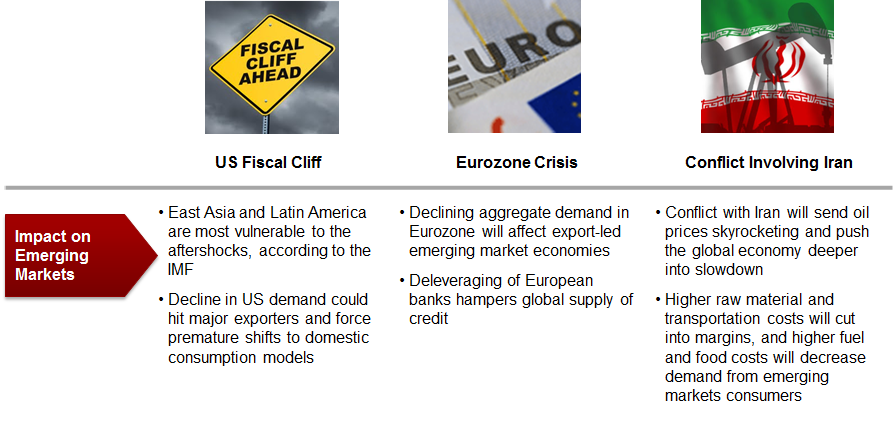




Global uncertainty is increasing. The back-and-forth negotiations surrounding policy decisions on the US Fiscal Cliff, Eurozone crisis, and potential conflicts in the Middle East may be intriguing for political scientists, but for global business executives, they are cause for major headache. These policy decisions don’t just affect the upcoming elections; the anemic growth of the global economy is at stake. Any escalation of one of these major drivers of global risk could seriously thwart hard-earned recovery, and plunge the globe into another recession.
With that said, emerging markets continue to show promise for 2013, even in the face of increased global risk. By focusing on economies that are better positioned to withstand the major influencers of uncertainty, and mitigating exposure to economies that are highly susceptible, growth can still be achieved. For example, economies in: Asia Pacific, Sub-Saharan Africa, and parts of Latin America are relatively well insulated. In the near-term, countries such as: Indonesia, Nigeria, Philippines, and Colombia exhibit the necessary growth fundamentals to withstand some of these potential negative shocks. However, looking at the growth fundamentals alone is not enough. Let’s take a closer look at the three big reasons why emerging market executives need to prepare contingency plan as soon as possible.
1. US Fiscal Cliff – How will you plan for a sharp decline in global demand?
The primary determinant of exposure to the US Fiscal cliff is the amount of exports emerging market regions send to the US. However, the ripple-through effects of the US falling over the fiscal cliff (or probably more appropriately, sliding down the fiscal slope) are much more far-reaching. A reduction in US demand will reduce manufacturing as export-led economies rebalance to reach new market equilibriums. This decline in manufacturing will also reduce demand for the input-commodities, adding downward pressure onto commodity prices. Executives that are caught off-guard by the susceptibility of some economies in their portfolio will find themselves playing catch-up in attempting to rebalance their resource allocation.
2. Eurozone Crisis – Are you prepared for a sudden reversal of foreign direct investment flows?
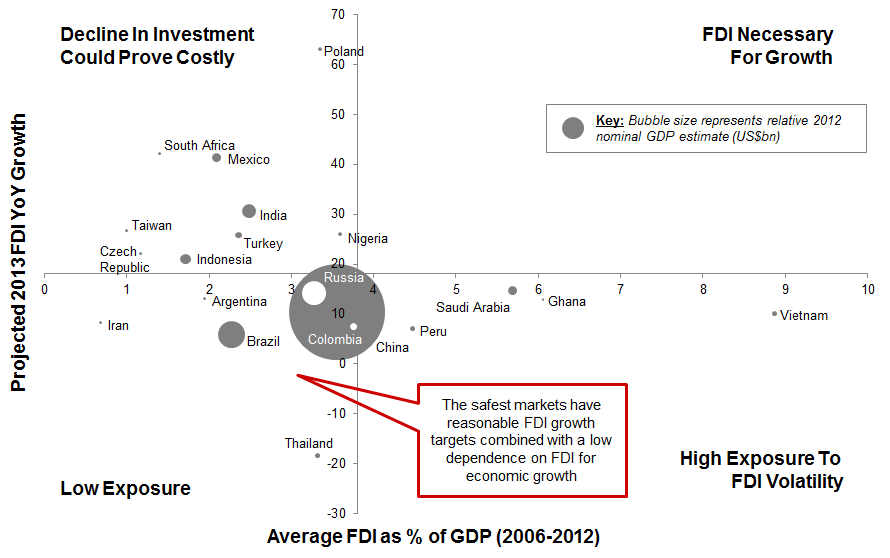
Trade and financial linkages are the fundamental transmission channels of an intensified Eurozone Crisis. A weakening Eurozone economy, combined with heightened perceptions of global risk, could undermine the foreign direct investment inflows that are currently expected to moderately increase for emerging market economies in 2013. Economies that are dependent on advanced economy capital flows for growth could see a major source of investment dry up.
3. Conflict in Middle East – What happens if there is a major oil shock?
Any conflict in the Middle East could result in a major decline in global oil supply, prompting a spike in oil prices. Higher oil prices would reduce sluggish growth and raise production costs (eroding profitability), while upward pressure on inflation could trigger a reassessment of credit supply in emerging markets. All of these factors combined could cripple indebted economies and threaten a liquidity crisis. The susceptibility and flexibility emerging markets have in dealing with this scenario depends on their adequacy of reserves, and their potential to shift production to exports to enhance their repayment capacity. For example, countries such as Ukraine and Poland are in major danger of a liquidity crisis if economic tensions rise due a reduction in global oil supply.
Only by fully understanding the implications and impacts of these events on business can companies appropriately react to the downside possibility. Executives that plan for the worst will find themselves a step-ahead of the competition if any of these risks materialize. In a highly competitive environment, that extra advantage can be the difference between exceeding and missing performance targets.