Emerging Market View: What Our Analysts Are Reading

Emerging Market View What our analysts are reading

Much like the US soccer team advancing in the World Cup despite a loss to Germany in yesterday’s game, Brazil’s economic outlook (regardless of the economic angst in recent years) seems to be catching a break as well - and it’s about time.

“Brazil still offers a significant amount of untapped opportunities in most sectors, especially in relatively faster-growing regions in the North and Northeast. Successful multinationals stress the need to focus on the long-term,” according to Pablo Gonzalez, Senior Analyst for Brazil after reading an article published by the FT.

FSG’s clients are encouraged to read further on how to make the case for Brazil, our latest report which identifies the opportunities and long-term factors that continue to make Brazil a good bet for multinationals. Also in the news lately is the rising cost of energy, a topic of recent concern given the unrest in the Middle East. The Wall Street Journal reports that higher oil prices are casting a shadow over emerging markets.

“Higher energy prices disproportionately affect emerging market consumers and economies. The increase in oil prices as a result of the rising political risk premium from the conflict in Iraq could spell trouble for emerging markets that are large importers of oil or already experiencing decelerating growth,” says Sam Osborn, Associate Practice Leader for FSG’s global analytics.

An example of impact follows Turkey’s recent decision to cut interest rates again.

“The interest rate cut will be helpful to local businesses but will fuel inflation. Rising energy prices because of the situation in Iraq are already affecting transportation costs, and the central bank will struggle to contain them with lower interest rates. As a result, MNCs can expect consumers to be squeezed for at least several more months,” says Martina Bozadzhieva, Head of EMEA Research at FSG.

However, Iraq is not the only concern:

FSG clients should review more analyses of rising energy prices here.​

Mexico’s Prolonged Slowdown Continues to Rattle MNCs’ Sentiment toward the Fast-Reforming Market

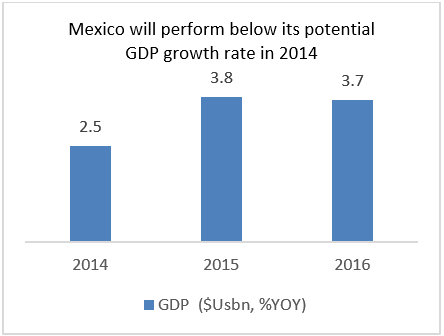
The Mexican economy has continued to underperform in 2014, with expectations for 3%+ growth becoming increasingly unachievable. Q1 GDP growth came in at a weak 1.8% YOY, far below initial expectations. FSG’s forecasted 2014 GDP growth for Mexico has fallen to 2.5% YOY as domestic demand contracts and an expected recovery in exports is delayed due to US economic weakness. That said, FSG continues to expect that an acceleration of government spending and higher export demand through the remainder of the year will accelerate economic growth, however a recovery in consumer spending is likely to lag well into the second half of the year, as consumers adapt to higher taxes introduced back in January.

Mexico GDP

Meanwhile, progress on passage of key structural reforms has been slower than initially forecasted, although both telecommunications and energy reform are expected to be discussed and passed through extraordinary legislative sessions in June. Multinational sentiment remains bullish over Mexico’s long-term promise, largely as a result of these reforms, but the recent weakness of the economy and slow progress toward passage and implementation of these reforms has somewhat tempered exuberance toward Mexico.

In our latest quarterly market review on Mexico FSG explored three key trends that will have an impact on the business environment and corporate sentiment over the medium term:

  • Market liberalization will create upheaval and churn across key industries in Mexico: As the Mexican government looks to increase competition in concentrated industries, this will create new challenges for incumbent players and open up new opportunities for multinationals thinking of entering the market
  • The government’s centralization drive is transforming B2G dynamics: The government’s reform efforts, while largely supportive of greater market liberalization and private investment also seek to consolidate and strengthen the federal Mexican state against domestic interest groups, state and municipal governments, which will transform B2G sales efforts and government engagement strategies for multinationals
  • Energy costs remain the biggest threat to Mexico’s manufacturing competitiveness: Even as more companies are considering increasing their manufacturing presence in Mexico, rising energy costs remain an important threat to the cost competitiveness of manufacturing in Mexico

For more information, FSG clients can access the full report here.