

Brazilian presidential candidate Eduardo Campos (PSB) was tragically killed in a plane crash yesterday, throwing Brazil’s October presidential election into disarray and causing big swings in local financial markets. Campos’s running mate, Marina Silva, was not onboard the plane, according to party officials.
Campos was in third place in recent polls with the support of about 10 percent of voters. While he was not expected to win the October 5 vote, he was perceived as a market-friendly alternative to President Dilma Rousseff, and his death will set off an intense scramble for his supporters in an increasingly-contested election. While it is too soon to draw a definitive conclusion about the impact of this event on the shape of the presidential race, FSG believes that Campos’s demise is likely to improve Rousseff’s chances of re-election in the first round. This is because:
1. Rousseff was already hovering around 50% of total valid votes in the latest polls: Rousseff only needs to receive just over 50% of the valid vote to win in the first round, and according to IBOPE’s election poll from August 7, Rousseff would get 50% of valid vote despite obtaining only 38% of total vote. This is because blank and null votes do not count toward the total vote.
IBOPE Voting Intention Poll – August 7 2014
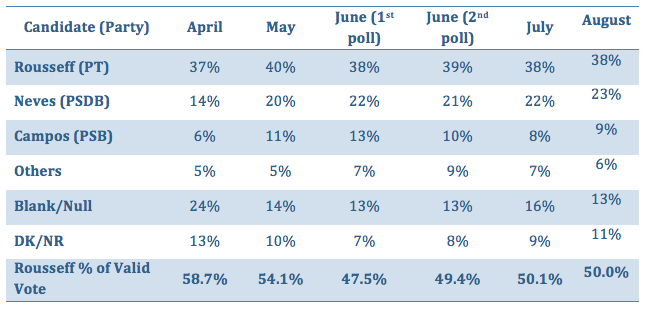
2. A portion of Eduardo Campos’s votes will go to Rousseff in the first round: Regardless of who becomes the new candidate for the PSB, it is expected that at least some of Campos’s supporters will shift their support to Rousseff, which would provide her with the extra votes she needs to be the first-past-the-post in the first round. The fact that Campos served as a minister under PT president Lula, and that his political party (PSB) was part of Rousseff’s governing coalition until 2013, puts him in the orbit of the PT in the eyes of many voters. Some Lula supporters had shifted their support away from Rousseff to Campos only because they were disappointed with Rousseff’s execution of PT’s policies, but now that Campos is no longer in the race, they might shift their support back to Rousseff.
3. The proportion of null and blank votes could increase: By the same token, Campos had also gathered the support of disaffected voters from other political parties other than the PT, namely the PSDB. In the absence of another solid candidate that represents “the option for change,” the percentage of voters that vote in blank or null could increase. Additionally, a significant chunk of former PT voters supporting Campos might not be willing to shift their support back to Rousseff, or any other candidate. This would automatically increase the percentage of valid votes obtained by any candidate in the first round, including Rousseff, facilitating her re-election as president of Brazil without the need of a second round.
One factor that could disrupt this outlook would be the selection of Marina Silva to replace Campos as the PSB candidate, and her subsequent rise in the polls. Given Silva’s strong national brand, and the potential for a robust sympathy vote, there is a good chance that she could syphon votes away from both Rousseff and Neves to force a second-round vote. If this were to happen, the potential for Silva to endorse either Rousseff or Neves in a runoff election could prove to be a significant wildcard.
Given this potential runoff scenario, FSG will be monitoring the following factors in the weeks ahead:
- Nomination for Campos’s replacement: The PSB has 10 days to nominate a new presidential candidate, and initial reactions within the PSB suggest that Campos’s running mate Marina Silva will become PSB’s new candidate.
- Potential for Silva to issue an endorsement: Assuming Silva is the candidate chosen to replace Campos, there is a lot of uncertainty as to who she might support in a second round. In fact, during the 2010 presidential elections, when she was the third-place finisher in the first round with her own political party (Green Party), she decided not to endorse neither Rousseff nor José Serra (PSDB).
- Where Silva’s supporters might go in a runoff: Assuming again that Silva is PSB’s presidential candidate the precedent we have from 2010 is that 50% of her votes went to Rousseff and 50% to Serra. What her voters would do this time around is hence very unclear.
In summary, although Rousseff’s re-election in the first round on October 5 seems be the most likely scenario, we still need to wait for new polling data and for the definition of the PSB’s internal political transition to have a clearer sense of the impact of Campos’s death on the presidential elections.
FSG clients can access all research on Brazil through the client portal. Not a client? Contact us for more information.