About Chris Moore

Christopher Moore joined Frontier Strategy Group in 2007 and currently serves as Head of Bespoke Research. Previously, he served in a number of other key product management roles at FSG, most recently as Director of Strategic Research, which addresses the operational challenges executives face in emerging markets globally by providing best practices case studies and peer benchmarking. He has also served as interim head of FSG’s APAC and EMEA research practices, and as product manager for global accounts. Prior to joining FSG as a senior research analyst, Mr. Moore was a strategy consultant supporting private equity and a range of industrial and consumer products companies on acquisition and market entry initiatives. He holds a bachelor’s degree in economics from the University of Virginia.

Find more about me on:

Recent Posts

PODCAST: Innovation in Emerging Markets - Expert Interview

Podcast Blog

In this podcast, Frontier Strategy Group Expert Adviser Brandi Moore shares her expertise on building a strong culture of innovation in emerging markets. In the business press, stories of successful emerging markets-led innovation from companies like GE and Unilever dominate headlines, but most companies struggle to achieve similar results. Brandi shares her view on why, and offers practical solutions.

To listen to or download the podcast, click on this link to access the iTunes store.

————————————————————————————————————————————————————

Bradi MooreiBrandi Moore has been solving challenging business problems in India since 2004. She has worked in India with Wipro, Infosys and other top outsourcers building processes to span learning gaps between Indian concepts and Western business models. She has extensive experience developing methodologies for US executives managing Indian employees, leading India-based projects and negotiating with Indian executives.

Brandi has negotiated with foreign governments, large corporations and inside India with stakes as high as $200 million. She is trained in the 5-D Hofstede model and executes negotiations based on culture as well as formal negotiation strategy.


PODCAST: Integrating Acquisitions in Emerging Markets

Podcast Logo

In this podcast, Frontier Strategy Group Expert Advisor, David Hodge, shares his experiences and best practices in the realm of post-merger integration. David was a key member of the transaction team for Amcor’s 3 largest acquisitions, and has completed M&A transactions in 10 separate countries. He highlights four of the most common pitfalls to avoid, and shares a “strategic growth framework” for capturing the most value.

To listen to or download the podcast, click on this link to access the iTunes store.

Building long-term distributor relationships, one year at a time

I recently shared some insights into effectively structuring distributor contracts in China that were gleaned from the recent executive discussion hosted by FSG in Shanghai. The eight executives that FSG brought together, representing heads of China or heads of Asia for a range of technology, industrial, and healthcare companies, also spent quite a bit of time discussing two sides of the same coin: building relationships with distributors, with a long-term partnership in mind, and transitioning or ending relationships with distributors.

But, it is hard for us to discuss these two issues without coming back to contracts! The key takeaway on contracts that was discussed in my previous post was the necessity of conducting an annual review and negotiation of the contract. In addition to the benefits outlined in that post, an additional benefit of an annual discussion is the opportunity to sit down across the table from your distributor and level-set on where the relationship stands, what is going well, and what needs improvement. This guidance and feedback, shared in the context of achieving mutual benefit, is the anchor of a strong relationship. It is also the best tactic at your disposal for ensuring that distributors are not caught off guard if you decide to make a change to the relationship (either by ending it, or scaling it back).

Nobody likes surprises. But, even in the best case scenario, when bad news is being delivered to your distributors, there is a risk in the Chinese market of “losing face.” Several executives mentioned instances of terminated partnerships where the local distributor felt that he had “lost face,” and as a result, felt a personal vendetta against the vendor. This could be manifested in the disgruntled former distributor establishing a relationship with a competitor (and taking key accounts along), sharing trade secrets, or poisoning your company’s reputation in the market.

One way to minimize the damage of a perceived loss of face is to ensure that when territories are transitioned, it is from a small distributor to a larger distributor (and not vice versa). A large distributor will have greater power in the marketplace to minimize the damage that could be caused by a disgruntled former small distributor. But, if you switch from a large distributor to a small distributor, the disgruntled former large distributor has an increased ability to harm your business and impair the operations of your new, smaller distributor.

As the discussion turned to the challenge of transitioning from indirect to direct in China, the key takeaway was to expect the unexpected. Your distributors may well be telling the truth when seemingly making excuses for underperformance, so do not be too hasty to make such a transition, or in his words, “wait until the pain is unbearable.”
Finally, it is important to bear in mind that investing in developing the capabilities of distributors does not and should not be conflated with retaining distributors. Taking a “tough love” approach has proven to be a trend among the highest growth companies. Investing in distributors to develop the capabilities you require should not prevent you from terminating relationships with distributors that are not meeting expectations, and a track record of doing so instills current and future partners with a higher expectation of accountability.

A structured, annual contract negotiation process builds a natural inflection point into the vendor/distributor relationship, which offers an opportunity to proactively evolve the relationship over time, or to bring the relationship to its conclusion with minimal loss of face.

China’s channel challenge

The slowdown impacting China could get worse before it gets better for business-to-business companies. Demand from the US and Europe for Chinese exports will remain depressed until issues such as the eurozone crisis and US fiscal cliff are resolved. Investment is constrained by the heavy debt burden of local and provincial governments in China, and existing overcapacity. China’s forthcoming leadership transition only adds an extra layer of uncertainty for Western companies attempting to grow their foothold in the Chinese market.

It was against this backdrop that FSG brought together eight senior-most China executives from leading technology, healthcare, and industrial companies to discuss best practices for managing the channel and driving growth despite the headwinds. Our discussion over breakfast in Shanghai yielded insights into three aspects of the vendor/distributor relationship: 1) structuring effective contracts, 2) building long-term relationships, and 3) minimizing the pain of transitioning away from an under-performing distributor.

For this post, I’ll touch on contracts. I’ll address the other two points in a future post.

The key takeaway I took from the discussion on contracts was seemingly counter-intuitive. Every executive around the table acknowledged that there is little chance of any Chinese partner strictly adhering to the letter of contracts, but despite the apparent futility of these documents, all of the executives agreed that the best practice is to more heavily invest in the negotiation, preparation, and enforcement of contracts. Local Chinese partners are more likely to view a contract as a roadmap than a strict and binary agreement. And, every executive in the room could share his own horror stories of partners violating contracts (or setting up new legal entities to skirt inconvenient agreements). Although it may seem counter-intuitive to over-invest in contracts when there is little guarantee that partners will strictly adhere to them, a strong argument was made that investing the time and energy to structure a detailed contract can pay dividends, and furthermore, these contracts should be negotiated annually.

Companies should take a modular approach to structuring contracts, that links specific distributor activities to points of margin. This accomplishes two things. First, it sets clear expectations for the distributor of what capabilities they are expected to bring to bear with a direct link to their incentives. Secondly, it allows the vendor to “take back” activities in the future, either because the distributor is underperforming, or because the vendor has built some of its own internal direct capabilities but does not wish to sever distributor relationships entirely.

We spent quite a bit of time discussing the ins and outs of building and eventually transitioning distributor relationships in China; I’ll share some highlights of this discussion in my next post.


Asia CEO Insights: Investing in the Strategic Planning Process

Over the past few weeks, I have been posting some of the key takeaways from a recent Executive Breakfast on the topic of strategic planning in emerging markets. The event, hosted by Frontier Strategy Group in Singapore, was attended by a group of nine senior Asia-based executives. In this third and final post (you can find part one here, and part two here), I wanted to touch on some of the highlights on the topic of investments – both in terms of financial capital as well as human capital – in the context of strategic planning.

Incentives were discussed as a possible tactic for countering short-term thinking by local teams. Many companies have considered using “plan accuracy” as a KPI for evaluating managers’ variable compensation, but one executive from the pharmaceuticals industry felt that this led to managers being overly conservative in their planning and execution in order to ensure that targets could be consistently met, which could result in missed opportunities and lost market share. Another executive shared that he has found success in providing highly attractive long-term incentives to instill long-term thinking, as well as to fight attrition. For example, one general manager on his team received a bonus equivalent to a full year’s salary for developing and then successfully executing an aggressive four-year strategic plan.

Beyond the question of human capital, financial capital was naturally a key topic of discussion. For many executives running an emerging markets portfolio, operations often do not yet have the scale necessary to self-fund new initiatives, so the case must be made to corporate headquarters for additional investment. FSG has recently profiled The Coca-Cola Company’s approach of creating a global opportunity fund (as distinct from an emergency fund), contributed to equally by each business unit, to which requests for funding could be submitted via a rigorous and competitive application process.

Another approach, used by several companies attending our discussion, is to ask managers to submit “layered” plans, consisting of baseline plan supplemented by one, two, or more layers of “what if” scenarios. For example, local managers are asked to provide details into the specific investments that would be made, and incremental opportunities captured, if corporate were to invest $1 million above the baseline plan, $2 million above baseline, and so forth. The downside risk discussed to this approach is whether such a methodology encourages managers to submit overly optimistic plans as they make the case for additional resources. Here again, the group came to consensus on the need for a high degree of discipline to checking progress against plan milestones on a frequent and structured basis.

Although having the right capabilities in place is necessary to achieve success, capabilities alone are not sufficient. The right incentives and adherence to processes are also key to ensuring that time spent planning is time well spent.

Asia CEO Insights: Incorporate Local Market Dynamics into the Strategic Plan

CEO Takeaways

“Knowledge of local markets should not reside only in local markets. Institutionalizing knowledge is critical in light of the high attrition of local talent in Asia.” –Head of Asia, Food & Beverage Company

Last week, I shared the first post in a small series on key takeaways from the recent Executive Breakfast hosted by Frontier Strategy Group in Singapore. I had the opportunity to join nine senior APAC executives for a robust discussion on managing the strategic planning process despite the volatility and distance from HQ that characterize doing business in emerging markets.

One of the most important capabilities for multinational companies to possess is an effective and efficient process for capturing the insights and wisdom of front-line managers when formulating strategic plans. In Asia, the fact that highly capable local managers are so difficult to retain for more than a few years before they leave for a big pay increase being offered by a competitive firm, or that many managers have relatively little multinational work experience, adds an extra layer of complexity to an already thorny challenge.

Furthermore, we discussed the fact that constantly churning local teams may lack a sense of ownership of plans developed by predecessors. And, that when employees expect to have short tenure with the organization, it can be hard to incentivize them to invest in developing and implementing long-term plans that may not maximize short-term personal benefits.

A leading packaged food company in attendance of our discussion has responded by attempting to institutionalize local market knowledge at the regional and corporate headquarters (where employee tenure tends to be longer and strategic capabilities tend to be more consistent) by developing a strategic planning Center of Excellence within each business unit to own the process of long-term planning, and gives local teams ownership (and accountability for) short-term planning and execution.

Another executive, from the fashion/retail space, chimed in to mention that his company has used a similar Center of Excellence strategy, with the added tactic of segmenting focus by channel as well as business unit. Some of the executives in attendance questioned the obvious drawback of not involving local teams directly in long-term planning, but acknowledged that this approach may be a realistic compromise in markets suffering from particularly high attrition.

An executive from the medical devices industry has shrunk the planning horizon for country teams to just two months; longer-term planning is done at the regional level. In his view, the key to executing in this type of bifurcated planning environment is a highly structured discipline of communication between regional and country teams, and strict accountability to meeting mutually agreed upon strategic milestones.

Another important consideration when it comes to managing the human element of planning is of course incentives. I’ll touch on some of the highlights of our discussion on that front in my next post.


Can strategic plans survive in emerging markets?

“One of our senior corporate strategic planners just took on a general management role in India. Now he gets it!” –Head of Asia, Healthcare Company

In the late 19th century, Prussian military officer Helmuth von Multke famously remarked that, “no plan survives first contact with the enemy.” Many managers in emerging markets might agree with Multke. Strategic planning is often a frustrating and time consuming process, which is complicated in emerging markets by heightened volatility, scarcity of data, and front-line communication hindered by distance and time zones. These three challenges often converge and result in strategic plans that do not last for more than a few quarters before being scrapped or forgotten.

Multke, however, was actually a meticulous planner. He developed a planning process that considered a wide range of variables and potential outcomes in order to provide front-line officers with a framework to guide battlefield decisions, despite rapidly changing and unpredictable front-line developments. As a general manager in emerging markets, your mandate is similar: to implement a planning process that results in plans that 1) guide day-to-day decisionmaking of employees, 2) are robust enough to withstand volatility, and 3) are reflective of local market dynamics despite the scarcity of granular data and the fog of distance.

Last week, I met with a group of nine senior Asia executives from a range of industries over breakfast at the Fullerton Bay Hotel in Singapore to discuss their best practices for strategic planning in emerging markets. Much of the conversation centered on recognizing and responding to the capabilities and constraints of local teams relative to corporate teams. We spoke a bit about incentives. And, we touched on the question of how to best make the case for investment and additional “plus plan” funding.

I’d like to take a few blog posts to share some of the key takeaways of our discussion in the coming weeks. Watch this space.

Three Strategies for Helping Partners Manage Working Capital

As credit continues to dry up in the wake of the ongoing eurozone crisis and continued macroeconomic uncertainty, multinational companies need to ensure that their distributors and channel partners in emerging markets can weather the storm, purchase inventory, and fund operations. In my previous post, we looked at some of the strategies companies can use internally to shore up their collections efforts and reduce days sales outstanding. In this post, we will focus on three strategies for helping external distributors and channel partners manage their working capital more efficiently.

External Focus: Three Strategies for Helping Partners Manage Working Capital

1. Off-load inventory holding costs by arranging smaller, more frequent shipments to distributors

The retail industry has been among the industries most impacted by the global economic downturn. To help its local distribution partners weather the crisis, one FSG client in the apparel industry has emphasized its flexibility to local distribution partners by reducing minimum order sizes while ramping up the frequency of shipments. This approach has the added benefit of enabling a more rapid response to changing fashion trends, which boosts sales and prevents distributors from accruing stockpiles of unsold (and out-of-fashion) inventory.

2. Provide a shared IT platform to improve efficiency and monitor business health

A FSG client that is a leading manufacturer of white goods has provided its local distribution partners with a shared IT platform that facilitates the free flow of high-value information. The system allows for the sharing of real-time sales data, pricelists, product information, macroeconomic data, and market trends among the company and its distributors. The company gains in-depth insight into the health of its partners’ businesses and can take action to recommend efficiency improvements or recognize early warning signs of looming trouble.

3. Forecast demand and actively manage inventory

Many FSG clients have reported their local partners’ tendency to inefficiently manage inventory, which ties up working capital that could be more effectively allocated to revenue-generating activities. One client in the construction equipment industry has provided its local partners with a software-based demand forecasting system for spare parts that strikes a balance between customer satisfaction (parts availability is critical for minimizing customer downtime) and working capital optimization. After securing buy-in from its partners by demonstrating this win-win relationship, the Council member is able to exert more control over managing inventory levels at the individual dealer level.

In the current economic environment, generating free cash flows and reducing risk continue to be top priorities for MNCs in emerging markets. The current climate provides not only a sense of urgency, but also a window of opportunity, to implement better working capital management practices. If and when we see a return to robust growth in global markets, companies that have established these good habits will be sure to yield more profitable growth than their competitors that have not been so diligent.

3 Strategies for Improving Collections Efficiency in Emerging Markets

For executives in emerging markets, currency volatility stemming from the eurozone crisis and other uncertainties has added an extra layer of complexity and urgency to the management of working capital. Reducing Days Sales Outstanding (DSO) is critical for preserving margins if local currency–denominated receivables depreciate against the dollar. Furthermore, reduced access to capital continues to be a major pain point for smaller, local partners in emerging markets. Helping these local partners navigate the credit crunch by giving them the tools to more effectively manage their working capital can be critical for ensuring their survival, maintaining the continuity of supply chains and distribution networks, and fostering long-term goodwill.

Executives need to consider two dimensions when evaluating the best strategies for mitigating these challenges: Internal (their own business operations), and External (their distributors and other channel partners). Let’s focus on the Internal dimension first:

Internal Focus: Three Strategies for Improving Collections Efficiency

1. Prioritize receivables based on risk and value rather than age

Traditionally, treasury teams have aligned resources by prioritizing the oldest outstanding receivables for collection. An FSG client in the agricultural chemicals industry has given its treasury team a more strategic mandate to look beyond age to consider risk and value as the key metrics guiding collections activities. This ensures that extra steps can be taken at an early stage to collect from the accounts that are most likely to lapse beyond 30 or 60 days outstanding, which minimizes foreign exchange exposure, lowers default risk, and ultimately reduces DSO.

2. Avoid a “one size fits all” approach to collections

Many companies have invested extensively in automating receivables collections, but one FSG client in the software space has emphasized the importance of the general manager working with the treasury team to ensure that collections strategies are adapted for specific customer segments. Recognizing that a small, privately owned local company with 30 employees requires a different collections strategy than a government client will not only improve the efficiency of collections and reduce DSO but will also help to foster goodwill and increase the long-term value of the relationship.

3. Separate disputes from normal collections processes

For many companies, the inability to segregate disputed receivables from a particular invoice can seriously impact cash flows and negatively impact DSO. An FSG client in the consumer electronics industry invested in a receivables management software package that allows it to disaggregate these disputes from invoices. Now, rather than placing an invoice’s entire value in dispute due to a disagreement with the customer regarding one line item, the company can move forward with collection of the agreed-upon balance and handle the remainder through the normal dispute process. This simple shift has allowed the company to reduce past due accounts receivable by 20%.

In my next post, we will take a look at the External dimension, with three strategies focused on third-party distributors and channel partners.

5 Common Mistakes to Avoid in Emerging Markets

Local Competitors

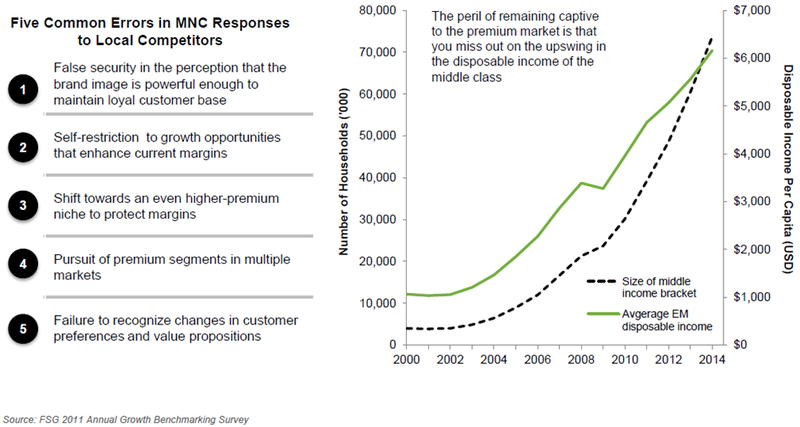
  • Maintaining a steadfast focus on the premium market is the leading cause of significant downturns in corporate revenue growth that many MNCs experience
  • A failure to shift tactics away from the premium segment will prevent you from taking advantage of the increase in disposable income and size of the middle income segment in emerging markets
  • The figure above illustrates the 5 common errors MNCs tend to make when responding to local competition in emerging markets