About Christine Herlihy

Christine Herlihy is a Latin America Analyst at Frontier Strategy Group. Her research focuses on the key political, economic, and business trends affecting multinationals in Latin America, as well as on strategic decision-making. Christine graduated with honors from Georgetown University, where she studied international relations and Spanish, with a focus on economic development and emerging markets. Previously, Christine worked as a Research Associate in the U.S. Executive Director’s Office at the Inter-American Development Bank in Washington, DC. She has lived and studied in Santiago, Chile, and has also worked in the field of immigration law.

Find more about me on:

Recent Posts

Cost-Effective Workforce Planning in Latin America

Getting the Right People in the Right Seats Has Never Been Cheap or Easy in Latin America

Even under the best of circumstances, it is difficult and expensive for multinationals to recruit and retain key talent in emerging markets. This is particularly true for the companies we work with in Latin America, given that governments across the region have historically under-invested in education and human capital. As a result, the supply of workers with the technical and managerial skills needed to carry out day-to-day business operations remains limited.

The underlying scarcity of skilled labor continues to drive up wages across the region, and in most cases, nominal wages outpace both inflation and productivity, boding poorly for the sustainability of current labor market dynamics and the consumption-led growth they have facilitated over the medium-term.

To make matters worse, demand for talent continues to rise as multinationals step up their investment in the region in an effort to compensate for sluggish growth in developed economies. Problems related to talent management have long plagued Brazil, and our expectation is that as companies strive to scale up their presence in Colombia and Peru, existing recruitment and retention challenges in these markets will be exacerbated, forcing companies to rely on costly expatriate hires.

Unfortunately, there is no silver bullet—today’s talent gaps are structural and will endure over the medium term even as governments begin to step up investment in secondary and tertiary education. However, conversations with our clients and expert advisors reveal that integrating workforce planning into the strategic planning process pays great dividends and helps companies move away from ad hoc, high-cost external hiring towards cost-effective, retention-boosting redeployment strategies.

Cost-effective Workforce Planning Is the Key to Unlocking Efficiency, Retention, and Revenue Gains

Redeploying internal talent more efficiently is a cost-effective near-term alternative to external hiring, while optimizing your regional organizational footprint offers a medium-term solution to the high costs associated with across-the board localization. Over the long term, hiring young and investing in top performers to ensure they gain the skills they need to assume leadership roles within the organization is the key to building a cost-effective, enduring talent pipeline with retention and brand building gains that compound over time.

The ability to redeploy existing talent is contingent upon increasing visibility into the internal labor pool. If visibility is a challenge, consider adopting programs aimed at increasing senior management’s exposure to high potential employees throughout the organization, across functional, geographic, and business unit lines.

Requiring senior managers to have succession plans in place, and ensuring that KPIs incentivize managers to develop their direct reports are two best practices for preventing managers from shielding their high performers in the hopes of keeping them on their teams to the detriment of broader organizational goals.

Additionally, grouping countries based on their business environments and labor market conditions allows you to leverage strategic economies of scale by prioritizing capabilities you need in each environment, cross-applying workforce planning best practices, and planning for the future as markets and competitive landscapes evolve.

One industrial company we work with offers a case in point: to mitigate the risks associated with heterodox macroeconomic policies in Argentina, their regional leadership team leveraged the expertise their Venezuela country manager had gained through years of navigating complex capital controls, high inflation, shortages, and retention challenges, and tasked him with strategic responsibility for Argentina. As ‘wild card’ manager, he was able to work with his Venezuela functional heads to quickly bring their Argentine counterparts up to speed on best practices for mitigating financial and operational risks.

There are benefits to be gained in extending this line of thinking to other types of business environments. For example, the workforce planning challenges that companies face today in Brazil are likely to be repeated down the road in Colombia and Peru as investment increases and subsequent demand for relatively scarce skilled labor accelerates. Internship programs and long-term investment in the training and development of local hires have proven successful in Brazil, and understanding common trends in labor market dynamics is essential to making the case for investing in similar programs in the Andean region, so that your company will be well-positioned to ride out the coming talent crunch.
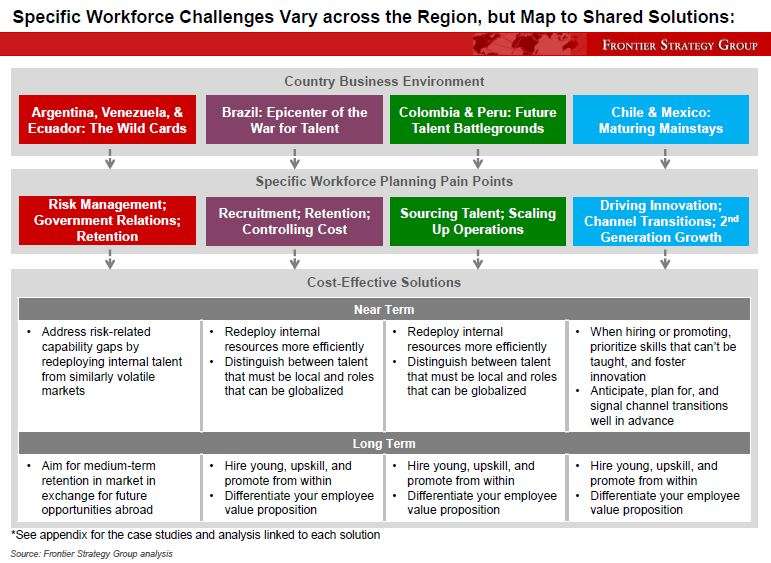
Specific Workforce Challenges Vary across the Region, but Map to Shared Solutions

For further reading on cost-effective workforce planning strategies and organizational footprint optimization in Latin America, FSG clients are encouraged to review the following reports:

  • Click here to access our full report on cost effective workforce planning and regional labor market dynamics in Latin America

Optimistic About Mexico’s Second Half Performance

While FSG clients continue to view the Mexican economy as a source of opportunity, revenue growth came in under expectations in the first quarter, and targets for 2013 reflect lower expectations than in previous years. That said, executives remain relatively optimistic about the potential for stronger growth in the second half of the year, contingent upon accelerated government spending and investment in infrastructure, progress on the structural reform front, and continued economic recovery in the US.

From a macroeconomic perspective, manufacturing exports, the troubled construction sector, and stalled government procurement proved to be significant drags on growth in recent months. Additionally, Mexican consumer and producer confidence declined during H1, and the pace of consumption and credit growth have moderated, reflecting the impact of sluggish external demand, falling remittances, currency depreciation, and inflationary pressures on domestic sentiment and purchasing power.

Broadly speaking, Mexico’s near-term prospects remain highly contingent upon US economic performance, although Peña Nieto’s commitment to accelerating investment in infrastructure and pushing through fiscal and energy reform also has the potential to drive growth and foreign direct investment in the months ahead.

It is against this economic backdrop that FSG believes multinationals should be tracking the following three trends during the third quarter of this year as an indication of how the business environment is likely to evolve over the medium term:

  • Ramping up of government spending under the new administration
    • Recent developments: During the first quarter of 2013, government expenditure fell short of budgeted amounts by 4.9% in Q1. This slowdown, while common in Mexico during periods of political transition was a key driver of Mexico’s underperformance during the first half of the year.
    • Forecast: Our expectation is that government spending will accelerate in the second half of the year. Companies in the construction sector stand poised to benefit as infrastructure projects are prioritized.
  • Near-term exchange rate volatility
    • Recent developments: In recent weeks, the peso has depreciated sharply against the US dollar amid speculations that the Fed will begin to wind down bond purchases as the US economy continues to improve.
    • Forecast: Over the long term, recovery in the US bodes well for Mexico. As such, near-term capital outflows should be interpreted as a reaction to the shift in US monetary policy rather than perceived weakening of Mexican fundamentals.
  • Healthcare reform efforts will emphasize preventive care
    • Recent developments: In addition to pushing for reduced costs and expanded access to healthcare services, Peña Nieto has indicated that preventive care will be prioritized when healthcare reforms are rolled out.
    • Forecast: Companies in the pharmaceutical, medical device, and consumer goods spaces should consider low-cost, high impact ways to proactively align their marketing, government relations, and product development strategies with government efforts to reshape consumer behavior and promote a healthy lifestyle.

FSG clients may click here to access a full report for further reading on FSG’s quarterly market view of Mexico.

Though Chile’s Consumption Story Remains Solid, Multinationals’ Supply-side Costs Are Likely to Rise

With the second quarter now well under way, Chile continues to outperform, though downside risks loom on the horizon as the outlook for copper prices weakens. Internal demand remains a key growth driver and continues to outpace top-line growth, raising fears that the economy may be on the verge of overheating. In our view, such fears are overblown at present, given that increased consumption has been driven in large part by rising real wages rather than increased borrowing.

Rising labor costs, increased potential for skilled labor shortages, and more restrictive credit conditions do, however, represent supply-side risks for multinationals already hard-hit by rising energy costs and the potential for strike-related supply chain disruptions as the electoral cycle kicks into gear.

Trend #1: Near-term Supply Chain Disruptions Likely as Election Year Politics Take Hold

  • In recent weeks, strikes have broken out in a number of different sectors in Chile. Port workers have disrupted copper and fresh fruit exports, miners at the state-owned copper company Codelco demanded higher wages, preschool teachers from Fundación Integra called a 24-hour strike, and LAN airline workers have publicly protested against firings. These strikes are timed to capitalize on the electoral cycle, and while the volume is expected to decline following November’s election, multinationals may experience supply chain disruptions as a bandwagoning effect plays out across various sectors of the economy

Trend #2: A Stronger Peso Will Fuel Capital Investment Over the Near-Term

  • The Chilean peso appreciated 7.8% against the US dollar in 2012, and as of mid-April, has appreciated 2.2% in 2013. The sustained real appreciation of the peso has strengthened domestic purchasing power, benefitting companies importing consumer durables and capital goods into the Chilean market, while taking a toll on commodity exporters. Multinationals with local operations and/or production are likely to face rising costs as the prices of non-tradable inputs (i.e. labor, real estate, water, and electricity) rise in USD terms, even against a backdrop of muted inflation.
  • While the peso will remain strong against the dollar in historical terms, moderation is anticipated over course of 2013, given a weaker outlook for copper demand and expectations that the Fed will scale back bond purchases.

Trend #3: An Uptick in Immigration Will Offset Chile’s Increasingly Tight Labor Market

  • While multinationals are concerned about the potential for shortages of skilled labor and rising labor costs as the Chilean economy approaches full employment, a recent uptick in arrivals of skilled immigrants from the distressed economies of Spain and Argentina may help fill critical capability gaps. Currently, companies with more than 25 employees can only fill 15% of positions with foreign hires. However, our expectation is that reform efforts will aim to raise this cap and streamline the visa process, while increasing inter-agency cooperation to ensure that policy is optimized to meet the country’s labor and technical needs.

FSG clients may click here to access a full report for further reading on FSG’s quarterly market view of Chile.


Latin America’s Moment: Making the Case and Capturing Opportunity

Making the Case for Latin America Has Historically Revolved around the Region’s Untapped Growth Potential

Making the case for resources has long been a challenge for emerging markets executives—while emerging markets represent tremendous growth opportunities, they have historically been viewed as risky, volatile, and fragmented, undermining corporate willingness to commit large amounts of resources. On a regional level, many of the Latin America executives we work with have expressed frustration at having to defend the region’s potential when top-line growth has been higher elsewhere in the world, particularly in Asia.

At Frontier Strategy Group, we have long strived to help our clients overcome such skepticism and communicate upwards effectively by emphasizing the region’s hard-won macroeconomic stability, relatively under-penetrated markets, and growing middle class. While these drivers remain in place and multinationals’ growth targets for Latin America are now on par with those seen in Asia, sluggish global growth has raised the stakes, and emerging markets are increasingly expected to deliver both top- and bottom-line growth.

However, Sluggish Global Growth & Underperformance in 2012 Have Undermined Confidence in Latin America

In the wake of Venezuela’s recent devaluation and the death of President Hugo Chávez, as Argentina continues to impose heterodox capital and import controls and Brazil edges towards stagflation, it is easy to understand why multinational executives face growing skepticism from risk-averse corporate centers as they strive to make the case for resources in Latin America.

Fortunately, Executives Compelled to Reassess the Region’s Potential Can Walk Away Reassured

While we certainly acknowledge the endogenous and exogenous factors undermining Latin America’s near-term outlook, we remain bullish about the region’s potential over the medium-to-long term, and our optimism is grounded in a demonstrable belief that the region’s core advantages have in fact remained intact, and will be reinforced by positive secular trends.

Not Only Do Latin America’s Core Advantages Remain Intact…

Latin America’s core advantages can be divided into four buckets, including profitability, relative growth, stability, and concentrated financial resources. Of these four advantages, profitability stands out as the most salient given the pivot to profitability that emerging markets executives are experiencing. As growth remains stalled in developed economies and corporate places increasing pressure on emerging markets, 73% of FSG clients in Latin America have experienced or expect to experience a shift in corporate emphasis towards bottom-line growth over the near-term. With this in mind, it is certainly reassuring to consider that available data on publicly traded companies indicate that average operating margins in Latin America are 55% higher than in the BRICs excluding Brazil.

At present, Latin America derives its profitability advantage vis-à-vis other emerging market regions primarily from a host of demand-side factors which allow multinationals to sell at higher margins and maximize the gains associated with realizing economies of scale. However, these advantages have the potential to diminish over time as competition within the region increases, meaning the time to build market share and brand loyalty is now.

When it comes to GDP growth, while the pace of growth in other emerging markets is expected to decelerate in comparison with pre-crisis rates, LATAM has remained relatively resilient and will accelerate in the coming years.

If you’re tempted to dismiss growth and profitability out of fear of resurgent instability, think again. More conservative corporate centers have historically associated Latin America with hyperinflation, uneven growth, and overexposure to commodity boom-and-bust cycles. Part of the story we’re striving to help our clients communicate is that while these sorts of risks persist in specific markets, the region as a whole has progressed tremendously thanks to orthodox macroeconomic reforms.

Inflation targeting regimes, reduced deficit spending, and the liberalization of trade and capital flows have brought down inflation, empowered consumers and provided the stability necessary for sustained growth. Latin America also remains well-positioned to ride out any future global downturn, as its economy is less dependent on trade than APAC, and less integrated into the global financial system, reducing the risk of Eurozone contagion. Concentrated financial resources also bode well for B2C and B2B multinationals—per capita private consumption spending and government expenditure in LATAM outpace other EM markets including India and EMEA, and are on par with China.

But investment and reform are positioning the region to build on these strengths moving forwards, unlocking new opportunities for multinationals:

Most importantly, Latin America is well-positioned to build on these core advantages, and secular trends are already yielding proof points. Trends we’re tracking range from Peña Nieto’s ambitious reform agenda and the resurgence of manufacturing in Mexico to Colombia’s peace dividend and Peru’s rapid rise. On a pan-regional level, energy resources will bolster government coffers and empower investment in infrastructure and human capital, while the rise of the Pacific Alliance will provide a decidedly pro-business counterweight to the increasingly anachronistic Mercosur. The region is on the rise, and there has never been a better moment to make—and win—the case.

As Multinationals Plan for Growth in Brazil, Profitability is Key

FSG recently surveyed our clients and expert advisors regarding their expectations for their businesses in Brazil over the next 5-10 years, and the results reflect two important trends: cost-consciousness and path-dependency. For many years now, companies have invested in Brazil and been content with robust top-line growth. However, in the wake of the financial crisis, as the US and Eurozone markets have struggled and China is currently experiencing a slowdown, many multinationals are running out of patience. Increasingly, top-line growth in Brazil is not sufficient, and our clients are concerned with cutting costs and improving operational efficiency so as to improve their bottom-line performance.

As they do so, they remain cognizant of the potential for government action to address specific constraints—while many of our clients are skeptical about the true impact reforms will have, our view is that government actions will help mitigate the impact of some constraints, most notably infrastructure and access to financing, while failing to address others, due in large part to domestic politics. This variation is impacting our clients’ strategic plans in quite interesting ways.

For example, while companies continue to equate geographic expansion in the Northeast and Center-West with growth potential, they are primarily planning for product-led growth over the near term, due to the logistical costs associated with expanding to lesser-penetrated regions where infrastructure is poor or non-existent. It should be noted that a zero-sum approach is neither evident nor expected. FSG clients are not discounting geographic expansion, but many executives are being forced by cost concerns to make trade-offs, and this often results in short-term concerns dictating strategic priorities.

Over the medium-to-long term, we do expect that push and pull factors, including market saturation and the need to serve existing accounts will continue to drive expansion, and we also expect infrastructure reforms to decrease the marginal costs associated with geographic expansion, making this approach much more feasible from a cost-benefit perspective. Of critical importance are external urgency drivers, including the 2014 World Cup and 2016 Olympic Games, which help raise the stakes and motivate the government to engage the private sector in infrastructure projects.

As executives plan for growth in Brazil, their decisions are increasingly motivated by the need to ensure the growth they deliver is profitable. Trends worth tracking in light of this paradigm shift are those that promise to tilt the balance down the road in favor of outcomes that may not be feasible from a cost-benefit perspective at present.

Brazil in Q3: Multinationals Shift Focus in Response to Slow Down

Brazil has been a cause of concern for multinationals as of late, with credit-fueled consumer spending and GDP growth both trending downwards in Q3. This slowdown is particularly worrisome for B2C companies, who fear for their ability to meet annual growth targets. The macroeconomic drivers of this trend paint a mixed picture: on the one hand, inflation and unemployment both remain low, and an emerging middle class continues to benefit from government cash transfers and social programs. On the other hand, even after the central bank’s most recent round of rate cuts, interest rates remain relatively high, external headwinds continue to hamper demand for exports, and consumers are increasingly hesitant to take on additional debt.

There is, however, an upside to this story which bodes well for long-term growth: consumer spending is expected to rebound over the medium-term, as government spending ramps up in preparation for the 2014 electoral cycle and World Cup. Furthermore, the Rousseff administration has begun the politically difficult process of setting Brazil on the path towards an investment-led growth model. This transition is likely to proceed in fits and starts, given that more than 50% of federal government spending goes towards pensions and government salaries at present, and Rousseff’s left-wing and labor union supporters will adamantly oppose any cuts. These challenges, while not unique to Brazil, are exacerbated by the sheer size and diversity of the country, and multinationals should expect structural reforms to proceed gradually, with limited impact over the short-to-medium term.

Many multinationals in Brazil who have long been concerned with growth have responded to the current slow-down by shifting their focus to operational efficiency and profitability. Notable best practices include: transitioning from an indirect to a direct or hybrid distribution model, streamlining and centralizing back office services, leveraging technology to improve supply chain efficiency, and pursuing growth by expanding within Brazil’s five regions and second-and third-tier cities.

The experience of Takeda Pharmaceuticals in Brazil illustrates that these strategies often work best in tandem. Takeda entered the Brazilian market in 2011. While its initial acquisition gave Takeda access to major wholesalers and chains, regional wholesalers and smaller pharmacies remained out of reach. Takeda then acquired Multilab, a locally based pharmaceutical company with an established regional distribution network. As a result of this acquisition, Takeda was able to increase its product portfolio and market share within Brazil, while gaining a valuable foothold within Brazil’s emerging regions that leaves it advantageously poised for future growth. Main take away points from Takeda’s success story include the following:

1. Multinationals should anticipate and plan for growth beyond the South and Southeast regions. The North and Northeast in particular are expected to experience economic growth, and multinationals that successfully penetrate these markets now will be poised for success down the road.

2. Multinationals hoping to increase their presence in Brazil through acquisition must carefully analyze the distribution capabilities of potential targets, and choose those with capabilities that best address existing deficiencies. This is especially crucial in lesser-penetrated regions, including the North and Northeast. Infrastructure is less developed in these regions, making scalable direct distribution quite difficult, while indirect and hybrid models require relationships with regional wholesalers and local retailers that foreign multinationals are often unable to forge endogenously.