Emerging Market Currency Volatility…It’s Getting “Real”

“Currencies should not be used as a tool of competitive devaluation. The world should not make the mistake that it has made in the past of using currencies as the tools of economic warfare.”
- George Osborne, Britain’s Finance minister

For emerging market finance ministers, the concept and impact of “currency wars” is very real. As loose monetary policies in developed economies encourage high capital inflows to emerging markets (often referred to as “hot money”), emerging countries struggle to control inflation and the upward pressure on their currencies. This often leads to a surge in competitive devaluations as governments feel compelled to intervene in order to protect fragile domestic economic recoveries, which has the resulting consequence of amplifying currency volatility. However, these competitive devaluations should not be considered as “economic warfare”, they are economic stabilization measures and a natural result of expansionary monetary policy. As many media outlets implicitly (or probably explicitly) understand, conflict is much more exciting than accord. By emphasizing the antagonistic aspects of these decisions, they are unfortunately misleading the public into thinking that these interventions are purely for competitive purposes.

However, multinationals are impacted when emerging markets governments respond to capital inflows by more aggressively printing money to sell on the open market to buy hard currencies. The reality is that the selling of local currency to buy developed-market bonds creates a cycle that further depresses yields in developed markets, pushing more capital to emerging markets, restarting the cycle of currency volatility again. Unfortunately for international executives, currency volatility creates many problems, such as difficulties in:

1. Pricing products
2. Anticipating costs
3. Uncertain business planning
4. Greater reluctance to hire new employees
5. Price instability in commodity markets

For international executives that are increasingly focused on profitability, currency volatility is one of the most important trends to watch this year. For example, a 10% increase in profitability in a given market will be essentially wiped out by a 10% decrease in the value of the local currency when results are reported.
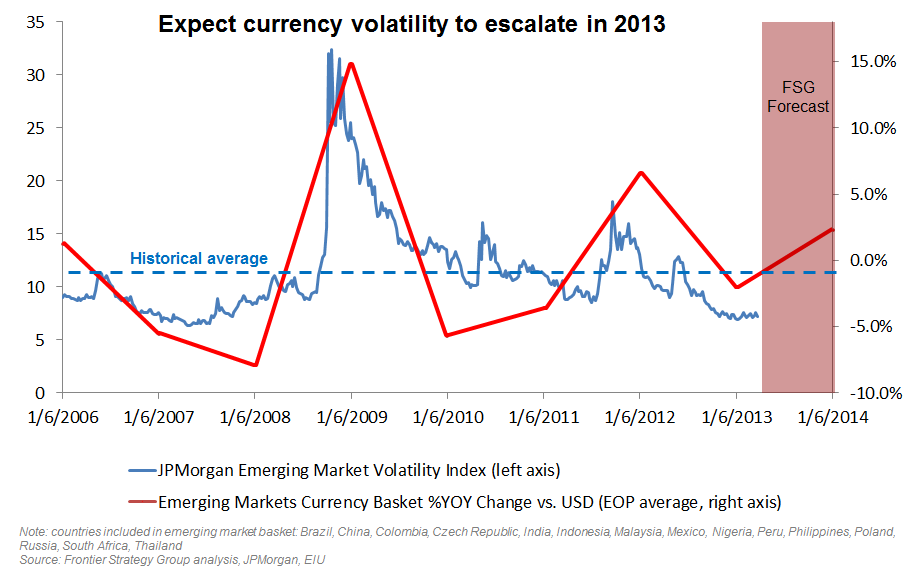
Currency Volatility Chart


Latin America’s Moment: Making the Case and Capturing Opportunity

Making the Case for Latin America Has Historically Revolved around the Region’s Untapped Growth Potential

Making the case for resources has long been a challenge for emerging markets executives—while emerging markets represent tremendous growth opportunities, they have historically been viewed as risky, volatile, and fragmented, undermining corporate willingness to commit large amounts of resources. On a regional level, many of the Latin America executives we work with have expressed frustration at having to defend the region’s potential when top-line growth has been higher elsewhere in the world, particularly in Asia.

At Frontier Strategy Group, we have long strived to help our clients overcome such skepticism and communicate upwards effectively by emphasizing the region’s hard-won macroeconomic stability, relatively under-penetrated markets, and growing middle class. While these drivers remain in place and multinationals’ growth targets for Latin America are now on par with those seen in Asia, sluggish global growth has raised the stakes, and emerging markets are increasingly expected to deliver both top- and bottom-line growth.

However, Sluggish Global Growth & Underperformance in 2012 Have Undermined Confidence in Latin America

In the wake of Venezuela’s recent devaluation and the death of President Hugo Chávez, as Argentina continues to impose heterodox capital and import controls and Brazil edges towards stagflation, it is easy to understand why multinational executives face growing skepticism from risk-averse corporate centers as they strive to make the case for resources in Latin America.

Fortunately, Executives Compelled to Reassess the Region’s Potential Can Walk Away Reassured

While we certainly acknowledge the endogenous and exogenous factors undermining Latin America’s near-term outlook, we remain bullish about the region’s potential over the medium-to-long term, and our optimism is grounded in a demonstrable belief that the region’s core advantages have in fact remained intact, and will be reinforced by positive secular trends.

Not Only Do Latin America’s Core Advantages Remain Intact…

Latin America’s core advantages can be divided into four buckets, including profitability, relative growth, stability, and concentrated financial resources. Of these four advantages, profitability stands out as the most salient given the pivot to profitability that emerging markets executives are experiencing. As growth remains stalled in developed economies and corporate places increasing pressure on emerging markets, 73% of FSG clients in Latin America have experienced or expect to experience a shift in corporate emphasis towards bottom-line growth over the near-term. With this in mind, it is certainly reassuring to consider that available data on publicly traded companies indicate that average operating margins in Latin America are 55% higher than in the BRICs excluding Brazil.

At present, Latin America derives its profitability advantage vis-à-vis other emerging market regions primarily from a host of demand-side factors which allow multinationals to sell at higher margins and maximize the gains associated with realizing economies of scale. However, these advantages have the potential to diminish over time as competition within the region increases, meaning the time to build market share and brand loyalty is now.

When it comes to GDP growth, while the pace of growth in other emerging markets is expected to decelerate in comparison with pre-crisis rates, LATAM has remained relatively resilient and will accelerate in the coming years.

If you’re tempted to dismiss growth and profitability out of fear of resurgent instability, think again. More conservative corporate centers have historically associated Latin America with hyperinflation, uneven growth, and overexposure to commodity boom-and-bust cycles. Part of the story we’re striving to help our clients communicate is that while these sorts of risks persist in specific markets, the region as a whole has progressed tremendously thanks to orthodox macroeconomic reforms.

Inflation targeting regimes, reduced deficit spending, and the liberalization of trade and capital flows have brought down inflation, empowered consumers and provided the stability necessary for sustained growth. Latin America also remains well-positioned to ride out any future global downturn, as its economy is less dependent on trade than APAC, and less integrated into the global financial system, reducing the risk of Eurozone contagion. Concentrated financial resources also bode well for B2C and B2B multinationals—per capita private consumption spending and government expenditure in LATAM outpace other EM markets including India and EMEA, and are on par with China.

But investment and reform are positioning the region to build on these strengths moving forwards, unlocking new opportunities for multinationals:

Most importantly, Latin America is well-positioned to build on these core advantages, and secular trends are already yielding proof points. Trends we’re tracking range from Peña Nieto’s ambitious reform agenda and the resurgence of manufacturing in Mexico to Colombia’s peace dividend and Peru’s rapid rise. On a pan-regional level, energy resources will bolster government coffers and empower investment in infrastructure and human capital, while the rise of the Pacific Alliance will provide a decidedly pro-business counterweight to the increasingly anachronistic Mercosur. The region is on the rise, and there has never been a better moment to make—and win—the case.

The Waiting Game – Launching New Products in China

China Survey

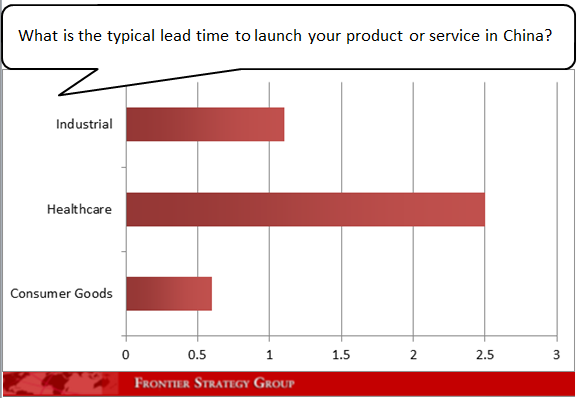
The ability to bring products to market quickly is one of the biggest factors that separates leading multinationals from the rest of the pack. Companies that continuously release innovations in the form of new products and services are able to differentiate themselves as “first-movers,” and gain a key advantage against the competition. In order to better understand the expectations for launching new products in China, Frontier Strategy Group recently conducted a senior executive poll to determine how long it takes for companies to bring new products to market. On average, healthcare companies require roughly two and a half years to bring a new product to market, while consumer goods average just over half of a year. Industrial companies fall close to the middle, averaging just over 1 year. If your company takes longer than the industry average in launching a new product, you could be leaving yourself vulnerable to organizations that are more efficient in new product development.

Also within this research, FSG identified the average revenue and profit contributions by industry within emerging markets and China. As an example, Industrial companies have a far larger percentage of their business in emerging markets than any of their peers, with more than 40% of their current profits derived from emerging markets and an expectation of over 50% in just five years. By analyzing the nature of your industry as it stands right now, compared to the momentum and expectations for the future, you too can have a unique insight into the growth opportunities for your business in emerging markets.


Brazil: High Costs Weigh on Profitability, Limiting the Impact of Growth

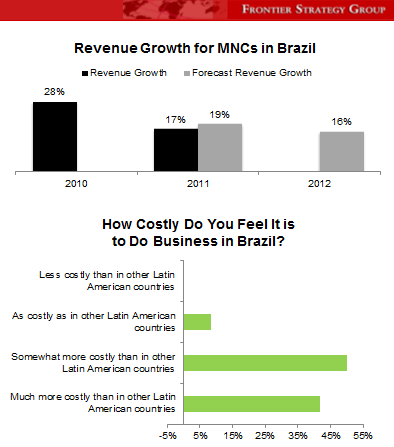
Brazil Revenue Growth

Brazil remains a growth engine for multinationals in Latin America:

Despite the economic slowdown, multinationals are counting on Brazil to deliver significant growth in 2012.

But the high cost of doing business, known as Custo Brasil, is eroding the profitability of Latin American business portfolios:

92.3% of executives believe that doing business in Brazil is at least somewhat more costly than the in other Latin American countries.

Are corporate growth expectations for 2012 unrealistic?

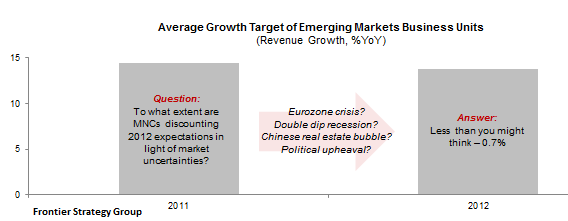
Despite the uncertainty and volatility surrounding the 2012 economic environment, corporate expectations for emerging market business units remain high, across regions and industries. Companies such as Heinz (NYSE: HNZ-P) and BlackRock (NYSE: BLK) are expecting emerging markets to continue to drive growth, but Frontier Strategy Group has observed two potential red flags that emerging markets executives should consider as they look to 2012:

1.Expectations are aggressive, but strategies are conservative
–Profitable growth is the priority in 2012. Most executives are emphasizing conservative methods for expansion over riskier and more resource-intensive options
–Companies are expecting to achieve targets by taking market share, rather than entering new markets, launching new products, or M&A
2.Strategies may be undermined by the tactics used to implement them
–Despite the emphasis placed on profitability, a majority of companies plan to compete on price, lowering the prices of their existing products developed for Western markets, rather than adjusting product features, which would allow them to reduce costs while increasing value
–Margins will be further squeezed if deteriorating market conditions cause customers to be increasingly price sensitive

FSG has surveyed senior executives running emerging markets business units to collect detailed insights into growth targets and strategies, hiring, salaries, organizational structure, and more.