Forging New Links: Overcoming Obstacles to Supply Chain Integration in Latin America

Latin America Supply ChainLatin America’s history of pervasive economic and physical trade barriers has proven a significant impediment to the integration of multinationals’ regional supply chains. Tariff and non-tariff trade barriers, complicated and inconsistent tax rules, and the nearly-impenetrable Amazon Basin and Andes Mountains have forced many companies to take an ad hoc approach to supply chain development in Latin America.

This ad hoc approach has meant that supply chains in Latin America are often a fragmented and inefficient drag on bottom-line performance, rather than the streamlined competitive advantage they can be in developed markets. Indeed, according to a report by JDA Software Group, longer lead times and less flexible supply chains means that days inventory outstanding for manufacturers averages 133% higher in Latin America than in the US, while days inventory outstanding for retailers averages 77% higher.

Despite these impediments to supply chain integration, growing corporate pressure to improve bottom-line performance, coupled with the threat posed by increasingly sophisticated local competitors, is causing some savvy LATAM executives to take a second look at opportunities to improve supply chain performance. Supporting this trend are emerging regional supply chain enablers like the recently-enacted Pacific Alliance agreement, growing government investment in transportation infrastructure, and the deepening presence of world-class third-party logistics providers.

Major companies taking advantage of these enablers include Diageo and Proctor & Gamble, both of which recently announced investments aimed at consolidating their Latin America supply chains. Companies that are able to differentiate themselves by cutting costs and improving customer service through supply chain integration will find themselves better positioned to navigate growing competitive threats as Latin America enters a phase of stronger macroeconomic headwinds.
Tomorrow’s Latin America Won’t be Won with Yesterday’s Playbook

Frontier Strategy Group is witnessing a dizzying array of changes to the business landscape in Latin America. Some are highly visible shifts in the external political and economic conditions in key markets such as Brazil, Mexico, and Venezuela, to name a few, while others involve subtle evolutions in internal corporate mandates for Latin American business units of multinational corporations. For this reason, FSG recently released a new Regional Overview of the factors influencing the results of our clients as well as emerging trends likely to impact performance and shape strategy for the coming years. The research is drawn from extensive interviews with senior executives at leading multinationals, independent experts, and analysis of surveys of FSG’s client base. Below are featured trends from the report, accessible to FSG clients:

Economic Performance is Strong, but Risk - and Skepticism - is Growing
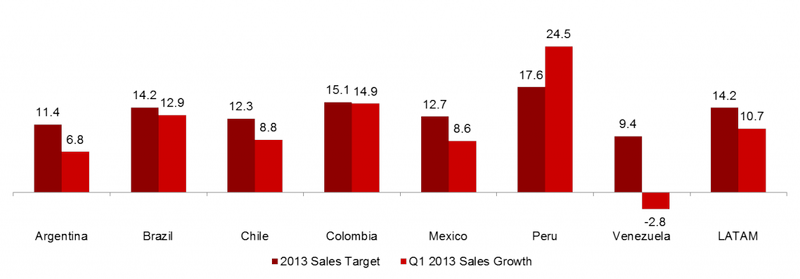
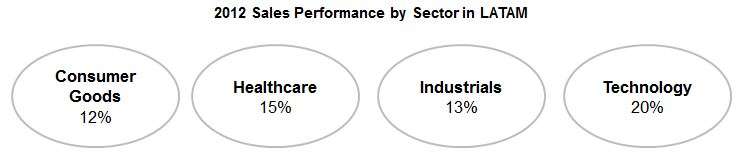
Compared to global averages, and even in comparison to other emerging market regions, Latin American growth remains, in the aggregate, relatively robust. Yet many industries in Latin America in 2012 either just met or underperformed expectations, and now with a persistent slowdown and protests in Brazil and crisis always on the horizon in Venezuela and Argentina, skeptics are growing louder, forcing executives to justify further investments in the region. Furthermore, FSG’s data indicates that slow growth in Argentina, a weak Q1 in Mexico, and the devaluation in Venezuela threaten goal attainment of sales targets in 2013 as well.

2013 Performance Targets in Key LATAM Markets

2012 Sales Performance by Sector in LATAM

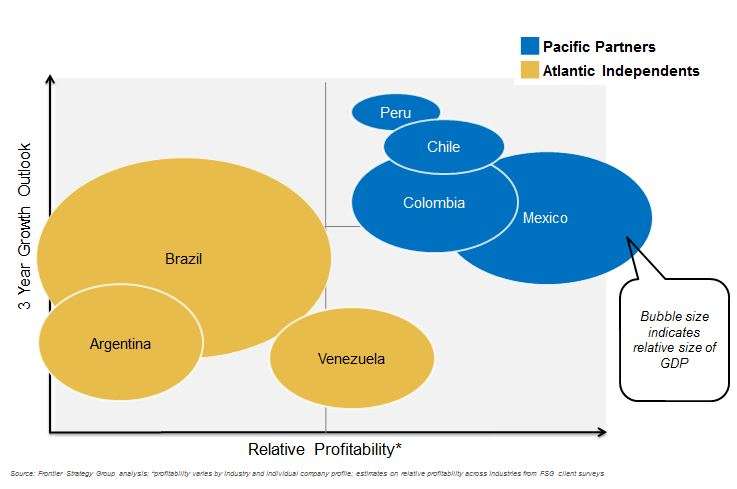
Latin America Splitting into Two Distinct Groups: Pacific and Atlantic
The dynamic Pacific economies are integrating rapidly, as evidenced by the creation of the Pacific Alliance trade group, creating new trade dynamics and opportunities for increasing scale and reorienting supply chains. In contrast, the Atlantic economies are increasingly insular and crisis prone, a trend typified by the increasingly dysfunctional Mercosur customs union. These distinctions are growing and becoming more tangible as companies position to mitigate risk from reliance on Mercosur and maneuver to gain from new opportunities presented by the Pacific Alliance.

The “Grow-fast, Worry about Profitability Later” Days are Coming to an End
Many executives perceive a strong shift in corporate mandates for Latin American business units towards bottom line results, rather than purely on top line growth. This shift is changing the way executives prioritize markets, evaluate organizational structures, measure and orient workforces, and make the case for resources.

New Blueprints for Success
As both internal corporate and external dynamics have changed, senior executives are drawing up new blue-prints for success by examining existing assumptions around optimal organizational footprints and structures and by prioritizing markets and communicate opportunity based new criteria such as relative profitability and operating margins.

3 Year Growth Outlook v Relative Profitability

Conclusion
FSG’s LATAM Regional Overview expands on these trends and shares analysis of client survey responses on how they are responding to these shifts. FSG believes that despite increasing volatility and growing macroeconomic and political risks, Latin America continues to offer excellent opportunities and high returns relative to other regions. That said, today’s business environment already is significantly different from that of just a year or two ago, and regionally-focused executives are wise to recognize that their strategies must evolve in tandem.

Latin America’s Moment: Making the Case and Capturing Opportunity

Making the Case for Latin America Has Historically Revolved around the Region’s Untapped Growth Potential

Making the case for resources has long been a challenge for emerging markets executives—while emerging markets represent tremendous growth opportunities, they have historically been viewed as risky, volatile, and fragmented, undermining corporate willingness to commit large amounts of resources. On a regional level, many of the Latin America executives we work with have expressed frustration at having to defend the region’s potential when top-line growth has been higher elsewhere in the world, particularly in Asia.

At Frontier Strategy Group, we have long strived to help our clients overcome such skepticism and communicate upwards effectively by emphasizing the region’s hard-won macroeconomic stability, relatively under-penetrated markets, and growing middle class. While these drivers remain in place and multinationals’ growth targets for Latin America are now on par with those seen in Asia, sluggish global growth has raised the stakes, and emerging markets are increasingly expected to deliver both top- and bottom-line growth.

However, Sluggish Global Growth & Underperformance in 2012 Have Undermined Confidence in Latin America

In the wake of Venezuela’s recent devaluation and the death of President Hugo Chávez, as Argentina continues to impose heterodox capital and import controls and Brazil edges towards stagflation, it is easy to understand why multinational executives face growing skepticism from risk-averse corporate centers as they strive to make the case for resources in Latin America.

Fortunately, Executives Compelled to Reassess the Region’s Potential Can Walk Away Reassured

While we certainly acknowledge the endogenous and exogenous factors undermining Latin America’s near-term outlook, we remain bullish about the region’s potential over the medium-to-long term, and our optimism is grounded in a demonstrable belief that the region’s core advantages have in fact remained intact, and will be reinforced by positive secular trends.

Not Only Do Latin America’s Core Advantages Remain Intact…

Latin America’s core advantages can be divided into four buckets, including profitability, relative growth, stability, and concentrated financial resources. Of these four advantages, profitability stands out as the most salient given the pivot to profitability that emerging markets executives are experiencing. As growth remains stalled in developed economies and corporate places increasing pressure on emerging markets, 73% of FSG clients in Latin America have experienced or expect to experience a shift in corporate emphasis towards bottom-line growth over the near-term. With this in mind, it is certainly reassuring to consider that available data on publicly traded companies indicate that average operating margins in Latin America are 55% higher than in the BRICs excluding Brazil.

At present, Latin America derives its profitability advantage vis-à-vis other emerging market regions primarily from a host of demand-side factors which allow multinationals to sell at higher margins and maximize the gains associated with realizing economies of scale. However, these advantages have the potential to diminish over time as competition within the region increases, meaning the time to build market share and brand loyalty is now.

When it comes to GDP growth, while the pace of growth in other emerging markets is expected to decelerate in comparison with pre-crisis rates, LATAM has remained relatively resilient and will accelerate in the coming years.

If you’re tempted to dismiss growth and profitability out of fear of resurgent instability, think again. More conservative corporate centers have historically associated Latin America with hyperinflation, uneven growth, and overexposure to commodity boom-and-bust cycles. Part of the story we’re striving to help our clients communicate is that while these sorts of risks persist in specific markets, the region as a whole has progressed tremendously thanks to orthodox macroeconomic reforms.

Inflation targeting regimes, reduced deficit spending, and the liberalization of trade and capital flows have brought down inflation, empowered consumers and provided the stability necessary for sustained growth. Latin America also remains well-positioned to ride out any future global downturn, as its economy is less dependent on trade than APAC, and less integrated into the global financial system, reducing the risk of Eurozone contagion. Concentrated financial resources also bode well for B2C and B2B multinationals—per capita private consumption spending and government expenditure in LATAM outpace other EM markets including India and EMEA, and are on par with China.

But investment and reform are positioning the region to build on these strengths moving forwards, unlocking new opportunities for multinationals:

Most importantly, Latin America is well-positioned to build on these core advantages, and secular trends are already yielding proof points. Trends we’re tracking range from Peña Nieto’s ambitious reform agenda and the resurgence of manufacturing in Mexico to Colombia’s peace dividend and Peru’s rapid rise. On a pan-regional level, energy resources will bolster government coffers and empower investment in infrastructure and human capital, while the rise of the Pacific Alliance will provide a decidedly pro-business counterweight to the increasingly anachronistic Mercosur. The region is on the rise, and there has never been a better moment to make—and win—the case.