
 YouTube
The Impact of the Pacific Alliance and Regional Integration for Multinationals: Interview with FSG Expert Advisor Barbara Kotschwar
Although it is only one year old, the Pacific Alliance is one of “the most exciting things going on today in Latin America,” as Chile’s Finance Minister Felipe Larraín put it. The trade bloc links Colombia, Chile, Peru, Mexico, and, most recently, Costa Rica. Unlike Mercosur, which has become increasingly protectionist, the Alliance represents a coalition of open markets that boast Pacific coastlines and are increasingly open to trade with thriving Asian economies. In this context, senior executives in LATAM are curious to learn how evolving regional trade dynamics will impact business in the region. I recently had the opportunity to sit down with FSG Expert Advisor and research associate at the Peterson Institute for International Economics, Barbara Kotschwar, to get her take on the Alliance’s progress and potential impact.
Regional Dynamics
The aim of the Alliance is to further integrate member countries’ economies, harmonize existing trade regulations, increase trade opportunities with Asia, facilitate the movement of goods, services, capital and labor, and integrate financial markets.
Goods: Liberalization of 91.8% of goods with the remaining 8.2% to be phased out within the next 7-15 years
Services: Current Pacific Alliance members participate in the International Service Agreement (ISA) negotiations
People: Visa elimination for nationals of other Pacific Alliance countries
Financial: Integration of financial markets (MILA)
Given the particular challenge of recruiting and retaining skilled workers in the region, companies are betting on the Pacific Alliance, as tertiary education initiatives and free movement of labor could relieve tight labor markets, particularly in Colombia and Peru. With a view to generating more entrepreneurship, particularly among youth, the Pacific Alliance has also agreed to create a joint scholarship fund that would allow students to study in any member country in areas that are critical for improving competitiveness. Similarly, country members have agreed to eliminate visas to the nationals of each country to move freely in the region, although at present this remains limited to tourists. Dr. Kotschwar believes, however, that if the Alliance proceeds with the same momentum as it has had and achieves the objectives it has put down on paper, the potential for movement of labor seems to be the most logical next step.
Orientation towards Asia
One of the significant characteristics of the Pacific Alliance is to serve as an institutional bridge between Latin America and the Asia-Pacific. The effort to deepen economic ties with Asia bodes well given that a number of the Alliance members already have free trade agreements with several Asia-Pacific countries, including China, Japan, and South Korea. In the past, other blocs in Latin America, such as the Andean community, were also established as a base to increase scale and bolster regional value chains and domestic production. However, they failed due to exclusively promoting trade among members and insulating themselves with high tariff barriers.
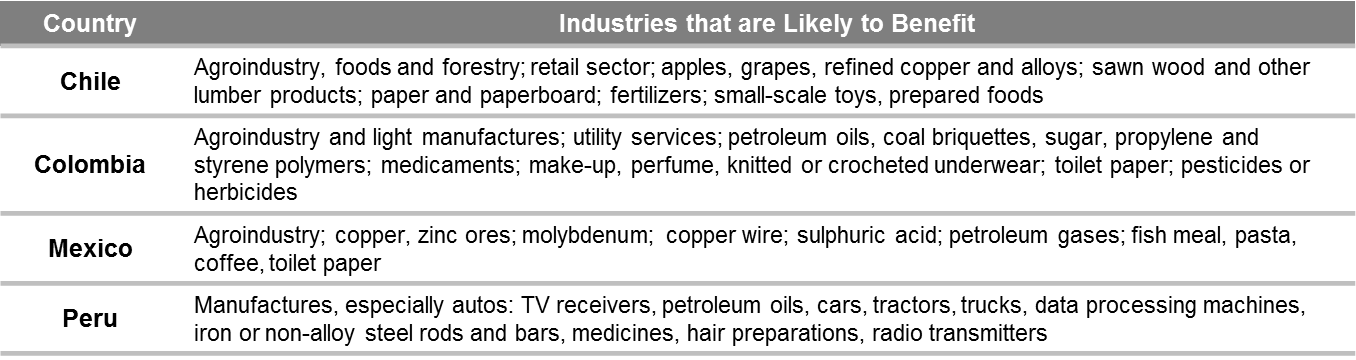
Under the Pacific Alliance, increased competition from Asia will allow multinationals in Latin America an opportunity to integrate their supply chains. However, LATAM senior executives grow wary as trade opportunities with Asia may drive down margins and market share. In order to mitigate risk, this is where the PA governments should encourage the private sector to lead the agenda. Studies discussed by Dr. Kotschwar indicate that other initiatives unfolding in the region, namely the Trans-Pacific Partnership, could bring income gains by 2025 of: $1.8 billion for Chile, $16.4 billion for Mexico and $3.3 billion for Peru.
Signposts to Monitor
The main barrier to effective implementation of the Pacific Alliance is if countries do not take the tough steps to upgrade infrastructure, streamline customs and administrative procedures, and invest in education to make the region a sound trade and investment hub. This will be more difficult in a climate of slowed growth, but reasons for optimism include the commitment and political will member countries have demonstrated thus far. Another obstacle is if the bloc allows itself to become a victim of its own success and allows too many countries to accede. New countries may be less prepared or committed than the original four. Allowing such growth could render the bloc yet another regional talk shop.
While challenges are still ahead of us, the Pacific Alliance has proved to be a brilliant piece of diplomatic effort. Now it is time to add substance. South America has largely benefited from the region’s great commodity boom, however, economic growth in the future will come mainly from productivity, investment, and efficiency—all pillars of focus of the Pacific Alliance.
_________________________________________________________________
 Barbara Kotschwar has been a research associate at the Peterson Institute for International Economics since 2007. Her research focuses on trade, investment, and regional integration. Recent projects include comparative analyses of Latin American experiences with free trade agreements, Chinese foreign direct investment (FDI) in Latin America, an assessment of Mexico’s economy, and studies on commercial relations between the United States and Middle East and North Africa (MENA) partners. Kotschwar is also adjunct professor of Latin American studies and economics at Georgetown University, where she has taught courses on political economy and trade and integration in the Americas since 1998.
Before joining the Institute, she was chief of the Foreign Trade Information System at the Organization of American States, where she also provided technical and analytical support to the Free Trade Area of the Americas (FTAA) process in the area of standards and technical barriers to trade in her capacity as senior trade specialist. She has advised Latin American and Caribbean governments on trade-related issues and has worked with multilateral and regional development banks on a variety of trade and development projects.


