About Clinton Carter

Clinton Carter is Associate Vice-President of Research and Product Development for Latin America at FSG. Previously, Clinton was FSG’s Director of Market Intelligence, focused on qualitative research and business strategy across emerging markets. Prior to joining FSG, he was an investment and economic development consultant in the Middle East and Central Asia. Clinton also worked as an analyst for the US Department of State and served as a fellow at the Brazilian Institute of Education in Sustainable Development in São Paulo, Brazil.

Clinton speaks Spanish and Portuguese. He attended Washington and Lee University and La Universidad Autónoma de Guadalajara, Mexico and holds a M.A. in International Relations and Economics from Johns Hopkins University – SAIS.

Find more about me on:

Recent Posts

Tomorrow’s Latin America Won’t be Won with Yesterday’s Playbook

Frontier Strategy Group is witnessing a dizzying array of changes to the business landscape in Latin America. Some are highly visible shifts in the external political and economic conditions in key markets such as Brazil, Mexico, and Venezuela, to name a few, while others involve subtle evolutions in internal corporate mandates for Latin American business units of multinational corporations. For this reason, FSG recently released a new Regional Overview of the factors influencing the results of our clients as well as emerging trends likely to impact performance and shape strategy for the coming years. The research is drawn from extensive interviews with senior executives at leading multinationals, independent experts, and analysis of surveys of FSG’s client base. Below are featured trends from the report, accessible to FSG clients:

Economic Performance is Strong, but Risk - and Skepticism - is Growing
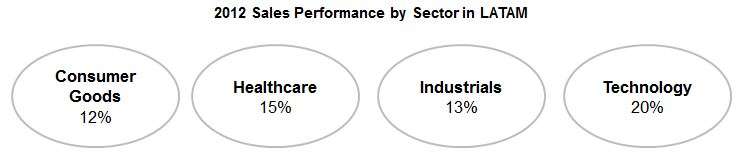
Compared to global averages, and even in comparison to other emerging market regions, Latin American growth remains, in the aggregate, relatively robust. Yet many industries in Latin America in 2012 either just met or underperformed expectations, and now with a persistent slowdown and protests in Brazil and crisis always on the horizon in Venezuela and Argentina, skeptics are growing louder, forcing executives to justify further investments in the region. Furthermore, FSG’s data indicates that slow growth in Argentina, a weak Q1 in Mexico, and the devaluation in Venezuela threaten goal attainment of sales targets in 2013 as well.
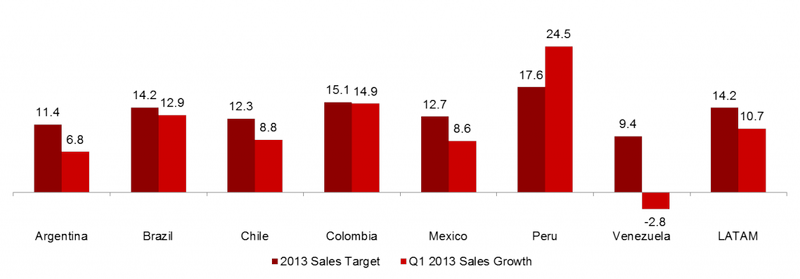
2013 Performance Targets in Key LATAM Markets

2012 Sales Performance by Sector in LATAM

Latin America Splitting into Two Distinct Groups: Pacific and Atlantic
The dynamic Pacific economies are integrating rapidly, as evidenced by the creation of the Pacific Alliance trade group, creating new trade dynamics and opportunities for increasing scale and reorienting supply chains. In contrast, the Atlantic economies are increasingly insular and crisis prone, a trend typified by the increasingly dysfunctional Mercosur customs union. These distinctions are growing and becoming more tangible as companies position to mitigate risk from reliance on Mercosur and maneuver to gain from new opportunities presented by the Pacific Alliance.

The “Grow-fast, Worry about Profitability Later” Days are Coming to an End
Many executives perceive a strong shift in corporate mandates for Latin American business units towards bottom line results, rather than purely on top line growth. This shift is changing the way executives prioritize markets, evaluate organizational structures, measure and orient workforces, and make the case for resources.

New Blueprints for Success
As both internal corporate and external dynamics have changed, senior executives are drawing up new blue-prints for success by examining existing assumptions around optimal organizational footprints and structures and by prioritizing markets and communicate opportunity based new criteria such as relative profitability and operating margins.
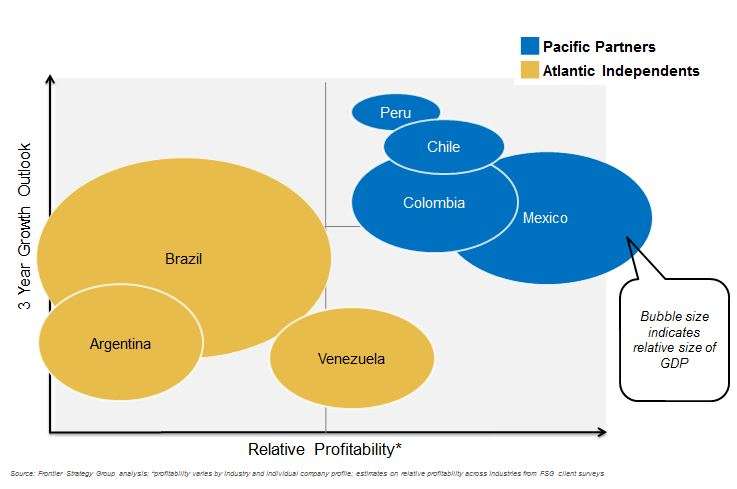
3 Year Growth Outlook v Relative Profitability

Conclusion
FSG’s LATAM Regional Overview expands on these trends and shares analysis of client survey responses on how they are responding to these shifts. FSG believes that despite increasing volatility and growing macroeconomic and political risks, Latin America continues to offer excellent opportunities and high returns relative to other regions. That said, today’s business environment already is significantly different from that of just a year or two ago, and regionally-focused executives are wise to recognize that their strategies must evolve in tandem.
The Bloom is Off the Rousseff

Today marks the seventh day of demonstrations in São Paulo; demonstrations that started as small protests expressing frustration with bus fare increases in the city but have now spread to major cities throughout the country. The protests have captured the imagination of the population and the media and have proven both resilient and spontaneous.

Frontier Strategy Group’s Latin American research team and expert advisory network are following the evolution of the demonstrations and would like to offer our clients analysis on how these developments have altered our FSG View on Brazil and how the events could impact our clients’ businesses.

FSG View on Brazil’s Economic Outlook:

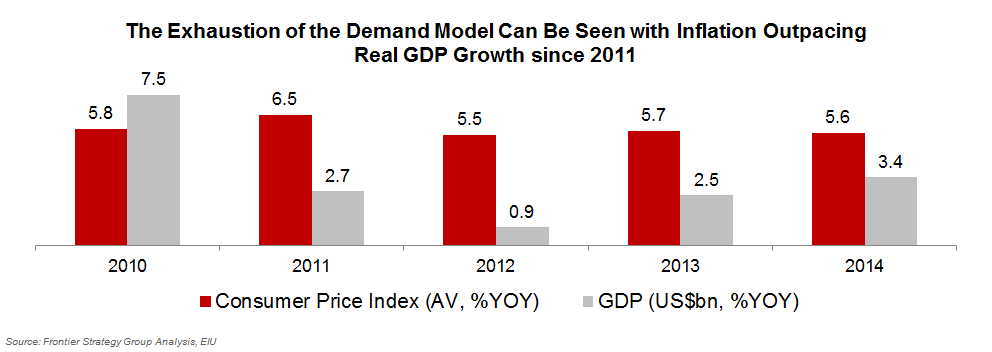
FSG’s recently released Regional Overview for Latin America expresses our view that Brazil’s macroeconomic slowdown and generally weak business performance of the last year is due to the exhaustion of the demand-driven economic model popularized by the Lula government and employed by the current Dilma Rousseff government (see graph below).

  • We caution our clients that even though this economic model is less and less effective at generating broad GDP growth, it is still effective at maintaining wage growth and high employment. Positive real wage growth and low unemployment are great news for Dilma, and until very recently her approval ratings were the highest of almost any head of state in the world.
  • Our view is that low unemployment and positive wage growth should translate to a good chance of reelection in 2014, therefore little incentive for the current government to make politically painful changes to the demand-driven growth model in the short term.
  • Therefore, we caution our clients to be prepared for a low-growth environment and little progress on needed reforms that would spur growth through higher productivity and a lower cost structure until at least 2014.

The Exhaustion of the Demand Model

    What Prompted the Protests?

    Clearly not all of Brazil’s population is as pleased and complacent as Dilma’s recent approval ratings suggested. The protests, broadly, are a stunning manifestation of a social trend that has accompanied Brazil’s transition to a middle-class country; the demands the middle class makes of government are different from the demands the poor make. As 40 million Brazilians enter the middle class and become both consumers of government services and tax payers, their priorities and demands become more sophisticated. This is a dynamic FSG has been tracking for some time, not just in Brazil, but also in Colombia, Russia, Turkey, and many other emerging markets as this trend will have profound impact on governments’ spending priorities.

    • The initial protests were over not just the price of bus fare, but the quality of service as well; essentially a question of value for money. Likewise, the subsequent demonstrations have focused on government priorities, transparency, and efficiency. No one can argue that Brazil does not devote considerable resources to social programs and alleviating poverty. Rather, the demands are for more accountability, greater efficiency, and prioritization of public investment in higher quality education and health; again, a question of value for money.

    How has the Outlook Changed?

    Short Term:

    • Multinationals in the consumer space can expect some disruption in sales, as consumers stay home and foot traffic slows in major urban areas.
    • Some businesses may experience work stoppages in the form of sympathy strikes, absenteeism, or shuttering of stores.
    • Investor confidence, already sour on Brazil, will weaken, and the Brazilian real will remain at several-year lows, though the Central Bank will maintain a floor on the value of the currency to guard against excess volatility.
    • Latin America and Brazil-focused executives will face tough questions on the sustainability of Brazil’s growth from increasingly skeptical corporate boards and headquarters. Negative headlines can have immediate impact on corporate sentiment towards an emerging market.

    Medium Term:

    • President Dilma Rousseff still has good cards to play. She is still fairly popular, her opposition is fragmented and currently lacking much leadership, and she has considerable government resources at her disposal.
      • Furthermore, while some protest language has focused on her, she has not been an explicit target of the protests. Dilma may yet succeed in harnessing some of the protest’s energy and present herself as sympathetic and aligned with the protester’s aims. That said, there is always a chance skillful opposition politician could channel the protests into electoral popularity. Yet, though the demonstrations add an element of unpredictability into next year’s elections forecast, Dilma is still in a relatively strong position.
      • Interest rates are likely to continue to rise, as inflation concerns and the political implications of inflation has the Central Bank and the government spooked.
      • Further targeted tax cuts and credit incentives to try to stimulate demand. These are increasingly ineffective measures economically, but still prove popular with potential voters.
      • Suspension of subsidy roll backs are likely. Planned hikes in gasoline prices and proposed cuts to public subsidies are likely to be delayed. This is harmful for Brazil’s fiscal position, but will keep more spending cash in the pockets of consumers.

    Long Term:

    • The government of Brazil will shift priorities over time. The new priorities will be improving quality and sophistication of services, rather than simply expanding access. This has profound implications for firms selling goods and services in terms of the value proposition likely to be most of interest to federal, state, and local government.
    • There are potentially positive long-term benefits to the protests. Principal among them is greater accountability of government in general.
      • Similarly, greater efficiency is not just a demand, but a fiscal necessity. Brazil has deep pockets, but with citizens and corporations balking at the cost of public services, the government will be asked to do more with less. This may encourage reforms in the models employed to provide services to the public. Expect an accelerated move toward public-private partnerships and greater use of concessions in public projects.
      • Transparency will improve. Brazil has already made some inroads in prosecuting public corruption, but the demonstrations will embolden media and watchdog groups to push for greater transparency and accountability.

    In Conclusion:

    The slow death of Brazil’s demand driven growth model is coinciding with the growing assertiveness of the middle class. The government has been very slow to respond to either phenomenon. The short term chaos of the protests will disrupt some economic activity, while the mid-term economic doldrums will continue. The political picture becomes more volatile, yet Dilma is still in a relatively strong position and is unlikely to try to upset her political coalition or potential voters with radical reforms that won’t bear immediate fruit. Long-term, a political awakening could increase accountability and efficiency of government.

    As a long term investment opportunity, FSG remains optimistic and convinced of the attractiveness of Brazil’s fundamentals. The case for continued prioritization of investment in the market, however, becomes more difficult with each day of negative headlines. For this reason, FSG is releasing a new “Making the Case for Brazil” report and presentation materials at the end of June. The materials are designed to help senior executives focus stakeholders on long term opportunities in the market and reaffirm the underlying potential of Brazil’s future.


    US-Colombia FTA Stumbles Out of the Gate, But Trade is a Marathon, not a Sprint: Highlights from FSG’s Bogota Interview with Expert Advisor Juan David Barbosa

    Despite general optimism at the opportunities provided by the new US-Colombia Free Trade Agreement, FSG clients have reported unwelcome delays and roadblocks in efforts to take advantage of the agreement, as noted in our recent Quarterly Market Review of Colombia.

    On a recent visit to Colombia, I sat down with FSG Expert Advisor Juan David Barbosa to discuss the first 9 months of implementation of the accord. Juan David specializes in trade law at the Bogota law firm of Posse, Herrera, and Ruiz, and previously served as the Deputy Director of Trade Remedies at the Ministry of Commerce of Colombia. Juan David has advised numerous multinationals on trade and market entry in Colombia, and was the featured expert in last year’s FSG teleconference on the new agreement.

    The Promise

    According to Juan David, the FTA’s would change the landscape for FSG clients, particularly those based in the United States or importing products to Colombia from the United States in the following ways:

    • Import tariffs on 80% of U.S. exports to Colombia would drop to zero, including strategic industries such as agriculture, construction, auto and aviation parts, medical products, and IT.
    • Legal and regulatory hurdles would fall as companies no longer needed local branches, suppliers were afforded more protection, and new rules made it easier to exit agreements with local companies.
    • Many of the key provisions of the agreement would enter into force between September of 2012 and March of 2013.

    Because of these sweeping changes, 90% of FSG clients expected the FTA to be a factor in increased investment for their companies in Colombia, and 54% of FSG’s expert advisors said the FTA would provide significant advantage for US companies over competitors from other countries without such an agreement.

    The Problem

    According to Juan David, and in line with recent experiences of FSG clients, Colombia is lagging in implementation of a number of key provisions:

    • Intellectual property rights protections
    • Increased safeguards in agency agreements for multinationals
    • New rules on taxes of alcoholic drinks
    • Electronic certification of origin
    • Rules on urgent shipping requests
    • Implementation of sanitation codes equivalent to the United States

    Accordingly, multinationals expecting the FTA to be a panacea for bureaucratic and logistical headaches are growing frustrated with delays of their products at customs and an unclear regulatory and compliance environment.

    The Causes:

    • Bureaucratic Entropy:
      • The root of the problem, says Barbosa, is not with laws and regulations now on the books, but rather with the capacity and will of the institutions charged with enforcing and acting under them. Comprehension and processes to enact the new rules is lagging the actual implementation timelines. In short, Colombia’s bureaucracy has not kept pace with the rapid evolution in the rules of the game.
      • Infrastructure Constraints:
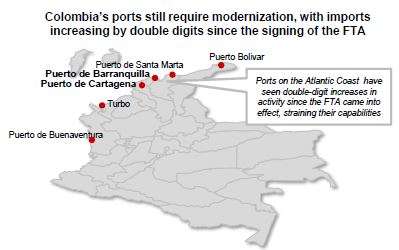
        • Likewise, the boom in trade with Colombia has created a parallel capacity constraint in logistics infrastructure. Ports and roads are clogged with an influx of goods. Construction and investment, while significant, has yet to catch up with the expansion in trade (see map below).
        • Protectionist Backlash:
          • Also concerning are recent import tariff hikes slapped on certain sectors of imported goods such as garments, textiles, footwear, agricultural goods, paper products, and some used machinery. While these don’t necessarily violate existing FTAs, they are indicative of political pushback from domestic manufactures threatened by the growth in imports. New free trade agreements, which have come into effect at the same time as a strong appreciation of the Colombia peso, have led to politically powerful domestic producers seeking relief in the form of protection and safeguards from the government.

    Colombia port map

    The Outlook

    The good news is that the Colombian government has recognized that it may have bitten off more than it can currently chew in regards to implementing multiple trade agreements over a short amount of time with limited bureaucratic resources. In response, the government has spaced out the implementation processes of current and upcoming agreements and will promulgate new guidelines by mid-May, 2013. This may buy U.S. based companies more time with a head start in Colombia as upcoming FTAs between Colombia and the EU and South Korean could take longer than anticipated to come into full effect.

    Less promising is the outlook for short term improvements in infrastructure bottlenecks. Though the government is currently investing heavily in construction of fixed infrastructure assets, project cycles are long and payoff takes years. Even here, the pace of investment has been hampered by bureaucratic constraints, as the second half of 2012 saw construction spending stumble because of poor project planning and lack of capacity to execute on the ambitious agenda.

    Fears of a broader protectionist backlash are probably overblown. Colombia has a strong political orientation towards free trade, and is eager to establish itself as one of Latin America’s most open economies. All politics are local, however, and local producers have shown they have the power to win temporary measures to shield themselves from competition in certain cases. Multinationals, no matter the industry or the country of origin, would be wise to monitor the local political winds to anticipate if their products could be on the wrong side of a tariff.

    The Big Picture

    Despite these early difficulties, Juan David remains optimistic; “The FTA will mature and offer excellent opportunities for U.S. corporations. Both for more established multinationals and newer entrants, Colombia remains an excellent investment destination. In fact, Colombia is an increasingly attractive place for U.S. companies to open their first emerging markets operation. For now, however, the FTA is less than a year old. It is still a newborn baby and has a lot of growing up to do”, stresses Juan David.

    ___________________________________________________________________________________________________

    Juan David BarbosaJuan David has more than 10 years of experience in customs and international trade proceedings and litigation, as well as in the development of import-export tax efficient strategies. Juan David has also worked in several international unfair trade practices (dumping) and safeguard investigations, as well as in the negotiation and implementation of free trade agreements. Before joining Posse Herrera & Ruiz, he worked in the Colombian Government as Deputy Director of Trade Remedies at the Ministry of Commerce, Industry and Tourism where he was responsible for all anti-dumping and safeguard investigations. He has a JD and a graduate degree in Taxation from Pontificia Universidad Javeriana and an LL.M. in International Business and Economic Law from Georgetown University.


    Argentina Consumer Crisis Redux: Lessons from History to Inform Investment Today

    Argentina Consumer

    While Argentina may be doomed to ignore the lessons of history and again plunge into recession or even economic free fall, investors are not obliged to follow blindly. For investors focused on the consumer products segment, previous crises offer ample clues to how consumers may behave in future crisis. Understanding these clues will be critical to crafting an effective strategy for mitigating risk and capturing opportunity in the consumer space should Argentina again march over the precipice.

    Frontier Strategy Group works primarily with large multinationals operating and expanding in emerging markets. In an effort to inform strategy for clients with exposure to the consumer segment in Argentina, Frontier Strategy Group shared insights gleaned from experts and leading executives who weathered the past two crises in the country, namely the hyperinflation of the 1980s and the 2001 debt default and ensuing chaos. While the macroeconomic imbalances that precipitated those crises are different than those driving the country towards recession now, the conditions they produced for the average Argentine consumer could be similar: loss of purchasing power, evaporation of savings, inflation, shortages of goods, and unemployment.

    Faced with these conditions in past crises, Argentine consumers responded with dramatic purchasing changes, as well as lifestyle alterations, and increased reliance on community. Practically speaking, this meant consumers reduced consumption of food and non-food consumer staples, substituted regular brands for cheaper alternatives, switched to cheaper transportation options, and were forced to prioritize between food and non-food consumer staples and other essentials such as medicines. Some significant lifestyle observed were consumers moving back from big cities to rural areas, home production of food, selling belongings, living off savings, and sharing housing and resources with many more members of family and community.

    To continuing reading the full version, click here

    Rising Trends for Q3 in Mexico

    Mexico stepped into the spotlight in Q3 of 2012 as multinational executives began to shift their operations and increase their investments into Mexico. Reignited interest into Mexico has been largely driven by higher labor costs in China and expectations that the presidential-elect and business friendly Enrique Peña Nieto will implement structural reforms aimed at boosting long-term economic growth. A common trend in Q3 was the growing interest for companies pursuing SME customers as larger client markets became increasingly saturated. However, limited financing opportunities for SMEs is preventing multinationals from achieving additional growth. SME lending is mainly restricted by three main inhibitors: weak regulatory systems, poorly trained state development funds unable to assess credit risk, and overwhelming control of the banking sector by large foreign commercial banks in Mexico.

    Multinationals may consider applying a best practices approach to SME financing. Sun Microsystems applies a credit assessment technique in another emerging market by using a quantitative and qualitative approach in order to determine credit worthiness for a potential SME client. In an attempt to assuage the multinational and lender concerns for SME financing, the Mexican government is considering an institutional reform creating a centralized development bank that will function as a main source of financing for underserved markets in Mexico. Public-private partnerships have served as an approach by commercial lenders to expand their portfolios to include SMEs as lenders provide credit lines to SMEs by partnering with a government agency that provides loan guarantees.

    Antonio Martinez and Erick Soto contributed to this piece


    Multinationals Reevaluating Growth Targets in Latin America

    Weaker regional growth in the first half of the year has driven multinationals to reevaluate their growth targets for 2012 as Argentina’s business landscape grows increasingly unnerving, Brazil’s economy slows, and devaluation risks in Venezuela swell as President Chavez drives up fiscal spending as part of his reelection campaign. However, many regional executives are looking towards new opportunities in Mexico as higher labor costs in China and election of business friendly Enrique Peña Nieto leads executives to believe the new administration will be able to implement structural reforms aimed at boosting higher and sustainable long-term economic growth. Meanwhile, many multinationals are undeterred by the weaker first half growth as they continue to invest in Brazil, hoping that government stimulus measures to revive consumer spending and industrial production in Brazil in the second half of 2012.

    Argentina: Multinationals are dealing with an increasingly dire business environment by decreasing investments and lowering growth expectations

    Brazil: Foreign investors shake off short-term woes as some multinationals position themselves for the long-term rewards that Brazil offers

    Chile: The forecast is upbeat as production, consumption, and high consumer sentiment all point to a favorable economic outlook for 2012

    Colombia: Colombia’s economy will continue to be a growth leader in 2012, but sluggish retail and falling industrial production dim its prospects

    Mexico: Multinationals remain bullish on Mexico’s growth prospects as a new administration offers hope for necessary structural reforms

    Venezuela: Multinationals remain cautious as ballooning fiscal spending contributes to rising currency devaluation risks for the beginning of 2013

    Antonio Martinez and Erick Soto contributed to this piece.

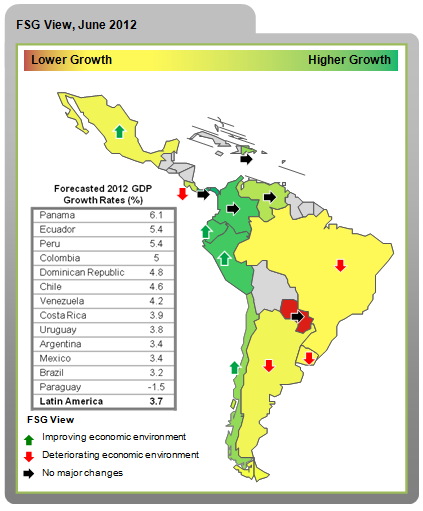
    Latin America - Emerging Markets Insights - June 2012


    LATAM

    Multinationals are taking note of the strength of the Andean economies of Colombia and Peru, but the increasingly negative outlook in Argentina and Brazil is weighing down growth in the region. Stagnating industrial output and diminishing consumer demand in Brazil led economists to trim economic growth expectations to less than 3% for 2012. The race for the Mexican presidency heats up as PRI candidate Enrique Peña Nieto maintains a steady lead heading into the July election. Meanwhile, the race for Venezuela’s presidency in October is underway contributing to market uncertainty as president Chavez registers to run for a third term despite his poor health.

    For a more detailed insight on key trends in Latin America, here are the analyst headlines for our key markets:

    • Argentina:A thriving black market for dollars and widespread withdrawals from local banks signal a growing belief that boom times are over
    • Brazil: Multinationals are facing increasing headwinds as the effectiveness of government stimulus falls short of expectations and credit markets soften
    • Chile: Higher-than-expected export growth is keeping Chile’s economy buoyant, but protests continue to mar President Piñera’s government
    • Colombia:Colombia’s potential is no longer a secret, but popularity brings a pricey peso that is eroding competitiveness
    • Mexico: Multinationals look to Mexico as a safe haven to weather the European storm
    • Peru: Stellar performance is only somewhat dimmed by concern over tax reform increasing the cost of doing business in Peru
    • Venezuela: Oil-fueled spending is succeeding at supporting higher growth this year, but Chavez’s poor health is creating political uncertainty

    *Erick Soto contributed to this piece.

    Brazil: Consumer Fever – and Some Headache

    Brazil Flag

    Full article in Latin Trade

    ‘Custo Brasil’ alive and kicking

    Nevertheless, exploring the expanding Brazilian market still comes at a price, and the business environment has remained remarkably difficult, if not hostile.

    Brazil has fared badly in the World Bank’s annual “Doing Business” survey, putting the country at a disadvantage against its main competitors worldwide. The latest survey ranks Brazil 126th among 183 countries, including a dismal 150th in the “paying tax” category.

    CFOs in multinationals operating in Brazil usually express a lingering concern – if not frustration – regarding tax complexity and compliance issues in Brazil, which often is described as the most critical case in the region. Almir Barbassa, CFO of Petrobras, the oil company, notes that 900 people are employed in Petrobras’ tax department.

    Jorge Gerdau, chairman of Gerdau, the steel group, has complained that companies in Brazil typically need 2,000 hours to comply with their tax obligations. He is now part of a presidential steering group to improve management and try to cut bureaucracy, but executives still complain about the lack of tax and labor reforms. President Dilma Rousseff has pledged to cut the tax burden, but structural reforms are not on the agenda.

    Rogerio Menezes, CFO of Akzo Nobel Pulp & Paper, is very critical of what he calls “the tax monster”. He says there already have been more than 300,000 changes in the tax legislation, which results in high compliance costs. This is a drag on Brazil’s competitiveness as a whole. At present, each of Brasil’s 26 states and the Federal District of Brasilia has its own tax legislation and is able to tax the so-called ICMS (a sort of sales tax on goods and services) at different rates.

    “The cost of doing business in Brazil continues to climb, as Brazil has failed to address the principal elements of the ‘custo Brasil,’ such as poor infrastructure, an onerous regulatory burden, heavy taxation and non-compensation labor costs,” says Clinton Carter, head of research for Latin America at Frontier Strategy Group (FSG), a U.S. business advisory firm. “Add to this a scarcity of skilled labor that is pushing salaries through the roof, and the result is a ‘custo Brasil’ that is climbing.”

    The bottom line for foreign investors is that “Brazilian business units are less profitable than those in other Latin American countries,” says Ryan Brier, FSG’s Associate Practice Leader for Latin America.

    According to an FSG survey , “net margins in Brazil are 5.1 percent narrower, on average, than in the rest of Latin America, largely due to taxes.” Whereas the average corporate tax paid amounted to 48 percent of profits in Latin America, the figure reached 69 percent in Brazil, FSG says. Fast-moving consumer-goods companies are much more heavily taxed than those operating in other sectors, it says.


    Key Lessons from Walmart’s Corruption Probe in Mexico

    Executives in high-risk markets should use Walmart’s troubles in Mexico to educate corporate headquarters of the difficulties of achieving high growth targets while abiding by FCPA standards in emerging markets. While Walmex’s growth was seen as one of the major success stories in emerging markets retail, we now know that it was fueled by business practices that created significant legal and reputational risk for the company

    For those who have done significant business in Mexico, the bribery allegations should not come as a major surprise, nor that skirting FCPA compliance has become more difficult. Almost two-thirds of Frontier Strategy Group’s Latin America clients reported that achieving FCPA compliance has become more difficult over the past few years, with over 65% of our clients considering Mexico one of the most challenging markets in which to remain compliant, behind only Brazil and Venezuela. Locally empowered managers violating FCPA standards were the major force behind Walmart’s troubles, and FSG’s board of on-the-ground experts considers this kind of violation to be one of the most common ways multinationals run afoul of regulations in Latin America.

    FSG does not expect the situation to get better over the next few years, and companies need to prepare accordingly. Vigilance is necessary, and companies should create clear incentives and develop cultures supportive of ethics compliance and sanctions for violations, along with regular reporting of compliance practices in each business unit. However, this scandal represents an opportunity. It is particularly important for executives to communicate to corporate headquarters why growth targets must come with appropriate resources to understand and mitigate the accompanying risks, and this is best achieved by resourcing effectively government engagement efforts.

    *Antonio Martinez, Analyst - Latin America contributed to this piece

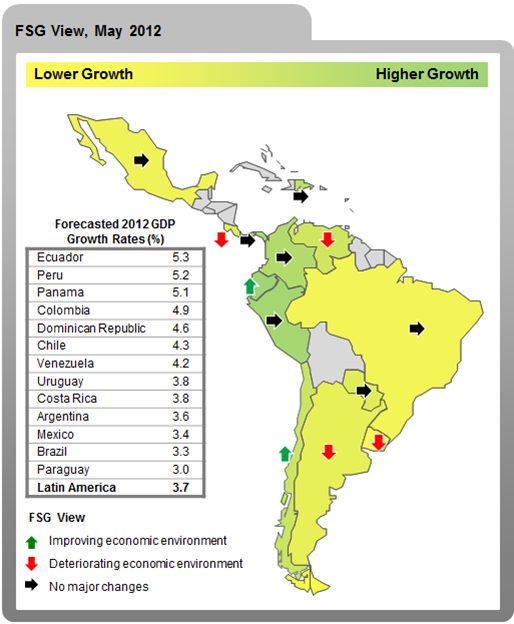
    May 2012 Latin America Outlook: Taking Global Volatility In Stride

    Frontier Strategy Group’s clients are revising growth forecasts for Latin America’s major economies upwards as the outlook for the global economy begins to stabilize. Growth leaders are emerging in the Andean region, and we expect that Chile, Colombia, and Peru will contend for the highest growth rate in Latin America in 2012. Strong fundamentals are keeping the Mexican economy remarkably stable while Brazil continues to miss the mark. Finally Argentina and Venezuela’s risk profile is increasing significantly, forcing MNCs to reconsider whether the potential rewards warrant the blood, sweat, and tears.

    For a more detailed insight on key trends in Latin America, here are the analyst headlines for our key markets:

    • Argentina: The nationalization of YPF has become the clearest indication of the Fernandez Administration’s hostility to investor concerns
    • Brazil: The Brazilian government remains committed to revitalizing the economy, but it has not yet had a discernible impact on industry
    • Chile: Strengthening domestic demand, higher copper prices and an improving international outlook point to continued strength for Chile’s economy
    • Colombia: Strong growth in an uncertain global environment is forcing Colombia to deal with an appreciating currency and rising wages
    • Mexico: Economic prospects appear to be stabilizing, but drug war violence sustains tension
    • Peru: Growing pains in spite of robust consumer spending
    • Venezuela: Chávez looks to foreign patronage to offset the deleterious effects of economic domination by decree

    *Melissa Pegus, Senior Analyst - Latin America contributed to this piece