Multinationals in Venezuela Should Prepare for a Slowdown in 2013

Post by, Antonio Martinez & Christine Herlihy

On October 7th, Venezuelan president Hugo Chávez was re-elected with 54% of the vote. While opposition candidate Henrique Capriles did manage to unite Venezuela’s historically fragmented opposition and garner a significant percentage of the vote, Chávez’s populist policies and mass-mobilization tactics ultimately allowed him to win a sizable victory. What this means in real terms is that Chávez and his macroeconomic tools of choice—namely, price controls, capital controls, expropriation, and populist social programs— will be around for another six years, barring health-related complications. As if bellicose rhetoric and a tendency to expropriate at will while belittling executives and political leaders alike on national television weren’t enough to look forward to, consider this: in addition to calling the election for Chávez, Frontier Strategy Group also expects significant currency devaluation sometime in early 2013 as well as a slowdown in government spending, with overwhelmingly negative implications for consumer spending.

This degree of pessimism may surprise many executives—after all, among FSG’s client base, especially among consumer goods companies, 2012 has been an extremely strong year in terms of revenue growth. However, the combination of government policies which have helped facilitate this success by bolstering consumer purchasing power through relatively low inflation, loose credit conditions, and robust government spending, are unsustainable over the medium-term. It is important to emphasize the extent to which the ‘health’ of the Venezuelan economy in 2012 has been driven by political, rather than macroeconomic fundamentals: not only is the current lending rate negative relative to inflation, but high levels of government spending are unsustainable given Venezuela’s growing debt burden and inability to capitalize on higher oil prices due to pre-existing oil-for-loans agreements with the Chinese.

Venezuela’s monetary policy has depleted foreign exchange reserves, and given that a large portion of the country’s outstanding loans come due in early 2013, FSG expects a devaluation of at least 32%, which will most likely take place after regional elections and the Christmas holidays, sometime between January and March 2013. Furthermore, as the spread between Venezuela’s official ‘non-essential’ exchange rate and the black market exchange rate continues to grow, there’s an increasing chance that the devaluation may be as high as 55-60%.

This devaluation will have a tremendously negative impact on consumer purchasing power, and CPG companies will be especially hard hit. Healthcare companies and luxury goods manufacturers are likely to continue bearing the brunt of price controls, and the risk of expropriation looms as large as ever. Of particular note—time is of the essence: multinationals have long struggled to access dollars and repatriate their profits in Venezuela, and these challenges will only increase in the wake of both an expected devaluation, and a government dealing with severe debt obligations. Multinationals need to plan ahead for a rocky 2013 in Venezuela.
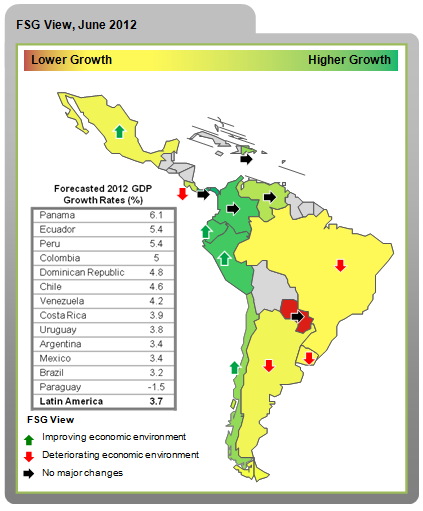
Latin America - Emerging Markets Insights - June 2012


LATAM

Multinationals are taking note of the strength of the Andean economies of Colombia and Peru, but the increasingly negative outlook in Argentina and Brazil is weighing down growth in the region. Stagnating industrial output and diminishing consumer demand in Brazil led economists to trim economic growth expectations to less than 3% for 2012. The race for the Mexican presidency heats up as PRI candidate Enrique Peña Nieto maintains a steady lead heading into the July election. Meanwhile, the race for Venezuela’s presidency in October is underway contributing to market uncertainty as president Chavez registers to run for a third term despite his poor health.

For a more detailed insight on key trends in Latin America, here are the analyst headlines for our key markets:

  • Argentina:A thriving black market for dollars and widespread withdrawals from local banks signal a growing belief that boom times are over
  • Brazil: Multinationals are facing increasing headwinds as the effectiveness of government stimulus falls short of expectations and credit markets soften
  • Chile: Higher-than-expected export growth is keeping Chile’s economy buoyant, but protests continue to mar President Piñera’s government
  • Colombia:Colombia’s potential is no longer a secret, but popularity brings a pricey peso that is eroding competitiveness
  • Mexico: Multinationals look to Mexico as a safe haven to weather the European storm
  • Peru: Stellar performance is only somewhat dimmed by concern over tax reform increasing the cost of doing business in Peru
  • Venezuela: Oil-fueled spending is succeeding at supporting higher growth this year, but Chavez’s poor health is creating political uncertainty

*Erick Soto contributed to this piece.

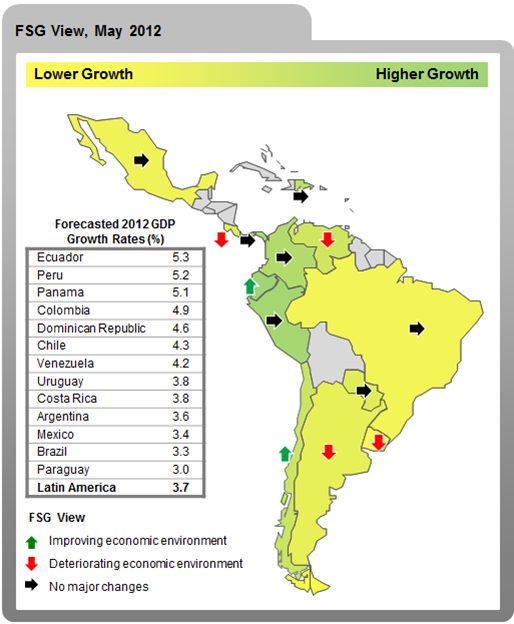
May 2012 Latin America Outlook: Taking Global Volatility In Stride

Frontier Strategy Group’s clients are revising growth forecasts for Latin America’s major economies upwards as the outlook for the global economy begins to stabilize. Growth leaders are emerging in the Andean region, and we expect that Chile, Colombia, and Peru will contend for the highest growth rate in Latin America in 2012. Strong fundamentals are keeping the Mexican economy remarkably stable while Brazil continues to miss the mark. Finally Argentina and Venezuela’s risk profile is increasing significantly, forcing MNCs to reconsider whether the potential rewards warrant the blood, sweat, and tears.

For a more detailed insight on key trends in Latin America, here are the analyst headlines for our key markets:

  • Argentina: The nationalization of YPF has become the clearest indication of the Fernandez Administration’s hostility to investor concerns
  • Brazil: The Brazilian government remains committed to revitalizing the economy, but it has not yet had a discernible impact on industry
  • Chile: Strengthening domestic demand, higher copper prices and an improving international outlook point to continued strength for Chile’s economy
  • Colombia: Strong growth in an uncertain global environment is forcing Colombia to deal with an appreciating currency and rising wages
  • Mexico: Economic prospects appear to be stabilizing, but drug war violence sustains tension
  • Peru: Growing pains in spite of robust consumer spending
  • Venezuela: Chávez looks to foreign patronage to offset the deleterious effects of economic domination by decree

*Melissa Pegus, Senior Analyst - Latin America contributed to this piece

Venezuela: A Tale of Potential and Peril

Venezuela presents a major challenge for MNCs who recognize the country’s market potential and high profit margins, but are troubled by the risks associated with any significant presence in the country. The upcoming elections in 2012 and recent concerns over Chavez’s health has renewed speculation over medium-term political and economic scenarios for Venezuela.

Advantages of Venezuela

Attractive demographics offer long-term prospects

  • 90% of Venezuelans live in cities and half of Venezuela’s 30 million people are under 25
  • GDP per capita is fifth highest in the region

Oil profits allow government to encourage domestic demand

  • Government maintains lending rate below inflation to encourage consumption

Business tax system is competitive with the region

  • Corporate and ordinary income tax rats are 34%
  • Attractive incentives such as non-taxable dividends for distribution of earnings and profit

Major Challenges

The operating environment is opaque and unpredictable

  • Little separation between executive, legislative, and judicial branches
  • Currency devaluation and expropriation are constant risks

Consumers behave differently than those in free market economies

  • Consumer spending is volatile as it is dictated by government spending policies
  • Price controls, inflation, and shortages alter consumer purchasing habits

Major structural challenges hinder growth prospects

  • Drought has led to shortages and rationing of electricity
  • Crime remains rampant, and a source of disillusionment with the Chavez regime
  • Oil production is rapidly declining