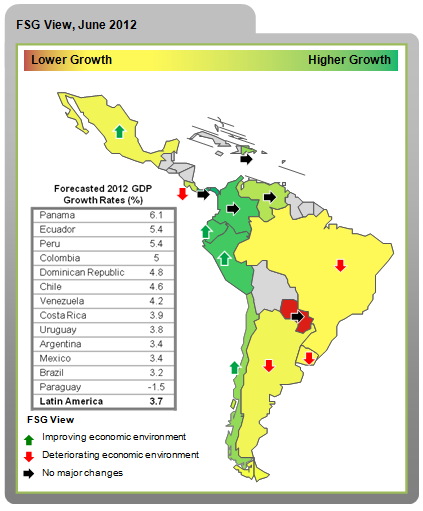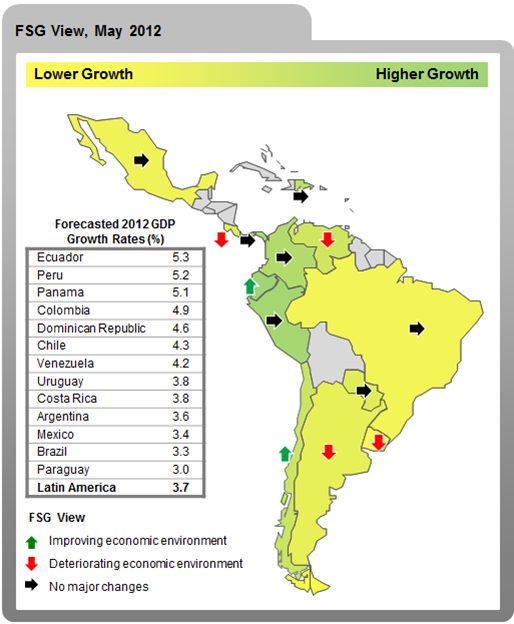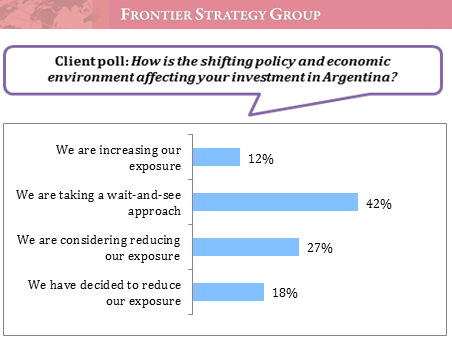
The recent imposition of additional trade restrictions coupled with economic policy uncertainties in Argentina continue to cast doubt onto the country’s economic outlook for 2012. Our clients and experts expect operational conditions to further deteriorate as surging government spending and minimal political opposition allows President Kirchner’s administration to continue on this volatile path. This volatility is leading many MNC executives to adopt a “wait-and-see” approach when conducting operations in Argentina. Indeed, 57% of FSG advisors reported being concerned about economic stability in Argentina, while 59% of clients believe in a likely economic crisis within the next 18 months.
Argentina’s troubles stem from high government spending, which has eliminated previous years of budget surplus while pushing upwards pressure on inflation. An appreciating peso has been boosting imports at the expense of the trade balance and further contributing to the budget deficit. The increase in non-automatic import licenses and the Argentine government’s demand for import pre-approvals has further complicated multinational operations in an already challenging economic environment. Judging by the positive Argentine public response to the nationalization of YPF it is hard to expect the Argentina government will adjust its restrictive course and instead apply economic austerity programs.
Despite increased restrictions, import strategies like engaging in government relationship building or increasing local production can potentially reward companies willing to take the risks. Finding locally produced products to export (or countertrading) can help companies come in line with Argentine government demands.
There are two likely scenarios to consider over the next 18 months: economic crisis or economic rebalancing. Under a worst-case scenario, Argentina will continue to muddle through with the current policies it has in place until the economic imbalances worsen to the point where a crisis ensues. A more positive scenario envisions Argentina enacting politically difficult austerity and a gradual devaluation of the peso that would set the economy on track for long-term economic growth and stability. At this point it is difficult to say which of these scenarios will likely prevail, but the fact that improvement will require Argentina to endure near term pain to achieve long-term gain does not bode well for multinationals.
*Erick Soto contributed to this piece