Healthcare Executives Are Facing Increasing Pricing Pressures from Governments in Latin America

This March in Miami, senior executives from leading healthcare multinational companies gathered for a debate and discussion session moderated by Frontier Strategy Group. The Miami Healthcare Breakfast Roundtable provided a unique opportunity for senior executives in the pharmaceutical and medical device industries to discuss shared challenges and solutions with each other. The executives were joined by FSG Expert Advisor and former senior executive for Merck-Serono, Philippe Crettex, for the discussion. The morning consisted of interactive discussion and best practices exchange on the topics of regional reference pricing trends and upcoming reforms affecting the healthcare sector in Colombia. Among the key takeaways from the discussions were:

  • While pharmaceutical companies have faced the challenge of international reference pricing for years, the pricing pressures are starting to spread to the medical device industry. Simultaneously, pharmaceutical companies are dealing with governments using biosimilares as pricing references for their costly biotech products
  • Markets such as Brazil and Colombia are increasingly codifying their reference pricing requirements, while other markets implement reference pricing informally. However, healthcare officials are increasingly communicating prices across borders, creating new pricing pressures in less advanced markets
  • Senior executives believe that investing in effective government engagement efforts and improving distributor relationships are vital to attain improved results on pricing. Investing on health economics studies will also help multinationals build credibility and trust with government officials
  • Most senior executives remain optimistic about the future changes to the healthcare system in Colombia, with greater efficiency likely to come, even if the new system’s implementation increases uncertainty over the short term

Frontier Strategy Group will continue to monitor regional reference pricing trends across Latin America, as well as the evolution of the Santos administration’s reform efforts over the coming months.

____________________________________________________________________________________________

Philippe CrettexPhilippe Crettex is a senior business leader in the pharmaceutical industry with 20 years of experience in Latin America. Most recently, Mr.Crettex was Senior Vice President of Latin America for Merck-Serono and previously held country manager positions in major markets such as Brazil, Argentina, Venezuela, and Colombia for other leading global pharmaceutical companies. Mr. Crettex has proven track record of managing change, delivering sustainable results, and developing successful management teams in Latin America.

As an FSG Expert Advisor, Mr. Crettex is available to FSG clients for consultation on many business issues with key areas of expertise including distributor selection and management, marketing, and product portfolio management. Please contact your account manager for further information or contact us at sales@frontierstrategygroup.com.
3 Key Objectives of Chinese Government Healthcare Spending

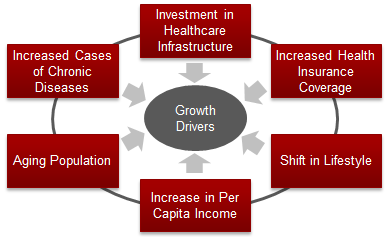
In the latest installment of China’s 5-year plan, the government laid out a series of initiatives that will make China one of the largest pharmaceutical markets in the world. China’s pharmaceutical market is expected to grow from $46 billion in 2009 to $178 billion in 2019, and this massive growth is largely being driven by the ongoing healthcare reforms.

These government initiatives are creating massive opportunities for companies with their fingers on the pulse of these programs. Here are three key government objectives and the impacts they are having on our clients:

1) Key Objective – To Provide Universal Healthcare Insurance

Under the healthcare reform, the government introduced two new basic healthcare insurance schemes, NRCMS and BMIUR, to expand coverage among the rural and the poor urban population, respectively. In addition to a much larger population with access to health insurance, reimbursement rates have also increased; which is likely the cause of higher per capita spending on medical examination and treatment in hospitals countrywide.

2) Key Objective – To Improve Healthcare Services at Grassroots Level

As of February 2012, around 2,200 county hospitals and 33,000 primary healthcare institutions have been renovated as part of the healthcare reform, with approximately 70% of township hospitals and 85% of community health centers having been upgraded. In 2010, 627 new hospitals were set up in China, and because of improved spending on healthcare facilities, about 70% of counties have at least one hospital at the secondary level-A. With all of this new construction, there has been a sharp uptick in utilization and demand for diagnostics and examinations.

3) Key Objective – Public Hospital Reform

Introduction of reforms in the public hospital system has been the toughest challenge for the Chinese government; the government’s reform plan includes separation of ownership and management and a gradual elimination of drug margins. This has led to the government announcing policies that promote private sector investment in hospitals. Specifically, the tendering process is now much more in the hands of individual hospitals and lower-tier clinical facilities, which could be a boon for healthcare companies that are able to leverage their geographic reach and local knowledge into a competitive edge during this process.

The Waiting Game – Launching New Products in China

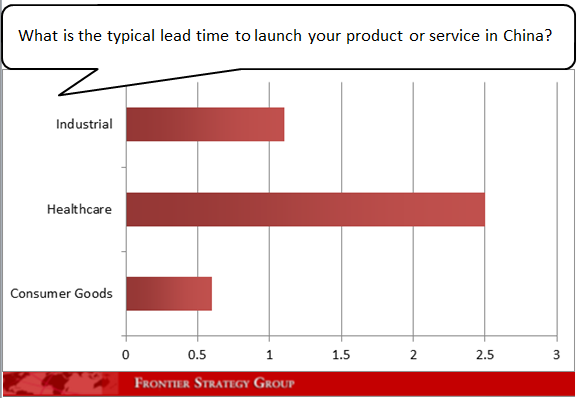
China Survey

The ability to bring products to market quickly is one of the biggest factors that separates leading multinationals from the rest of the pack. Companies that continuously release innovations in the form of new products and services are able to differentiate themselves as “first-movers,” and gain a key advantage against the competition. In order to better understand the expectations for launching new products in China, Frontier Strategy Group recently conducted a senior executive poll to determine how long it takes for companies to bring new products to market. On average, healthcare companies require roughly two and a half years to bring a new product to market, while consumer goods average just over half of a year. Industrial companies fall close to the middle, averaging just over 1 year. If your company takes longer than the industry average in launching a new product, you could be leaving yourself vulnerable to organizations that are more efficient in new product development.

Also within this research, FSG identified the average revenue and profit contributions by industry within emerging markets and China. As an example, Industrial companies have a far larger percentage of their business in emerging markets than any of their peers, with more than 40% of their current profits derived from emerging markets and an expectation of over 50% in just five years. By analyzing the nature of your industry as it stands right now, compared to the momentum and expectations for the future, you too can have a unique insight into the growth opportunities for your business in emerging markets.


MNCs are Going Direct in Saudi Arabia According to Poll Results

Saudi Business

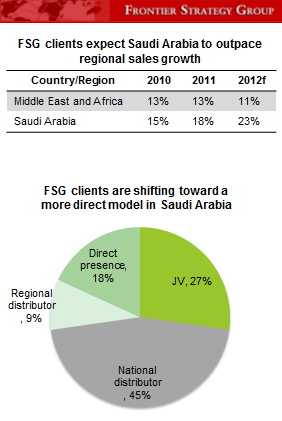
Companies are moving to more direct models in Saudi Arabia to capitalize on increasing public expenditure in priority sectors like education, healthcare, housing, and related infrastructure.

A local presence allows MNCs to be closer to customers and to leverage partners more effectively.

Drivers

Companies know their products better than distributors: Visiting local partners on an infrequent basis is not enough to imbue expertise in your product offering. There will always be a gap between realized and actual market potential without this knowledge.

Closer oversight of partners: Establishing a more direct presence allows companies to manage local partners closely and take advantage of special treatment due to the government’s mandate to prioritize companies with a local presence.

Business climate stability amid regional uncertainty: The Saudi market is growing in regional importance as companies de-prioritize business in less stable markets such as Egypt, Iran, Lebanon, Syria, and Tunisia.

Recognition of rising MNC competition: MNCs must get closer to customers due to the rapid expansion of foreign MNCs and regional conglomerates into the Saudi market.

Frontier Strategy Group View

Companies should no longer expect to capture the full potential of the Saudi market if they are based elsewhere in the Gulf region.

MNCs are finding it easier and more necessary than ever to go direct or form joint ventures in Saudi Arabia. The commercial infrastructure improved significantly over the past decade, exemplified by Saudi Arabia’s #12 global ranking in the World Bank’s Ease of Doing Business Index.