
Sluggish Growth in Brazil is Driving MNCs to Invest in Efficiency-Enhancing Measures

Brazil Economy

The case for Brazil is getting harder to make

While the Brazilian economy grew faster than expected during the second quarter, full-fledged recovery remains elusive and several rounds of interest rate hikes have yet to rein in stubbornly high inflation. FSG is expecting relatively weak GDP growth of 2-2.2% YOY in 2013, with potential for electorally-motivated fiscal stimulus to drive growth of around 2.7% YOY in 2014. These numbers are disappointing, and underscore the extent to which Brazil’s long-term potential remains constrained by structural bottlenecks and protectionist policies.

Most multinationals are in Brazil for the long haul, but many plan to limit investment

Here at FSG, we have been carefully tracking multinational sentiment with respect to Brazil, and on a recent trip to Miami, I had the opportunity to sit down with many of the LATAM executives we work with to discuss how the role of Brazil within their regional portfolios has changed as economic growth has slowed.

Suffice it to say that while weak prospects have put a damper on sentiment, few executives are contemplating pulling out of the market. However, many executives I have spoken with in recent weeks anticipate holding investment flat over the near- to medium-term, with the potential for scaling back presence if the situation does not improve over the course of 2014-2015.

Interestingly, this sort of pessimism is gaining ground in spite of high top-line growth. Most executives we work with don’t anticipate that Brazil’s slowdown will have a significant impact on their ability to reach ambitious revenue-growth targets, largely because in a market the size of Brazil, there is still white space to be found. Rather, they are concerned about hitting bottom-line targets, and with good reason: Brazil’s high-cost, protectionist operating environment poses a significant drag on margins for foreign multinationals.

Recent exchange rate volatility is making an already-difficult situation worse
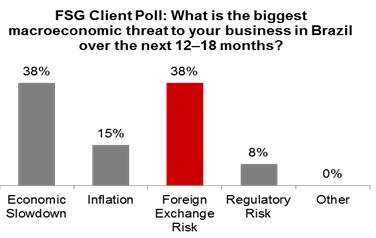
FSG Client Poll

The Brazilian real has been remarkably volatile over the course of Q3-early Q4, depreciating to a low of 2.45 BRL/USD in late August as investors were originally anticipating that the United States would begin to taper bond purchases in September. A majority of companies we work with report that they have built their budgets for 2013 around an anticipated exchange rate of exchange rate of 2.1–2.2 BRL/USD. As such, recent volatility has exacerbated their exposure to FX-related losses and made deal making a herculean endeavor.

Companies able to take the long view are targeting their investments to improve efficiency
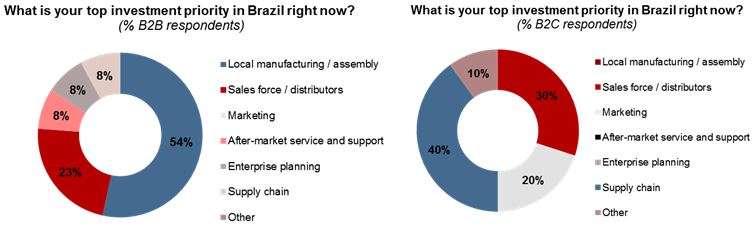
Top investment priority in Brazil

When all is said and done, there is little reason to believe that the protectionist bias of Brazilian labor, tax, and investment policies will change over the medium term. President Rousseff is likely to be re-elected, and domestic politics preclude any marked departure from the ad hoc interventionism that has defined her first term thus far. Executives that are able to plan for the long-term are increasingly coming to terms with this reality and targeting their investments accordingly in an effort to boost profitability. In the B2B space, many companies we work with view investing in local manufacturing as the best way to bring down costs over the medium to long run, while B2C companies are investing in their supply chains.

Optimistic About Mexico’s Second Half Performance

While FSG clients continue to view the Mexican economy as a source of opportunity, revenue growth came in under expectations in the first quarter, and targets for 2013 reflect lower expectations than in previous years. That said, executives remain relatively optimistic about the potential for stronger growth in the second half of the year, contingent upon accelerated government spending and investment in infrastructure, progress on the structural reform front, and continued economic recovery in the US.

From a macroeconomic perspective, manufacturing exports, the troubled construction sector, and stalled government procurement proved to be significant drags on growth in recent months. Additionally, Mexican consumer and producer confidence declined during H1, and the pace of consumption and credit growth have moderated, reflecting the impact of sluggish external demand, falling remittances, currency depreciation, and inflationary pressures on domestic sentiment and purchasing power.

Broadly speaking, Mexico’s near-term prospects remain highly contingent upon US economic performance, although Peña Nieto’s commitment to accelerating investment in infrastructure and pushing through fiscal and energy reform also has the potential to drive growth and foreign direct investment in the months ahead.

It is against this economic backdrop that FSG believes multinationals should be tracking the following three trends during the third quarter of this year as an indication of how the business environment is likely to evolve over the medium term:

  • Ramping up of government spending under the new administration
    • Recent developments: During the first quarter of 2013, government expenditure fell short of budgeted amounts by 4.9% in Q1. This slowdown, while common in Mexico during periods of political transition was a key driver of Mexico’s underperformance during the first half of the year.
    • Forecast: Our expectation is that government spending will accelerate in the second half of the year. Companies in the construction sector stand poised to benefit as infrastructure projects are prioritized.
  • Near-term exchange rate volatility
    • Recent developments: In recent weeks, the peso has depreciated sharply against the US dollar amid speculations that the Fed will begin to wind down bond purchases as the US economy continues to improve.
    • Forecast: Over the long term, recovery in the US bodes well for Mexico. As such, near-term capital outflows should be interpreted as a reaction to the shift in US monetary policy rather than perceived weakening of Mexican fundamentals.
  • Healthcare reform efforts will emphasize preventive care
    • Recent developments: In addition to pushing for reduced costs and expanded access to healthcare services, Peña Nieto has indicated that preventive care will be prioritized when healthcare reforms are rolled out.
    • Forecast: Companies in the pharmaceutical, medical device, and consumer goods spaces should consider low-cost, high impact ways to proactively align their marketing, government relations, and product development strategies with government efforts to reshape consumer behavior and promote a healthy lifestyle.

FSG clients may click here to access a full report for further reading on FSG’s quarterly market view of Mexico.