Memo to EMEA and LATAM regional heads: time to pick up the phone and chat

Struggling to Combat Slowing Growth and Rising Costs in Key BRICS Markets?

A conversation with your regional counterpart in EMEA, LATAM, or APAC can help you understand the common structural factors driving lackluster growth and help you re-set corporate expectations for growth in 2014
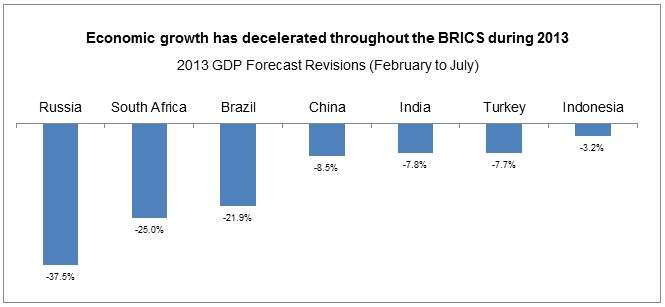
BRIC deceleration

2013 has been a difficult year for the BRICs—economic growth has decelerated across the board due to the confluence of external headwinds and domestic inefficiencies, while the political will to push for necessary structural reforms has proven elusive.

For emerging markets executives seeking to respond to slowing growth in key BRICS markets, cross-regional conversations can be valuable for issue diagnosis and strategy development. The premise of the argument here is a simple one: common problems can and ought to be identified, so that viable strategies for driving profitable growth given less favorable medium-term prospects for the BRICs can be replicated and applied across regions.

I’ve been ruminating about Brazil’s slowdown and potential for recuperation in 2014 for several quarters now, while my EMEA colleague, Martina Bozadzhieva, has been doing the same with respect to Russia. However, it wasn’t until we had an opportunity to sit down together and discuss the dynamics driving Brazil and Russia that we learned how much these two seemingly disparate markets have in common.

Listen to our podcast below for a quick recap of the structural factors driving lackluster growth in Brazil and Russia, and get a cross-regional perspective on strategies for managing corporate expectations and improving bottom-line performance across the BRICS.

Download the podcast or access the entire FSG iTunes library here.

Sluggish Growth in Brazil is Driving MNCs to Invest in Efficiency-Enhancing Measures

Brazil Economy

The case for Brazil is getting harder to make

While the Brazilian economy grew faster than expected during the second quarter, full-fledged recovery remains elusive and several rounds of interest rate hikes have yet to rein in stubbornly high inflation. FSG is expecting relatively weak GDP growth of 2-2.2% YOY in 2013, with potential for electorally-motivated fiscal stimulus to drive growth of around 2.7% YOY in 2014. These numbers are disappointing, and underscore the extent to which Brazil’s long-term potential remains constrained by structural bottlenecks and protectionist policies.

Most multinationals are in Brazil for the long haul, but many plan to limit investment

Here at FSG, we have been carefully tracking multinational sentiment with respect to Brazil, and on a recent trip to Miami, I had the opportunity to sit down with many of the LATAM executives we work with to discuss how the role of Brazil within their regional portfolios has changed as economic growth has slowed.

Suffice it to say that while weak prospects have put a damper on sentiment, few executives are contemplating pulling out of the market. However, many executives I have spoken with in recent weeks anticipate holding investment flat over the near- to medium-term, with the potential for scaling back presence if the situation does not improve over the course of 2014-2015.

Interestingly, this sort of pessimism is gaining ground in spite of high top-line growth. Most executives we work with don’t anticipate that Brazil’s slowdown will have a significant impact on their ability to reach ambitious revenue-growth targets, largely because in a market the size of Brazil, there is still white space to be found. Rather, they are concerned about hitting bottom-line targets, and with good reason: Brazil’s high-cost, protectionist operating environment poses a significant drag on margins for foreign multinationals.

Recent exchange rate volatility is making an already-difficult situation worse

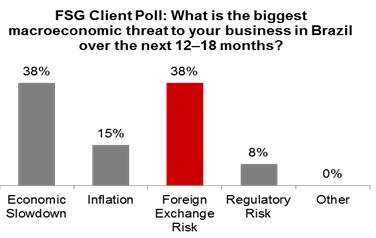
FSG Client Poll

The Brazilian real has been remarkably volatile over the course of Q3-early Q4, depreciating to a low of 2.45 BRL/USD in late August as investors were originally anticipating that the United States would begin to taper bond purchases in September. A majority of companies we work with report that they have built their budgets for 2013 around an anticipated exchange rate of exchange rate of 2.1–2.2 BRL/USD. As such, recent volatility has exacerbated their exposure to FX-related losses and made deal making a herculean endeavor.

Companies able to take the long view are targeting their investments to improve efficiency

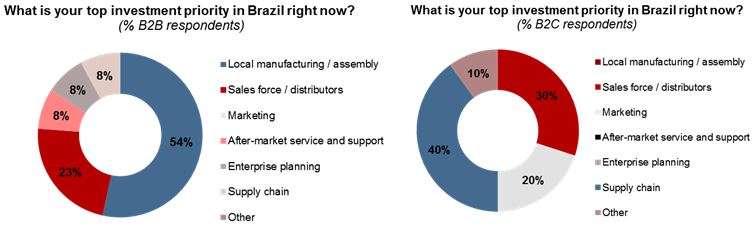
Top investment priority in Brazil

When all is said and done, there is little reason to believe that the protectionist bias of Brazilian labor, tax, and investment policies will change over the medium term. President Rousseff is likely to be re-elected, and domestic politics preclude any marked departure from the ad hoc interventionism that has defined her first term thus far. Executives that are able to plan for the long-term are increasingly coming to terms with this reality and targeting their investments accordingly in an effort to boost profitability. In the B2B space, many companies we work with view investing in local manufacturing as the best way to bring down costs over the medium to long run, while B2C companies are investing in their supply chains.

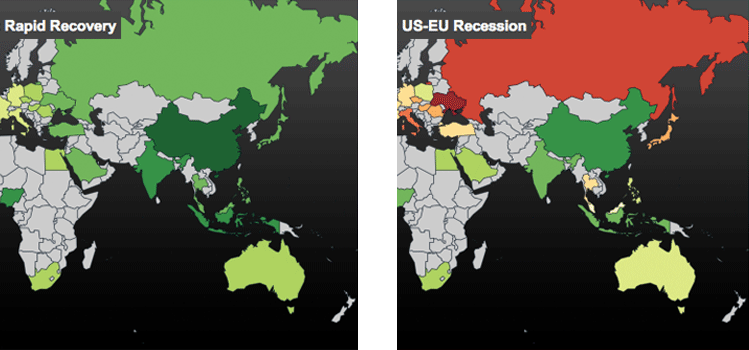
Monitoring the Global Economic Recovery

In a stable year, Q3 is a time MNCs use to adjust strategic plans and finalize budgets for 2012. However, 2011 is not a stable year. Volatility in the global economy has generated significant uncertainty in all planning processes. GDP growth projections for 2012 in Argentina range from 1.2% to 6.5%. For Russia, executives are making decisions based on GDP forecasts that range from -8% to 5.4%. These figures are critical to budget allocation, target setting, and strategic planning for 2012, and will continue to fluctuate in the coming weeks and months.

It will be increasingly difficult for MNCs such as Apple (Nasdaq: APPL) and General Electric (NYSE: GE) that have large exposures to volatile markets to manage through various scenarios. Through working with over 200 of the world’s most progressive multinational firms, Frontier Strategy Group understands what matters most to executives operating in emerging markets. In response to the economic slowdown Frontier Strategy Group launched FSG Monitor, and online resource for senior executives around the world to track the impact of the economic slowdown on their business performance in real-time.

For a limited time, FSG Monitor is available to the public, for anyone to access and view our proprietary intelligence platform.

Click on this link to view FSG Monitor yourself, or contact us for additional information.

MENA Insulated from Global Economic Shocks for Now

httpv://youtu.be/xtHIP7y3HXsv=tp3I0c-uZ-M

Because of close trade ties, US foreign aid to the region, and American thirst for oil, S&P’s downgrade to the US credit rating a few weeks ago is surely a harbinger of doom for economies in the Middle East and North Africa, right? Not exactly.

After the S&P downgrade, stock markets fell across the MENA. Investors are understandably concerned about increased risk. However, FSG does not expect this to shift the regional risk profile significantly. The region should be less susceptible to economic shocks in the short term as many economies have already taken a beating due to revolutions, transitions, and ongoing political uncertainty associated with the Arab Awakening. One potential impact would be an uptick in inflation growth in the Gulf. This is because five of six GCC currencies are pegged to the US Dollar. If the US Federal Reserve decides to begin a third round of quantitative easing, then it would place upward pressure on the price of importing goods in the region.

What unfolds in Europe and Asia for the rest of the year is likely to have a more profound impact on the investment outlook for the Middle East and North Africa going into 2012. A deepening Euro zone crisis threatens countries with close trade ties to the EU. Morocco and potentially Egypt could see their currencies weakened, while Turkey could be squeezed by a slowdown in exports and foreign investment.

Hydrocarbon economies like Kuwait, Qatar, Saudi Arabia, and the UAE are fairly insulated because their respective budgets factor in oil prices averaging a range from $55 (Qatar) to $85 (Saudi Arabia) per barrel on the year. Oil has already averaged well over $100 per barrel and we are approaching the last quarter of 2011. Gulf oil exporters can draw on excess crude revenue to sustain aggressive public spending and economic diversification programs in 2012. Still, a European recession combined with a trade slowdown in Asia would represent a serious blow to oil demand and impact prices as a result. This could lead to a delay in public sector projects and place an increasing burden on the private sector to create more jobs locally.

Overall, FSG does not expect global instability to impact the Middle East and North Africa in the short term. However, a deepening euro zone crisis combined with a slowdown to Asian demand could prove to be a toxic cocktail for the region in the medium term. The silver lining in this type of double-whammy scenario would be reduced global demand for commodities and lower food and fuel prices in the region. This would be particularly important for countries impacted by the Arab Awakening as they look to rebuild their economies.