Indian E-Commerce Poised for Growth

E-commerce in IndiaWhile an e-commerce boom in India has been thought to be on the horizon for a long time now, the industry is finally showing signs that it is heading in that direction despite having several false starts.

Why now?

  • Critical Mass: The Indian e-commerce industry is finally close to achieving the critical mass required for it to genuinely go through the boom that has been predicted to happen several tmes over the past decade. The number of unique visitors on retail sites doubled between 2011 and 2013, and more than 1.5 million more are visiting every month.
  • B2B is open: To develop the sub-sector without being politically unpopular, the Department of Industrial Policy and Promotion clarified its regulations on B2B e-commerce, allowing foreign firms to have 100% ownership in such ventures.
  • B2C is likely to open up very soon: The Prime Minister’s Office is in favor of opening up the fast-growing e-retail sector to FDI—a move that will allow global majors such as Amazon and eBay to invest in the country. Preparing for the upcoming change will help companies stay ahead of their competition.

Why should e-commerce matter to multinationals?

  • Large, Fast-growing Base: India’s fast-growing online population has now surpassed that of Russia, Brazil, and Japan to become the third-largest Internet population in the world. It also has one of the youngest populations of Internet users in the world, providing a large base of users who will more easily adapt to technological changes.
  • Strong Growth Expectations: With the introduction of faster Internet, an increase in urban disposable income, and the launch of global players with sophisticated platforms, some experts expect the e-commerce industry to be worth US$ 70 billion by 2025.

Key Consumer E-Commerce Trends:

  • Significant Non-Metro Following: Contrary to popular belief, e-commerce users are not purely from the top metropolitan areas of India; in 2011, cities with a population of less than one million accounted for almost 48% of total e-commerce users. Another study showed that more than 57% of the revenue from e-commerce products and 54% from the e-commerce services industry was derived from beyond the top eight metros.
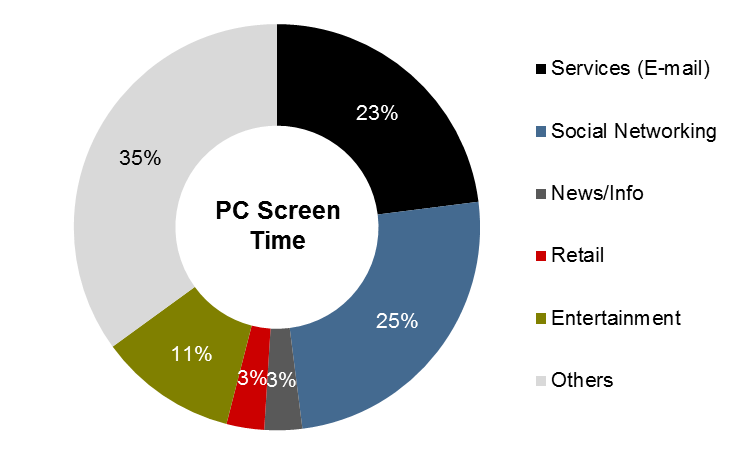
  • Time spent on retail not high: A closer look at the division of time spent online by users reveals that most of it is browsing through social-networking websites and on services (see chart below). With only 3% of screen time spent on actual retail, companies need to be exploring marketing (advertising) opportunities for influencing consumers’ final purchases.PC Screen Time

Key Business E-Commerce Trends:

    • SMEs will continue to be early adopters: SMEs are the primary users of B2B e-commerce in India (see case study on slide 21), because they manage businesses with relatively lesser amounts of capital and operate on a low-cost basis. Embracing this cost-efficient technological tool has allowed SMEs to create a self-serving business model, where they can access channel partners and customers through a single platform.
    • MNC’s likely to test with small orders and SMEs: Some large firms and MNCs in India have begun testing their B2B e-commerce platforms but are keeping them on a small scale to assess the integrity of the system. Avenues for testing a B2B platform would include launching it to (a) very small orders that are otherwise left unattended, (b) small firms that have not traditionally been of interest due to scale, or (c) firms looking for samples to test the product.

Holistic Strategy: Companies need to develop a holistic e-commerce strategy with tactics to handle both the online and offline channels. Not all industries will benefit from using online platforms for conducting commerce. But with users spending increasingly large amounts of time online and becoming dependent on the Internet for gathering of crucial information, companies need to investigate and form a social media strategy to create an impact.

Emerging Market Executive Spotlight: Disruptive Innovation with Terry Thiele

Disruptive Innovation

Frontier Strategy Group has built a vibrant and dynamic community of emerging market thought leaders ranging from our client executives to academics to former diplomats. In the case of our most recent Emerging Market Executive Spotlight Podcast all three definitions hold true. FSG’s CEO Richard Leggett recently recorded an interview with Terry Thiele, Director Sustainable Product Strategies at Lubrizol Corporation on the topics of disruptive innovation and related scenario planning. Terry’s career spans across the military, law, national security, and most recently in the private sector with Lubrizol Corporation’s strategic planning support and regulatory compliance department. You may download the podcast by clicking here, or subscribe to our Emerging Markets Podcast Series.

In this Emerging Market Executive Spotlight, Terry discusses the definitions, risks, and opportunities associated with disruptive innovation and the methods of scenario planning to prepare for its effects on global business. Innovation has and always will be disruptive, but not always in a negative manner. In fact, disruptive innovation can revolutionize a product, business, or an entire industry. Though still in the early stages of development, 3D printing is one technology that has worldwide economic implications and the potential to be extraordinarily disruptive to every aspect of the traditional value chain, especially in emerging markets. Though as Terry states, it’s not the technology that poses the problem but how companies respond to the disruptive change. 3D printing certainly has the potential to initiate the 3rd industrial revolution but is dependent on two things: cost competiveness and performance characteristics.

Listen to the podcast for further explanation of how to utilize scenario planning to properly prepare business for disruptive innovations such as 3D printing, as well as other insight on the matter from Terry Thiele.

__________________________________________________________________

Terry V. Thiele has been with The Lubrizol Corporation for 13 years during which time his principal responsibilities have included strategic planning support and regulatory compliance and advocacy, with an emphasis on environmental matters. In particular, Terry has led Lubrizol’s growing involvement with environmental life cycle assessments. He represents Lubrizol on the UN Clean Fuels & Vehicles Partnership, the American Chemistry Council’s Value Chain Outreach Committee, the American Petroleum Institute’s Used Oil Taskforce and the European Chemical Industry Council’s LCA Taskforce. Before joining Lubrizol, Terry performed environmental policy and government relations functions for AB Electrolux and the General Electric Company. Prior to that he spent the first 11 years of his career working in the Federal government with service in the Treasury Department, the Central Intelligence Agency, The Defense Intelligence Agency and the Executive Office of the President. He received his B.A. magna cum laude from Princeton University, his J.D. from the NYU School of Law and is a graduate of the National War College. Terry served for over 10 years in the U.S. Army Reserve, Judge Advocate General Corps, honorably discharged with the rank of captain.

The Competition is Heating up in Sub-Saharan Africa as New Growth Drivers mean New Opportunities for MNCs

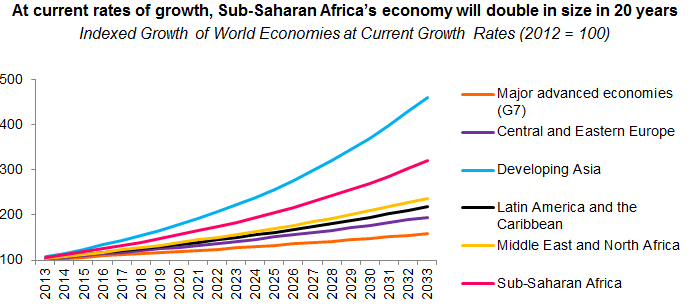
SSA Economic 20 year projectionSub-Saharan Africa (SSA) is the second-fastest growing region in the world, growing at an average of 5.6% per year. Our recent Regional Overview for Sub-Saharan Africa shows that the size of the SSA economy will double in size in less than 20 years. Given that many countries are updating the figures used to calculate GDP, the region’s economy will likely double in size ahead of current forecasts. When Ghana rebased its GDP in 2010, the size of its economy grew 60% on paper overnight. Nigeria is expected to follow suit at the end of the year, and as a result, will overtake South Africa as the largest economy on the continent. Another 25 African countries are expected to rebase their GDP in the next three years.

But it is not only GDP growth that makes the SSA opportunity one of the most attractive globally. It is much more the emergence of new growth drivers that are contributing to stronger, more sustainable growth. No longer are commodities, FDI inflows, and political reforms the main factors behind economic development. Going forward, a large and growing consumer base that is trading up, greater integration into the global economy, and increased government spending will complement existing growth drivers, leading to even stronger SSA performance:

Driver #1: A Vast Consumer Base with High Collective Spending Power: Africa’s population (including North Africa) will double to two billion by 2040, creating a large, aggregate consumer base that will trade up as wealth increases. At the same time, private consumption in SSA is expected to grow 10% YOY in 2014 to US$ 936 billion from US$858 billion in 2013. We expect this figure to be even larger once the region’s economies rebase their GDP.

Driver #2: Inclusion into the Global and Regional Economy: Africa is increasingly integrated into the global economy, particularly with other emerging markets. The BRICS (including South Africa) share of greenfield investment across all of Africa increased to almost 25% in 2012 from 19% in 2003. Manufacturing and services investments accounted for 75% of the dollars invested by the BRICS, contrary to the assumption that investment relationships are dominated by natural resources. Increased FDI into Africa, expected to reach US$ 50 billion in 2013, means competition is growing while first mover advantages are drying up.

Driver #3: Fiscal Reforms Increase Government Spending: Fiscal reform, in the SSA context, means increased spending across key sectors, different than in Western markets where it means budget cuts. Most governments increased capital expenditure in their 2013/2014 budgets to meet financing targets for infrastructure projects, education, healthcare and to create jobs, While this creates opportunities for companies selling to the government, it also means that the cost of doing business will increase. In order to keep budget deficits low, governments are financing public expenditure through subsidy reductions and increased tax collection.

For additional content and discussion regarding our regional overview of Sub-Saharan Africa, you may download the podcast by clicking here, or alternatively subscribing to our iTunes podcast library here.

Emerging Markets Opportunity Not Over

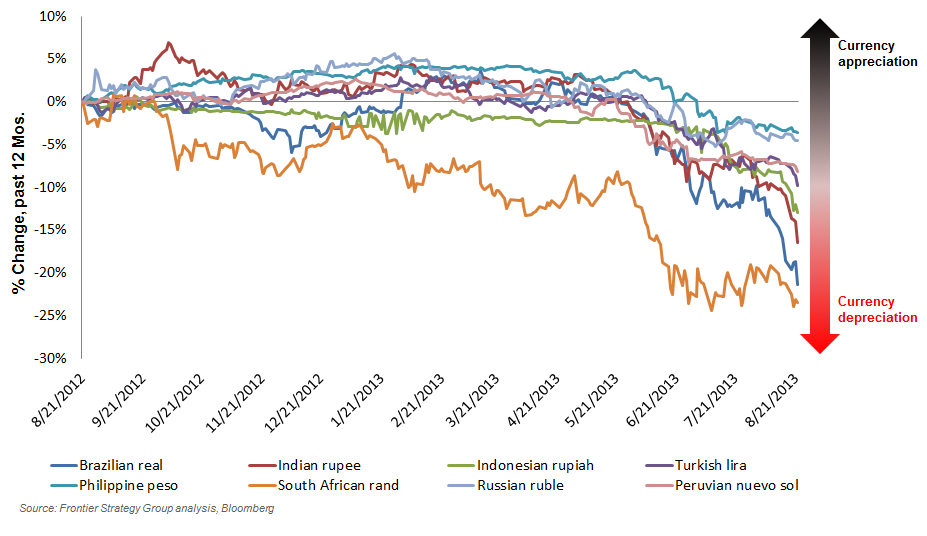
Currency-Volatility-Global-Performance-DriversRecent reversals in capital flows caused large and sudden currency devaluations, faster than many emerging markets expected or could manage. As a result, many market commentators have called this end of the emerging markets opportunity. That statement couldn’t be further from the truth. While companies should always expect challenges in emerging markets, the changing environment will also create a new set of opportunities.

FSG identified four ways companies can capture growth in this shifting environment:

  1. Leverage home-currency strength to win share back from emerging markets–based competition
  2. Double down on local production to reduce production costs
  3. Use balance sheet strength to earn financing margins
  4. Reassess customer segmentation to identify local customer “winners”

FSG looks at these strategies and the drivers of the changing global environment in our 2014 Global Performance Drivers report, now available for FSG clients.

What happened?

Capital flows reversed because of push and pull factors. As the US economy continues to improve, the Federal Reserve is expected to reduce bond purchases, changing the risk-return payoff for portfolio investors, “pulling” capital out of emerging markets. We also see slowing growth in emerging markets “pushing” capital to developed markets. The outflow of capital is more concerning for countries like Turkey, Poland, and Ukraine, which have high levels of short-term external debt. Countries fitting this profile may run into short-term funding challenges that could drive up local interest rates, or in the worst case cause temporary liquidity problems. Other countries like India and Indonesia may now struggle with inflation as currencies decrease faster than is manageable, driving up costs for consumers.

Emerging Market View: What Our Analysts Are Reading

EM View


Russia PM Plans 5% Spending Cuts as Slow Growth Pressures Budget - The Wall Street Journal

Companies should work with their local teams and partners to understand how the government’s spending cuts could affect specific sectors and projects that they may sell into, as well as any of their local customers.
- Martina Bozadzhieva, Associate Practice Leader for Central and Eastern Europe


Corporates Take Emerging Market Volatility in Stride - CNBC

Recent volatility, particularly in regard to currency, has opened up new nodes of opportunity for multinational companies. The longer-term emerging market opportunity is not going away.
-Sam Osborn, Senior Analyst for Global Analytics


India’s Industrial Output Rebounds - The Wall Street Journal

Rupee recovers (more than any other emerging market currency, since the end of August), Industrial production numbers surprise most economist, and, inflation also remains relatively low. Could the worst be behind for India? Is the government/central-bank feeling like they might be in a position to introduce some measures to revive growth.
- Shishir Sinha, Analyst for Asia Pacific

Emerging Market View: What Our Analysts Are Reading

EM View


The Next Emerging Market Crisis - The New York Times

Fears of an emerging market crisis due to massive capital outflows tend to be overblown. Emerging markets have much more flexibility in managing their economies than in the 1998 panic, with higher levels of foreign exchange reserves and smaller amounts of short-term and total external debt.
- Sam Osborn, Senior Analyst for Global Analytics

.

Ghana’s Supreme Court Upholds Mahama’s December Poll Victory - The Financial Times

Short-term political uncertainty in Ghana has been resolved following the Supreme Court’s ruling against an election rerun. This is good news for the economy as new elections could have meant a delay in much-needed spending cuts. The government is focusing its efforts on reducing the budget deficit from 12% to 9% of GDP this year, by cutting subsidies and increasing taxes.
- Anna Rosenberg, Senior Analyst for Sub-Saharan Africa

.

GST to reforms, Centre accepts panel recommendations - Business Standard

India gets closer to formalizing the much awaited Good and Services Tax bill. While there is still a long way to go before the GST turns into formal regulation, pushing such reforms proactively will help the country in getting out of its current messy situation (while improving investor sentiment).
- Shishir Sinha, Analyst for Asia Pacific

FSG’s Matt Lasov on CNBC discussing Africa’s Growth Story [video]

Get Adobe Flash player


FSG’s Matt Lasov talks with CNBC on Africa’s New Growth Driver: The Consumer

Forging New Links: Overcoming Obstacles to Supply Chain Integration in Latin America

Latin America Supply ChainLatin America’s history of pervasive economic and physical trade barriers has proven a significant impediment to the integration of multinationals’ regional supply chains. Tariff and non-tariff trade barriers, complicated and inconsistent tax rules, and the nearly-impenetrable Amazon Basin and Andes Mountains have forced many companies to take an ad hoc approach to supply chain development in Latin America.

This ad hoc approach has meant that supply chains in Latin America are often a fragmented and inefficient drag on bottom-line performance, rather than the streamlined competitive advantage they can be in developed markets. Indeed, according to a report by JDA Software Group, longer lead times and less flexible supply chains means that days inventory outstanding for manufacturers averages 133% higher in Latin America than in the US, while days inventory outstanding for retailers averages 77% higher.

Despite these impediments to supply chain integration, growing corporate pressure to improve bottom-line performance, coupled with the threat posed by increasingly sophisticated local competitors, is causing some savvy LATAM executives to take a second look at opportunities to improve supply chain performance. Supporting this trend are emerging regional supply chain enablers like the recently-enacted Pacific Alliance agreement, growing government investment in transportation infrastructure, and the deepening presence of world-class third-party logistics providers.

Major companies taking advantage of these enablers include Diageo and Proctor & Gamble, both of which recently announced investments aimed at consolidating their Latin America supply chains. Companies that are able to differentiate themselves by cutting costs and improving customer service through supply chain integration will find themselves better positioned to navigate growing competitive threats as Latin America enters a phase of stronger macroeconomic headwinds.

Why a Syria strike could disrupt port traffic through Beirut

Port of BeirutThis blog post is in response to the very good analysis offered by Rebel Economy regarding how a Syria strike could impact MENA’s economy. I want to offer one counterpoint on why I don’t think the impact of a potential strike is overstated as it pertains to transportation disruptions through Lebanon.

As Rebel Economy points out, cargo traffic has increased through the Port of Beirut during the Syrian Civil War. Aside from upgrades to the port infrastructure, this is for two reasons that are related to the conflict. First, companies are re-routing regional shipments to go through Beirut (and Aqaba) rather than Latakia and Tartus, Syria’s two largest port cities, to avoid risky overland transport to other locations in the region. Second, the huge influx of Syrian refugees has supported domestic demand in Lebanon.

But a military intervention in Syria, even on a small scale, could make the Port of Beirut seem a lot riskier. I can think of a few ways that a Syria strike might lead to spillover in Lebanon: heightened communal tensions, an Israeli conflict with Hezbollah, or a new wave of Syrian refugees. Any of these scenarios could undermine Lebanese political stability, hurting the competitive advantage that the Port of Beirut has enjoyed this year. Sometimes perception is all that matters in these types of situations and some companies could be scared off rather than counting on Lebanon’s resilience.

Earlier in the year, some shipping companies considered re-routing cargo traffic through the Cape of Good Hope in South Africa in the event of MENA unrest impacting transit through Beirut, Aqaba, and the Suez Canal. While this type of major transport shift would only happen under extreme circumstances, the fact that it has been considered demonstrates that companies are wary of what a widening regional conflict could mean for their business.

Further instability would mean higher insurance rates for sea freight shipping through the MENA region. This development might force companies to pass on higher costs to customers. Senior executives should monitor how higher transportation costs indirectly impacts their businesses and the spending power of customers. For consumer-oriented companies, higher costs might encourage customers to trade down to low-cost products. For companies selling to small businesses, be mindful of changes in your customers’ access to financing in case of tighter credit conditions. For companies selling to governments, the threat of transportation disruptions could put further pressure on government finances in import-dependent economies.

Germany is juggling many roles and could drop the ball on the eurozone

Germany Blog PostGermany is at a turning point – or several – as voters go to the polls for the country’s federal legislative elections on September 22. Whether it is yet comfortable with the title, Germany drives the eurozone, and eurozone economic health is the top-down driver of the broader EMEA portfolio.

Meanwhile, Germany is being asked to lead Europe to recovery, but its banks are weak and its export-driven economy is struggling to find customers within the eurozone. Intense debate surrounds the issues of Germany’s economic strength relative to and necessary leadership role in the eurozone, but there has been little discussion of Germany’s fortitude relative to a standard that truly could boost eurozone recovery and re-open opportunities for multinationals in the region. Companies should thus be prepared for the volatility that will shake Germany and ripple into the eurozone and emerging markets in the wake of its national elections.

Expect eurozone volatility to increase after German elections

Chancellor Angela Merkel is expected to keep her post after Germany’s federal legislative elections on September 22. Leaders throughout the eurozone have stalled any meaningful reform as they await any signal of softening in German-led austerity policy toward the eurozone. Such hopes are misplaced and will increase volatility after the election as struggling southern European democracies begin to vote against the austerity policies that are holding their economies down. Although there are expectations for eurozone recovery next year, FSG expects the status quo.

The eurozone’s stagnant economic growth is driving Germany to find new customers

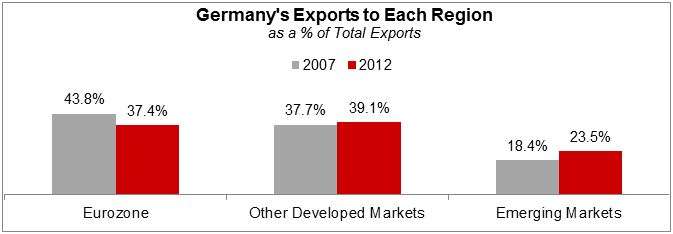
Although the eurozone is still Germany’s largest trading partner, its links to the US and BRICs are larger than what gross trade statistics suggest. FSG is seeing continued eurozone decay drive Germany to export less to the eurozone and more to emerging markets.

Germany's Exports to Each Region

However, its reliance on external markets also leaves it vulnerable to external shocks. A simultaneous eurozone squeeze and slowdown of emerging markets will result in a decline in Germany’s ability to prop up eurozone growth.

Germany’s banks remain highly exposed to risk relative to their peers

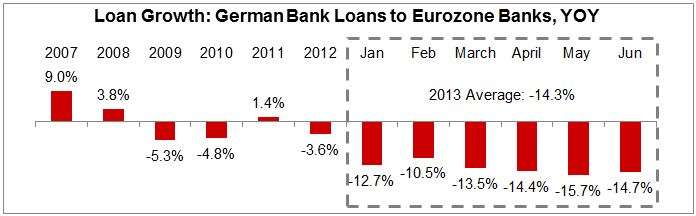
While Germany’s government enjoys “safe haven” status, its banks do not. German banks dramatically slowed lending to each other, with interbank lending decreasing 17.9% YOY in June, due to thin capital ratios, legacy exposure to bad debts yet to be written down, and weak earnings that are not replenishing capital bases.

The German banks’ decline in lending to eurozone by 14.3% YOY in H1 2013 signals that the vicious cycle of credit contraction that began in 2007 will continue to limit growth in Germany and across the eurozone. As banks slow lending to one another in Germany and across the eurozone, credit creation will stall as well.

Loan Growth - German Bank Loans to Eurozone Bankys, YOY

Despite its challenges, the eurozone still represents US$9 trillion in consumer spending per year, bigger than APAC and CEE combined. FSG is thus monitoring these trends in order to help clients to anticipate ways to increase margin share in the stagnant eurozone economic environment, and to get ahead of any recovery.

FSG clients may read further in our recently released report: Quarterly Market Review: Germany Q3 3013.