Indian E-Commerce Poised for Growth

E-commerce in IndiaWhile an e-commerce boom in India has been thought to be on the horizon for a long time now, the industry is finally showing signs that it is heading in that direction despite having several false starts.

Why now?

  • Critical Mass: The Indian e-commerce industry is finally close to achieving the critical mass required for it to genuinely go through the boom that has been predicted to happen several tmes over the past decade. The number of unique visitors on retail sites doubled between 2011 and 2013, and more than 1.5 million more are visiting every month.
  • B2B is open: To develop the sub-sector without being politically unpopular, the Department of Industrial Policy and Promotion clarified its regulations on B2B e-commerce, allowing foreign firms to have 100% ownership in such ventures.
  • B2C is likely to open up very soon: The Prime Minister’s Office is in favor of opening up the fast-growing e-retail sector to FDI—a move that will allow global majors such as Amazon and eBay to invest in the country. Preparing for the upcoming change will help companies stay ahead of their competition.

Why should e-commerce matter to multinationals?

  • Large, Fast-growing Base: India’s fast-growing online population has now surpassed that of Russia, Brazil, and Japan to become the third-largest Internet population in the world. It also has one of the youngest populations of Internet users in the world, providing a large base of users who will more easily adapt to technological changes.
  • Strong Growth Expectations: With the introduction of faster Internet, an increase in urban disposable income, and the launch of global players with sophisticated platforms, some experts expect the e-commerce industry to be worth US$ 70 billion by 2025.

Key Consumer E-Commerce Trends:

  • Significant Non-Metro Following: Contrary to popular belief, e-commerce users are not purely from the top metropolitan areas of India; in 2011, cities with a population of less than one million accounted for almost 48% of total e-commerce users. Another study showed that more than 57% of the revenue from e-commerce products and 54% from the e-commerce services industry was derived from beyond the top eight metros.
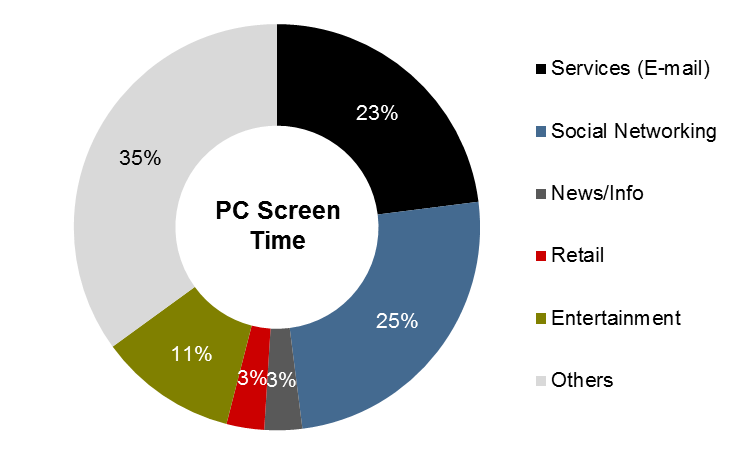
  • Time spent on retail not high: A closer look at the division of time spent online by users reveals that most of it is browsing through social-networking websites and on services (see chart below). With only 3% of screen time spent on actual retail, companies need to be exploring marketing (advertising) opportunities for influencing consumers’ final purchases.PC Screen Time

Key Business E-Commerce Trends:

    • SMEs will continue to be early adopters: SMEs are the primary users of B2B e-commerce in India (see case study on slide 21), because they manage businesses with relatively lesser amounts of capital and operate on a low-cost basis. Embracing this cost-efficient technological tool has allowed SMEs to create a self-serving business model, where they can access channel partners and customers through a single platform.
    • MNC’s likely to test with small orders and SMEs: Some large firms and MNCs in India have begun testing their B2B e-commerce platforms but are keeping them on a small scale to assess the integrity of the system. Avenues for testing a B2B platform would include launching it to (a) very small orders that are otherwise left unattended, (b) small firms that have not traditionally been of interest due to scale, or (c) firms looking for samples to test the product.

Holistic Strategy: Companies need to develop a holistic e-commerce strategy with tactics to handle both the online and offline channels. Not all industries will benefit from using online platforms for conducting commerce. But with users spending increasingly large amounts of time online and becoming dependent on the Internet for gathering of crucial information, companies need to investigate and form a social media strategy to create an impact.
Riding the Social Media Boom in China

I’ve been hearing about the challenges my APAC executives face while drafting their go-to-market plan using social media as a medium to target the Chinese consumer. I recently spent around 10 days in China which gave me an opportunity to discuss this with them in detail, and also convey our strong opinion on the matter. I managed to consolidate both FSG’s opinions and our clients’ pain points to provide some frameworks to help companies finalize their social media plan for China.

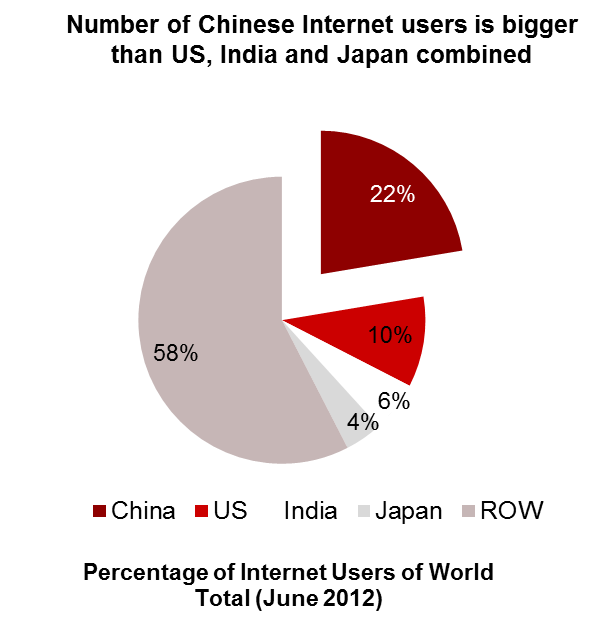
I recently noticed that a number of big department stores have been closed or scaled down, primarily due to the increased competition coming from the Internet (as compared to the number of stores which I observed several years ago). Social media is expanding its penetration of Chinese Internet, which is already the largest in the world. Many companies have started thinking about how to build social media into their business strategies, similar to what many MNCs did for the Internet 10 to 15 years ago.

Number of Chinese Internet users is bigger than US, India and Japan combined

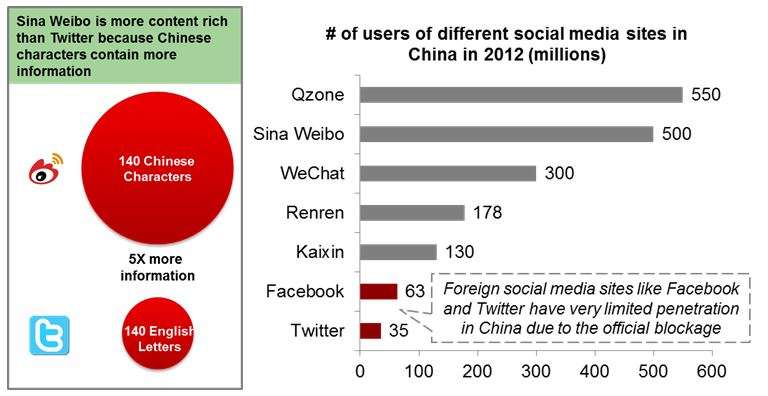
Chinese social media platforms are generally more interactive and users can share content in a greater variety of formats to a wider audience, therefore drawing more user contributions. Sina Weibo, a Chinese mircroblogging platform, is more user friendly and contains more features than Twitter to attract new users, retain elite users, and encourage all users to contribute more content, leading the platform to be more interactive.

Number of Chinese Internet users is bigger than US, India and Japan combined

Home grown platforms like Sina Weibo, Wechat, Qzone, Renren and Kaixin have dominated the social media space in China. Most were started as imitations of similar platforms in the West but over time have evolved into something quite different with unique product and service offerings specific for Chinese users.

A company’s social media strategy could be rendered obsolete very quickly as the market is ever-changing, with new companies, business models, and user features continuously mushrooming . FSG has built a simple 5-step process for B2C companies to build an effective social media communication plan. Social media is also not exclusive to B2C companies. B2B companies can leverage social media in an indirect way to build positive brand image, enhance internal communication, and even drive recruitment efforts. This is definitely a space where the marketing heads need to zoom-in on now to ensure they capitalize on the opportunity.

Surfing the African technology wave

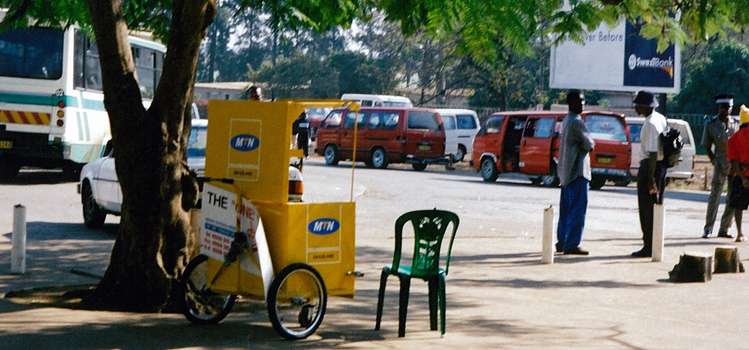
(Evidence of growing technology adoption, such as this mobile telephone sales booth in Swaziland, are increasingly ubiquitous in Africa)

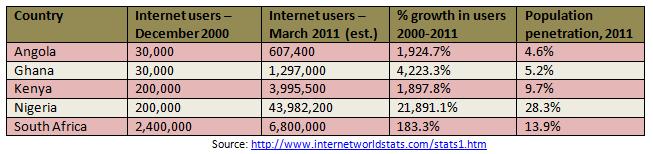
The adoption of new forms of communication in Africa over the past decade – both mobile telephone and internet – has been nothing short of revolutionary. The continent is estimated to have produced over 316 million new mobile phone users since 2000, passing 500 million total subscriptions late in 2010, and its total internet user population is now estimated at almost 120 million. Previously, communicating over long distances was fraught with difficulty and expense; that outlook has been transformed. The significance of these trends for African economic development, transparency and democratization is profound; the opportunity for technology companies and indeed for businesses across many other sectors capable of leveraging such channels for advertising and delivery is no less significant.

An unmitigated success story

The growth and profitability of mobile telephone networks in Africa is by now a widely related success story. In addition to the staggering uptake figures recorded (and company results posted), what is equally exciting is the innovation and knock-on benefits this trend has generated throughout the continent. These include access to innovative financial services products for mobile users (trailblazed by the much-studied M-Pesa scheme in Kenya), better agricultural product pricing information for farmers, and Celtel/Zain’s unprecedented low-cost international roaming capabilities within sixteen countries that are the envy of both travelling Europeans and companies importing goods physically across borders in Africa alike. New high-speed underwater fiber-optic cables encircling the continent’s coastline are meanwhile dramatically improving access speeds. Mobile broadband internet subscriptions in African countries are expected to reach a cumulative 265m by 2015.

The attraction of capturing the African digital market and exploiting its potential for new service offerings is bringing bigger and bigger names to the table. Earlier this month, Google announced it would be training 1,000 Kenyans to act as ambassadors for its products. Its move follows those of Asian companies LG Electronics and Huawei, both of which have already established local academies to train product experts and source locally-relevant innovations and adaptations to their product portfolio in the region. Korean electronics giant Samsung has announced a particularly ambitious growth strategy for the continent, aiming to generate $10 billion in annual revenue in Africa by 2015 (a fivefold increase on current sales which would put the market on an equal footing with China). Samsung reported 31% growth in revenue to US$1.23bn for its Africa operations in 2010.

New trends, new opportunities

Recent results announced by Chinese handset manufacturer Huawei on tremendous sales of its affordable IDEOS U8150 Android smart-phone in Kenya highlight the appetite and with it the opportunity for selling technology products in Africa despite comparatively low income levels. Figures revealed in June by mobile internet browser development firm Opera meanwhile showed Nigeria as the world’s fourth most active user market, followed by South Africa in seventh place. Belying its terribly outdated labeling as the ‘dark continent’, the hunger for connectivity, and openness to new technologies and service models, are clearly as strong - if not stronger - in Africa than anywhere else in the world.

Reflecting this rapid adoption of technology, e-commerce is an increasingly influential segment of African customer retail, enabling exponential increase in product access and equally dramatic reductions in the continent’s often forbidding costs of sale at through more traditional retail outlets. Recent media coverage highlights its rapid growth in South Africa, often a weathervane for the rest of the continent: the country’s population spent more than R2bn (US$275m) online in 2010 excluding air travel and accommodation outlays. This entailed a 40% increase on 2009’s figure, with 2011 expected to see a further 30% increase. The traditional perception that African consumers abide by the “I buy what I see” principle appears to be shifting, and forward-thinking businesses will seek to move ahead of that curve in their local online offerings.

In a similar vein e-learning and e-health solutions could also offer significant acceleration capacity to combating some of the continent’s serious social service provision deficiencies. Cloud computing, virtualization and hosted services are all constitute growth segments for further expansion. As the past decade has shown, in this respect the African sky really is the only limit.

Interested in learning how your company can leverage new technology channels to sell to and grow in Africa? Contact africa@frontierstrategygroup.com to learn how we can help