The general elections of 2014 might be one of India’s most highly anticipated political events of recent times where many expect a large shift in power after experiencing a decade of dominance by the Congress Party led UPA coalition. The elections bring with them a high level of ambiguity; what type of a coalition are we going to see at the center? Will BJP be able to achieve a landslide victory as has been predicted by majority of the opinion polls? Which political party is truly committed to reforms that will support the growth of the private sector and revive investment?
FSG breaks down its views for the elections into three simple phases: Pre-, during-, and post-elections:
1. Pre-Election: Companies’ Q1–Q2 Revenue Figures Should Benefit from Tax Cuts and Subsidies:
- Tax cuts -> Targeted at middle-class voters
- Companies in the B2C space should experience stronger top-line growth, as the government is using all the cash left in the current budget to please consumers before elections by reducing consumption taxes on several big-ticket items
- Subsidies and pensions -> Targeted at the “common” man
- Catering to the average voter, both urban and rural, the government has increased its energy subsidies by raising the cap on the number of subsidized gas cylinders supplied to households each year to 12 from nine
- Targeting another large voting group that comprises roughly 2.4 million people, the government changed its policy on pensions for retired soldiers; it will provide the same benefits for soldiers of the same rank and length of service, regardless of when they retire. Currently, pensioners who retired before 2006 receive less
- Speeding up project clearances -> Targeted at investor community
- In a final attempt to revive investor confidence, the Cabinet Committee on Investment, a body set up to speed up investment projects, claims to have cleared 296 projects (private and public) worth an estimated US$ 106 billion
2. During Elections: Companies Should Take the Results from Opinion Polls with a Grain of Salt
- Continent Worth of Voters
- Difficult to have a sample size to represent opinions of such a large and diverse audience
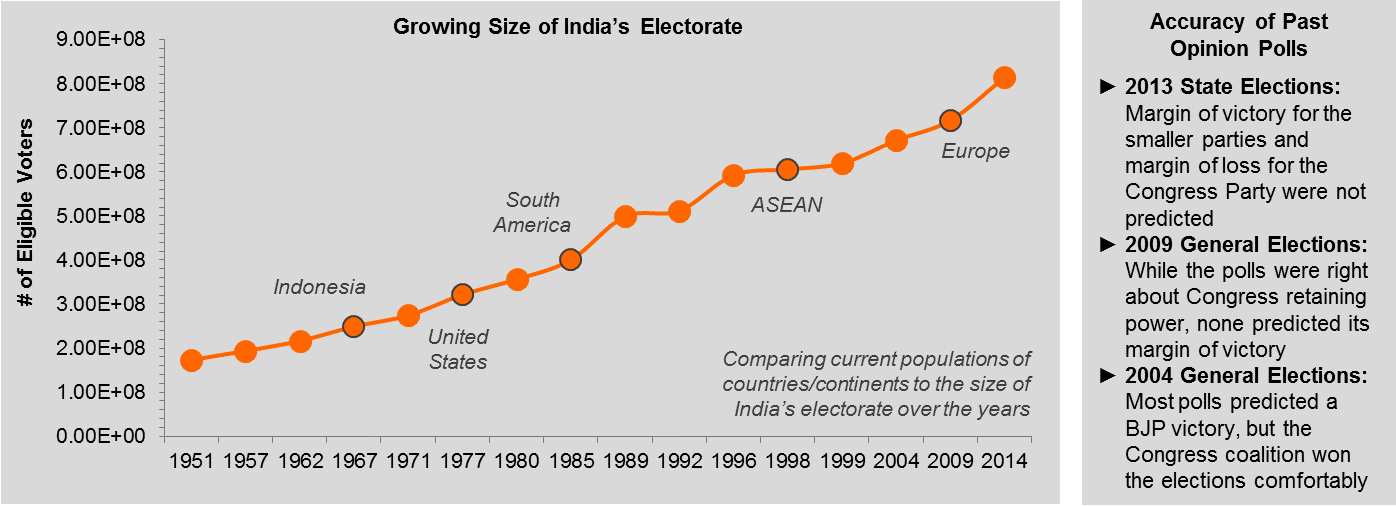
- Pluralist System: Disconnect Between Votes and Seats
- India uses the first-past-the-post electoral system, which declares the candidate with the most votes from each constituency the winner; there is no need for a majority
- This causes a disconnect between the popularity of a party and the actual seats it wins in an election; therefore, parties try to be strategic by maximizing the seat-to-vote ratio
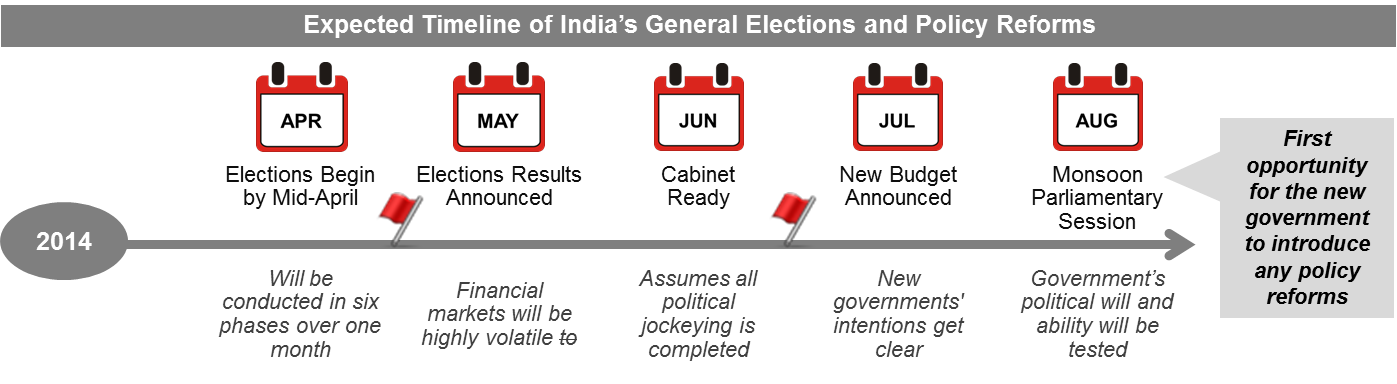
3. Post-Elections: Avoid the Financial-Market Hype; True Economic Reforms Only Possible by Q3–Q4 2014
- Avoid the Hype: General elections in India are always a time of volatility because of the economic significance associated with the policies that a new government brings. Companies should not read too much into market movements that take place during this uncertain time; the past six general elections have brought stock market and currency fluctuations
- Remain realistic about the policy change timeline: MNCs should not expect any major policy changes or turnaround on economic growth before the new budget is announced in July 2014 (the earliest possible). The impact of any potential reforms would only be felt in Q4 2014, assuming the government is able to pass changes in the parliament session between July and September 2014


Speak Your Mind