

For 25 days, the impeachment commission in Brazil’s Chamber of Deputies debated the merits of an impeachment request opened against President Rousseff in Brazil, and listened to the defense presented on Ms. Rousseff’s behalf. On Monday April 10th, the commission voted to approve the favorable impeachment report presented by commission president Jovair Arantes.
The result of the vote was 38 for and 27 against (See chart 1 below).
What comes next?
It is now expected that the full chamber will begin to consider the movement for impeachment on Friday (April 15th), with a possible vote scheduled for Sunday (April 17th). Although, it should be noted that the government could potentially delay the ultimate vote through legal maneuvering if it estimates it does not have the support necessary to block impeachment.
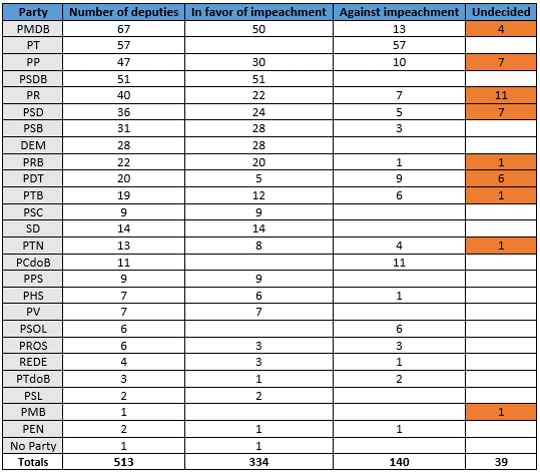
For impeachment to pass the full Chamber of Deputies, the opposition will require 2/3 of Congressmen to vote in favor (342 of a possible 513 votes – 67%). This is considerably more than the 58% that voted to support the movement in the Commission. However, several of the parties that saw their Congressmen vote against the impeachment in the Commission could see either all or a portion of their deputies vote in favor of the movement when it comes to a vote in the full house. A few key parties, including the PP and PSD, to whom the government recently conceded key ministerial positions and on which the government was relying on to block impeachment, had members vote in favor of the movement on Monday. Finally, according to a reported vote count from the PMDB, it is estimated that there are currently 334 votes in favor of impeachment and 140 against. That leaves an estimated 39 swing votes, with the oppositions needing to pick up only eight in order to push forward with impeachment (See chart 2 below).
Critical to Sunday’s outcome will be the countrywide protest scheduled to occur throughout next weekend, which will put considerable pressure on party leaders only four months from country-wide elections at the local level.
Key factors to consider
- Role of the PMDB in the Senate: Due to a ruling by Brazil’s Supreme Federal Tribunal earlier this year, even if the full Chamber of Deputies votes to continue with the impeachment proceedings, the Senate itself will then need to hold a vote to ultimately open the proceedings (with another two-thirds vote). The Senate has long been counted on by the government as its ultimate backstop, as it has been able to rely on the support of the body’s president Renan Calheiros (PMDB – RDJ). However, the Rio de Janeiro faction of the PMDB has officially thrown its support to impeachment, largely dashing this government hope.
- Michel Temer: The vice president, and next in line to become president should Dilma be impeached, has seen his own popularity severely diminished with 58% of Brazilians supporting his impeachment. Indeed, an impeachment commission is set to be opened for Temer as well, supported by similar charges as those against Dilma (crime of responsibility for spending funds not allocated by Congress).
- Case in Supreme Electoral Court (TSE): While FSG’s upside case has long been for the TSE to end the mandate of both Dilma and Temer by ruling that the PT’s 2014 campaign had been illegally financed, recent indications suggest that the process is a nowhere near completion. Furthermore, recent evidence introduced by the accusing parties (including the plea bargain from the ex-president of Andrade Gutierrez) will only serve to push a final decision even further. The likelihood of such a ruling sparing Brazil a potentially lengthy impeachment process is now considerably diminished.
Economic implications
- Exchange rate: The exchange rate closed Monday below 3.5 to the dollar for the first time in over eight months. The general sentiment is that an impeachment would lead to greater political stability, and thus drive greater capital inflows and demand for the real. However, it is far from certain that a Michel Temer government will be able to generate the necessary political support in Congress to sustain market confidence. Indeed, an impeachment and a shift of responsibility for the dire economic situation to a new party allows the PT, and particularly Lula, to go on the offensive with more than two years remaining before the presidential elections in October 2018. Rather than stabilize at a lower level, it is more likely than not that the real will fluctuate significantly over the course of the impeachment proceedings, likely climbing back toward 4.0 to the dollar in the short term.
- Headline growth: Again, while the initial movement toward impeachment is likely to bring about euphoria amongst investors, it is probable that the exuberance will recede should the process be extended for a significant period, with the government machine largely paralyzed. In such a case, still expect significant negative growth in 2016, with headline GDP approaching another year of near four percent contraction.
Chart 1: Vote tally from Commission on Impeachment (Monday, April 11th)
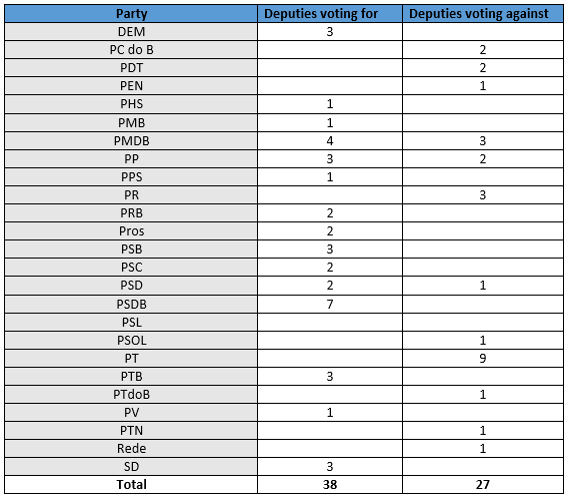
Chart 2: Anticipated votes according to PMDB for vote in full Chamber of Deputies (source: O Antagonista):
For our latest updates and insights, FSG clients can visit the client portal. Not a client? Contact us to learn more.