
Last week Saudi Arabia’s Deputy Crown Prince Mohammed bin Salman made news through a wide-ranging interview with a major news outlet for the second time in 2016 (in addition to the Economist’s interview in January)— on this occasion it was a five-hour chat with Bloomberg. The interview’s transcript provides a plethora of hints regarding the structure of Saudi Arabia’s yet-to-be released National Transformation Plan, which is meant to diversify the economy away from oil and promote sustainable growth in the coming years.
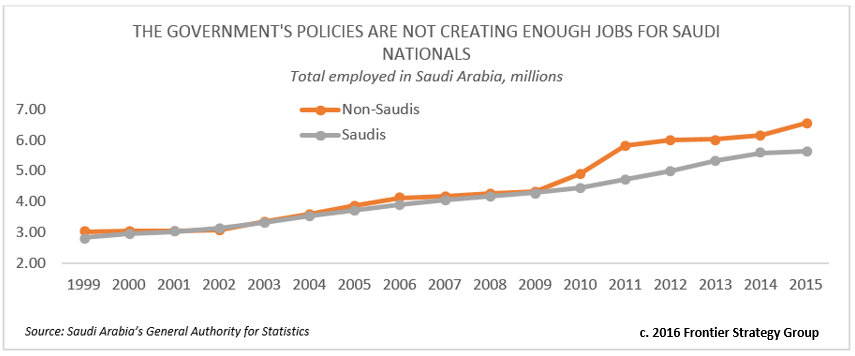
While the interview outlined the potential for sweeping changes in the Saudi market, there is one topic that was not addressed, which could have a more immediate and acute impact on foreign companies: changes to Saudization. In recent years, Saudization policies, which are meant to shift the burden of job creation to the private sector by requiring firms to hire a specific percentage of Saudi nationals, have simply failed to deliver meaningful change in society.
After a brief analysis of key data, it is plausible to assume that the country is on the verge of revamping labor regulations or doubling down on the current policy. As Jadwa Investment points out, Saudi Arabia’s official unemployment rate dropped to 11.5% in 2015 from 11.7% in 2014 but that is due to a lower labor participation rate rather than a surge in new jobs. In fact, according to official data recently released by the General Authority for Statistics, Saudi national employment only increased 1.4% YOY in 2015 which is the lowest growth rate since 1999 and below the population growth rate—1.8%. In contrast, non-Saudi employment grew 6.2% YOY in 2015.
This is a big problem when viewed through a demographics lens: two-thirds of Saudis are under 30 years old, and the youth unemployment rate is approximately 30%. Saudi Arabia must ensure enough jobs are created to keep up with more than 150,000 graduates entering the job market per year. It cannot do this without private sector assistance. Whether the government seeks to achieve this goal by raising labor quotas across sectors, or through another major overhaul of policies, change is coming. Senior executives that ignore these clear signals are in danger of significantly underperforming sales targets in the coming years.
What this means for foreign companies
Senior executives should guard against knee jerk reactions within their organizations ahead of potentially significant Saudization developments. It will be crucial to work with relevant regional and local staff, as well as local partners, to prepare for the possibility of new regulations going into effect. If new policies are implemented, senior executives will need to clarify internally how this impacts resources, profitability, staffing, training, and long-range plans.
As with all shifting business environments, there are always opportunities for companies that are prepared to take calculated risks. For companies operating in Saudi Arabia, moving to abide by new labor regulations could align with plans to set up manufacturing facilities and provide greater leverage against competitors. For companies seeking to enter the Saudi market, this could provide a chance to differentiate their organization from seasoned competitors that could be slow-moving in overturning long-established local structures. Regardless, the sands are shifting in Saudi Arabia and companies must be ready to demonstrate their willingness to localize if they want to continue cashing in on opportunities in the MENA region’s largest economy.
For our latest updates and insights, FSG clients can visit the client portal. Not a client? Contact us to learn more.