
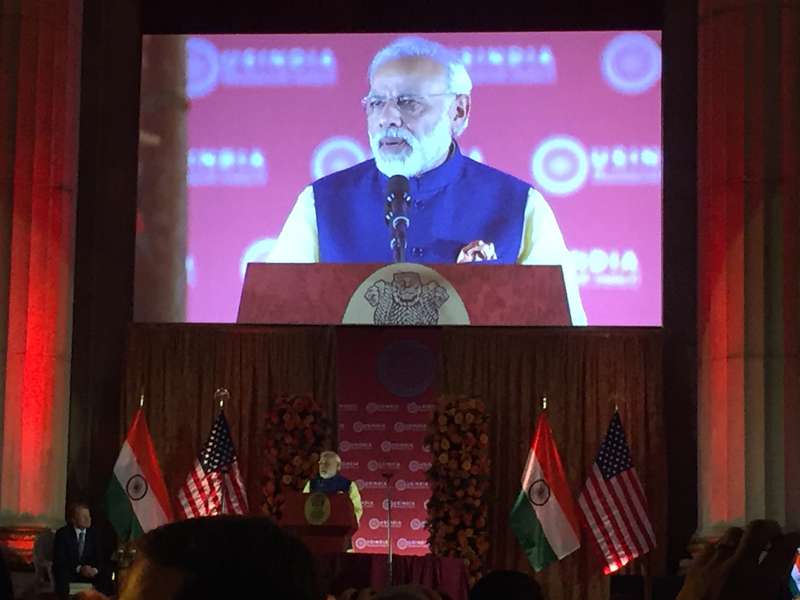
FSG attended a closed United States India Business Council (USIBC) dinner on Tuesday night welcoming Indian Prime Minister Narendra Modi to the US capital. After proclaiming India as the “safest bet” in the world for multinationals today, John Chambers, Executive Chairman of Cisco Systems, introduced Mr. Modi as one of the top three world leaders he has ever met.
Mr. Modi began his keynote speech with the statement that the world needs the engine of growth provided by India as the global economy continues to slow. In an apparent swipe at China, he emphasized the importance of this engine being democratic. He then launched into a forceful speech about how a larger Indian economy has multiple benefits that stabilize the world.
Aiming his comments at the congressional attendees at the dinner, Mr. Modi emphasized that India is much more than a market for the US. It is a reliable partner, presumably in defense matters, and a steady source of tech resources. By further opening up its defense sector, India is providing a big opportunity for defense contractors. Mr. Modi received a surprisingly loud applause from the audience when he announced that India now allows women to serve in combatant roles.
The energy sector, never able to provide enough energy for the growing economy, will finally get a boost, as India is purchasing six nuclear reactors from Westinghouse as part of the nuclear accord reached years ago.
Having completed two years in office, Mr. Modi talked about his desire to “reform and transform” the Indian economy by his administration’s ongoing work on macroeconomic policies and a “frontal attack” on the long endemic corruption that continues to put a burden on economic growth.
Although we have all heard these promises before, the policies include specific inflation targets, independence from meddling politicians on monetary policy, reduction in fiscal deficits, liberalization of foreign direct investment and opening up once closed industries to foreign investors. As evidence of this liberalization, Mr. Modi touted the investment that GE has made in setting up a locomotive manufacturing plant in Bihar, one of India’s most impoverished states.
The tenets of this administration’s plans to improve the Indian economy include:
- Digital India – A flagship program to transform India into a digitally-empowered society and knowledge economy. The program is centered on three key areas: (i) digital infrastructure, (ii) governance and services on demand, and (iii) digital empowerment of citizens. It is this initiative that made Mr. Chambers proclaim that Mr. Modi is driving digitization faster than any other country.
- Startup India – This initiative aims at fostering entrepreneurship and promoting innovation by creating an ecosystem that is conducive for start-ups. The objective is to make a nation of job creators instead of being a nation of job seekers.
- Make in India - Launched by Mr. Modi in September 2014 as part of a wider set of initiatives devised to transform India into a global design and manufacturing hub, it became a call to action to Indians, and an invitation to potential partners and investors around the world. It represents a comprehensive overhaul of outdated processes and policies.
Mr. Modi stated that these and other actions taken to improve the ease of doing business in India have helped the country move up in independent rankings like the World Bank’s Doing Business ranking, in which India moved up four spots over the past year. He also talked about major improvements in ports and the banking sectors as two examples of infrastructure advances. These banking improvements, for example, are bringing millions of people into the formal banking system for the first time.
Touching on social improvements, Mr. Modi mentioned a government-run savings program that pays high interest rates and uses the principal to help provide education to girls. He also made the insightful comment that India, with 800 million people under the age of 35, is a human resources “powerhouse” as the developed world’s population ages.
Mr. Modi must have appreciated the fact that Jeff Bezos, the founder of Amazon, chose the USIBC event to announce that Amazon is committing to invest three billion dollars, on top of the two billion announced in 2014, in its operations in India, and that India was now Amazon’s fastest growing geography with 45,000 employees and booming ecommerce.
Multinational firms are actively increasing investment in India as the economy expands, and the country takes on a new role in multinationals’ emerging markets portfolio.
This post was written by Neeraj Vohra, CFO of Frontier Strategy Group.
For more insights on India or an in-depth analysis of the macroeconomic outlook for the country, FSG clients can access the India 2020: Outlook and Scenarios report and other India resources on the client portal. Not a client? Contact us to learn more.