
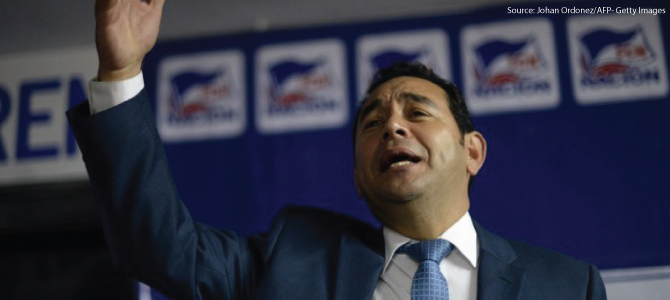
 Not even a month has passed since Jimmy Morales won Guatemala’s presidential elections running on a strong anti-corruption platform, and already there is a new mass protest against corruption to be held in Guatemala City on Nov.28.
Guatemalans first began taking to the streets in April of this year following the announcement by the country’s public prosecutor and the International Commission Against Impunity in Guatemala regarding the uncovering of a substantial corruption scandal tied to the country’s customs office.
The first victim of the consequent series of popular protests, which extended through September, was the country’s vice-president Roxana Baldetti, who resigned on May 8 and is now being held in jail as a precautionary measure while she awaits trial for charges of corruption. Four months later, in September, the protests brought about the resignation of the country’s president, Otto Perez Molina, who was subsequently stripped of his immunity by Congress and also jailed for precautionary measures while awaiting trial for corruption charges.
Mr. Perez Molina’s resignation came only days before the country was to hold presidential elections and consequently generated considerable uncertainty surrounding the expected electoral outcome. Indeed, the corruption story was the major driver behind the decision by the Guatemalan people to elect the former Comedian Jimmy Morales in a second round vote on Oct. 25. Mr. Morales, who has little previous political experience, will assume office in January of 2016.
Why FSG believes Guatemala will continue to outperform
Brought to power by a wave of popular discontent driven by a major corruption scandal, Mr. Morales lacks significant political experience, a structured plan for policy reform and even support in congress (his party holds only seven percent of the seats). While Mr. Morales is likely to struggle to pass significant reform, FSG believes it unlikely that renewed popular protests would be sufficient to disrupt continued economic growth. However, heightened protests driven by continued impunity for already identified corrupt officials, or the uncovering of a new corruption scheme, could result in supply chain disruptions and elevate operating costs. That said, Guatemala should continue to represent an outsized opportunity in an epoch of low growth in the larger Latin America region.
- Stable public finances: Despite the continued fragility of the Guatemalan political system, since protests began in April the economy has remained relatively shielded. This result can be viewed as a consequence of the government’s strong fiscal position that was generated by years of conservative fiscal policy and the resultant stable macroeconomic environment created for investors and consumer alike. Inasmuch, in the case of current or continued political instability the government has significant space to expand public spending while being unlikely to encounter problems meeting its short-term debt obligations. Overall, Guatemala maintains a more robust fiscal position than those of its regional counterparts such as Costa Rica, the Dominican Republic, or Panama, which confront both higher debt to GDP ratios as well as larger fiscal deficits.
Opportunities: Putting the Guatemalan opportunity into perspective against other markets in Central America and the Caribbean
Guatemala’s relatively stable government finances have provided its economy and large consumer base the necessary stability to expand in recent years and should continue to do so in the near future. While Guatemala currently represents the largest consumer base amongst its regional counterparts (aside from Puerto Rico), according to FSG forecasts by 2017 it should also have the largest overall economy with GDP reaching approximately USD 71 billion, just slightly larger than the Dominican Republic. Guatemala should receive a boost from continued strength in the United States, its main export market, as well as sustained appreciation of the US dollar, which will boost the purchasing power of remittances (FSG estimates remittances to Guatemala will reach 6.5 billion in 2015, or nearly 12 percent of GDP).
How FSG can help:
Despite the relevant opportunities, the complexity and lack of available data for countries in this region can often make market prioritization in Central American and the Caribbean difficult for multinationals. Additionally, differences across these markets in terms of their operating environment, go-to-market strategies and competitive landscape make it difficult to estimate the actual cost and difficulty of capturing new business opportunities. FSG can help companies drive strategic planning via its proprietary market prioritization methodology and unique market expertise. Likewise, FSG clients can look forward to a future report dedicated to channel strategy for Central America and the Caribbean to be published in Q3 of 2016, which will be aimed at helping clients identify the right distribution model for this region, learn how to leverage e-commerce, build sound processes to find, vet and manage partners, and plan for future channel transitions in Central America and the Caribbean.
For our latest updates on Guatemala and Latin America, FSG clients can visit the client portal. Not a client? Contact us to learn more.