Russia’s Positive Consumer Outlook Will be Hit by Inflation Spike in H2 2012


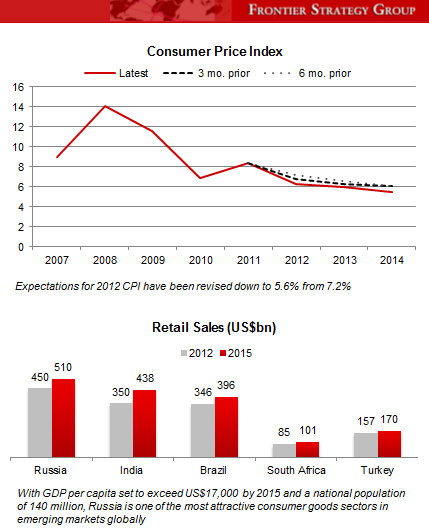
Consumer spending will remain high through H1 2012, benefiting the consumer goods and technology sectors. However, a struggling industrial sector and a rise in inflation will reverse this trend starting in H2 2012.

Drivers

Historically low inflation, averaging 6.1% in 2011, will support household spending through H1 2012. However, utility and residential tariff hikes scheduled for June will lead to a sharp uptick in consumer prices in the second half of the year.

Unemployment, at 6.1% in December, is at a historic low and is supporting a positive consumer outlook.

High energy prices are supporting the ruble, driving up consumer demand for imported goods.

Frontier Strategy Group View

High consumer spending will buoy demand for consumer goods, pharmaceuticals, consumer electronics, and durable goods through the first half of 2012.

A decline in energy prices remains a downside risk to the broader Russian economy, including to the consumer sector.

Over the next two years, some of the social spending increases promised by Vladimir Putin during his presidential campaign will be carried out, providing support for Russian consumers.

Social spending increases will have the strongest impact on sales of fast-moving consumer goods and out-of-pocket pharmaceuticals.


Political Risk is Here to Stay Under Putin


Original article appeared in Business Insider

MNCs should anticipate some political and economic liberalization, particularly among regional authorities, after Putin returns to the presidency. However, we expect any new reforms to have limited positive effect on the business climate in the country.

In the short term, Russia may see increased investor uneasiness paired with ruble depreciation and capital outflows, as the elections will be followed by protests. However, we expect the situation to stabilize and investor confidence to return by 2H 2012.

Putin is neither willing nor capable of delivering the reforms demanded by the Russian middle class. Over time, this will erode Putin’s legitimacy and power base. To avoid large-scale political change that may threaten their personal wealth, Russia’s political elite may decide to sacrifice Putin in a partial political liberalization that would see him replaced before his six-year term as president ends. This scenario is particularly likely if there is a major external economic shock, such as a sharp decline in energy prices.


Russia’s Protests: Higher Volatility, New Opportunities Await Multinationals


Putin

(Image from Euronews)

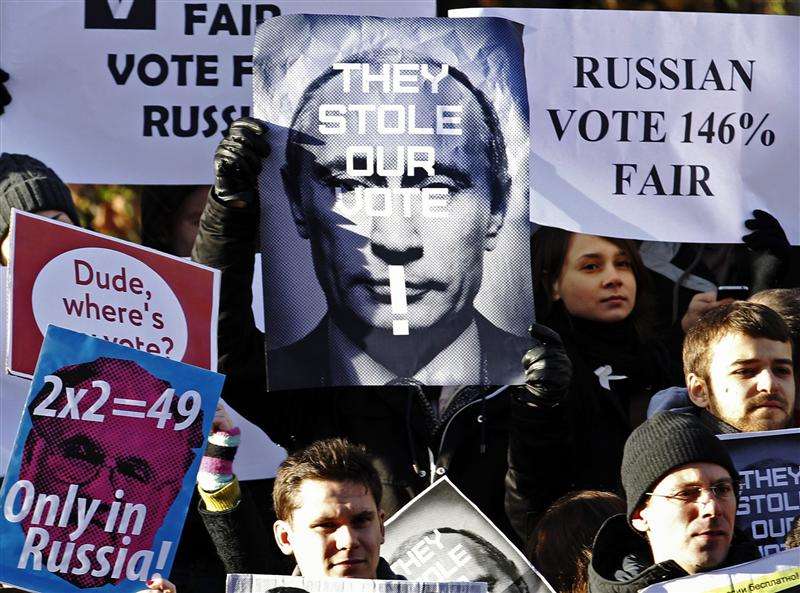
The popular protests following the latest Duma elections revealed a fundamental shift in Russian popular opinion which has been forming for over a year now: as Russians realize that the economic prosperity of the pre-crisis 2000s is slowly but surely turning into long-term stagnation, they are no longer ready to pay for it with their political freedom and sense of personal dignity. Russians feel humiliated by a state they see as increasingly captive to interest groups and corrupt officials. This is bad news for Russia’s political elite, but good news for multinationals.

We are not seeing an Arab Spring in Russia, and neither is any opposition group or personality powerful enough to galvanize the disenchanted voters. Barring a major Black Swan event, Putin will return to the presidency in March for a six-year term. However, the legitimacy of his power has been undermined and will continue to be, making him a weaker leader. As Russians increasingly demand change, he may be able to last through his six-year term, but he is unlikely to be elected for another one. Meanwhile, the power groups that stand behind him may decide an unpopular Putin is a liability they don’t want to bother with. A post-Putin Russia is much more likely to be ruled by a political leader unofficially promoted to national prominence by the established elite, than by an opposition leader who will be an outsider to Russia’s power circles.

For multinationals, this means that the overarching political environment in the country will remain unaffected in the short term, but there will likely be some reshuffles and instability within Russia’s elite, including among high-level state officials. To respond to demands for change, Putin will introduce some new faces to the government after the March elections, and MNCs should be positioned to engage with them through a more nuanced government relations strategy.

The perception of increased political risk will continue to drive capital outflows from Russia, putting downward pressure on the ruble and contributing to rising inflation. Capital markets, already highly sensitive to risk in Emerging Europe as a result of the eurozone crisis, will be cautious at best on Russia, making financing more costly to Russian companies. As a result, MNCs should expect high volatility on the Russian market at least until the outcome of and reactions to the presidential elections in March are clear.

And while MNCs will likely see some of their Russian partners struggle with tighter lending and a weaker ruble, this period will create opportunities as well. We expect high government spending through the March elections as Putin seeks to appease the population. The weaker ruble and higher volatility also make this an opportune time for MNCs interested in pursuing M&A. Even major Russian companies are increasingly struggling to raise money on the global capital markets, creating opportunities for strategic acquisitions by MNCs with a long-term vision for the Russian market.

Russian ruble taps two-year low on Kremlin shift


From MarketWatch

The Russian ruble fell to a more than two-year low versus the U.S. dollar Monday, under pressure after the nation’s Finance Minister Alexei Kudrin resigned over a policy dispute with President Dmitry Medvedev.

Kudrin resigned Monday as Russia’s finance minister and deputy prime minister, citing differences with the president on economic policies, the state-run RIA-Novosti reported.

Putin to return as Russian president

WSJ’s Richard Boudreax looks a how Vladimir Putin’s return as Russian president could hamper U.S. efforts to advance arms-control and trade agreements.

Some investors had seen Kudrin as a guarantor of the country’s financial stability, the news agency said.

“It is difficult to see how Mr. Kudrin’s resignation can be anything but market-negative,” said Neil Shearing, chief emerging market economist at Capital Economics, in a note to clients.

The ruble weakened following the news, with one U.S. dollar (ICAPC:USDRUB) buying 32.48 rubles, up 1.5% from Friday. It traded as high as 32.55 rubles earlier, a more than two-year high for the dollar, according to data on FactSet Research, which tracks closing levels.

Medvedev on Saturday endorsed Vladimir Putin’s return as president. Kudrin has reportedly refused to join Medvedev’s government should Putin become the new president after elections in March and appoint Medvedev as prime minister.

“For all Mr. Medvedev’s warm words on the need to progress market reforms, Mr. Kudrin has arguably been more influential in rebuilding Russia’s balance sheet from the ashes of the 1998 ruble crisis,” said Shearing.

And “with oil prices starting to slide and financial markets still jittery, now is not a good time for the government to lose its arch-fiscal hawk and one of its most influential liberal voices,” he said. “It is unlikely that Mr. Kudrin’s replacement will share his predecessor’s credentials and clout.”

Ruble, equities risks

For now, the Russian markets will likely take their cue from events in the global economy and the outlook for commodity prices in particular, Shearing said.

And the risks to the ruble and Russian equities “lie firmly on the downside,” given Capital Economics’s view that the euro-zone crisis is likely to deepen, Group of Seven growth will grind to a halt in 2012 and oil prices will fall further, he said. Crude-oil futures prices (NMN:CL1X) have fallen by around 15% year to date.

Matt Lasov, director of global research at Frontier Strategy Group, said the negative impact on Russia’s market from Kudrin’s resignation won’t be enough to change market fundamentals.

But “Russia will still struggle with an over-reliance on oil in an environment where European demand is set to drop, impacting Russia’s revenues and growth trajectory,” he said.

It wasn’t clear if news of Kudrin’s resignation came before or after the stock market’s trading session ended. The ruble-denominated Micex stock index closed 1.5% higher on Monday at 1,346.86 points, according to the Micex Group’s Web site. Year to date, the index is down 20%.

At Moscow’s other stock exchange, the dollar-denominated RTS stock index (RTG:RU:RTS) fell 0.1% to finish at 1,315.25 points. Competition authorities earlier this month approved merger plans for RTS and the Micex Group.


Putin’s return to the presidency – not all good news


Saturday saw Russia’s biggest political riddle resolved – Vladimir Putin announced he was running for another term as president and offered Medvedev the post of prime minister. What does this mean for Russia’s business climate?

We now have clarity about Russia’s leadership for at least another six years. United Russia is set to win the elections this fall, and there is no doubt Putin will win the presidential elections in March 2012. This implies continuity in current government policies and actors, and will certainly boost investor confidence in Russia. It should at least partially support Russia’s falling currency and weakening stock market. Although the continuing crisis in the euro zone and the falling oil prices will minimize the announcement’s positive effect on the ruble, we can at the very least expect greater capital inflows through the rest of the year as well as an increase in FDI in the country.

In the short-to-medium term, this is good news for MNCs selling and operating in Russia, especially in the context of an unpredictable global economy. However, there are several potential threats down the road companies should watch out for.

First, there is wide consensus that the Russian economy requires fundamental reform away from its dependence on oil prices and high government spending. Such reform would mean reducing government spending on social programs, and will certainly be met with discontent among the population, something that Putin may or may not be ready to face. There is significant inertia in the Russian government and Putin is if anything a symbol and perpetuator of the status quo. Should oil prices remain high, Russia will hum along well enough. However, a prolonged fall in oil prices will bring about a very serious crisis in Russia, and the country is nowhere nearly as well prepared to weather it now than it was in 2008.

Second, while Russians still see no political alternative to Putin, there is a growing sense of stagnation – political, social, and economic within Russia that Putin is increasingly beginning to symbolize. Russians may vote for Putin, but that doesn’t mean they actively support him and his policies. In the short-to-medium term this has few implications. In the long term, however, it’s the stuff of social upheaval. Russia is inevitably headed into a major political transformation, and it’s now clear its current political leadership is not ready to steward the country through to it.

To sum it up, MNCs will benefit from a relative improvement in Russia’s business climate in the short term, will need to watch carefully for whether and what economic reforms the government undertakes after March 2012, and expect that in the long term, the rules of the game in Russia will change.