My colleague Shijie Chen recently wrote about the need for provincial analysis to uncover new business opportunities in China. Regional analysis is also needed for India since a study of the parts is more revealing than a study of the whole. Comparative performance analysis of the Indian states has become more prominent than studies of national strategies, as state-based reforms will likely be one of the key drivers of higher national growth in the future. Here are four things to consider:
- Divergence in development: India’s economic growth story has not been one of coherent national expansion—it has been one of scattered tales of development, making the study of its individual parts highly important
- Above average states: At a time when the country is going through a slowdown, companies need to find the opportunities in states where there has been sustained high growth; in 2011, 75% of the states grew above the national average, and 25% experienced a double-digit economic expansion
- Coalition politics lead to regionalism: Because the central government is composed of coalition of parties, economic competition between the states has increased as regional parties vie to distinguish themselves
- States with their own policies: State governments are also likely to begin introducing their own economic policies to promote growth. Narendra Modi, chief minister of Gujarat, has introduced a five-year export policy in the state to promote its products on an international level. It is the first of its kind to be adopted in the country
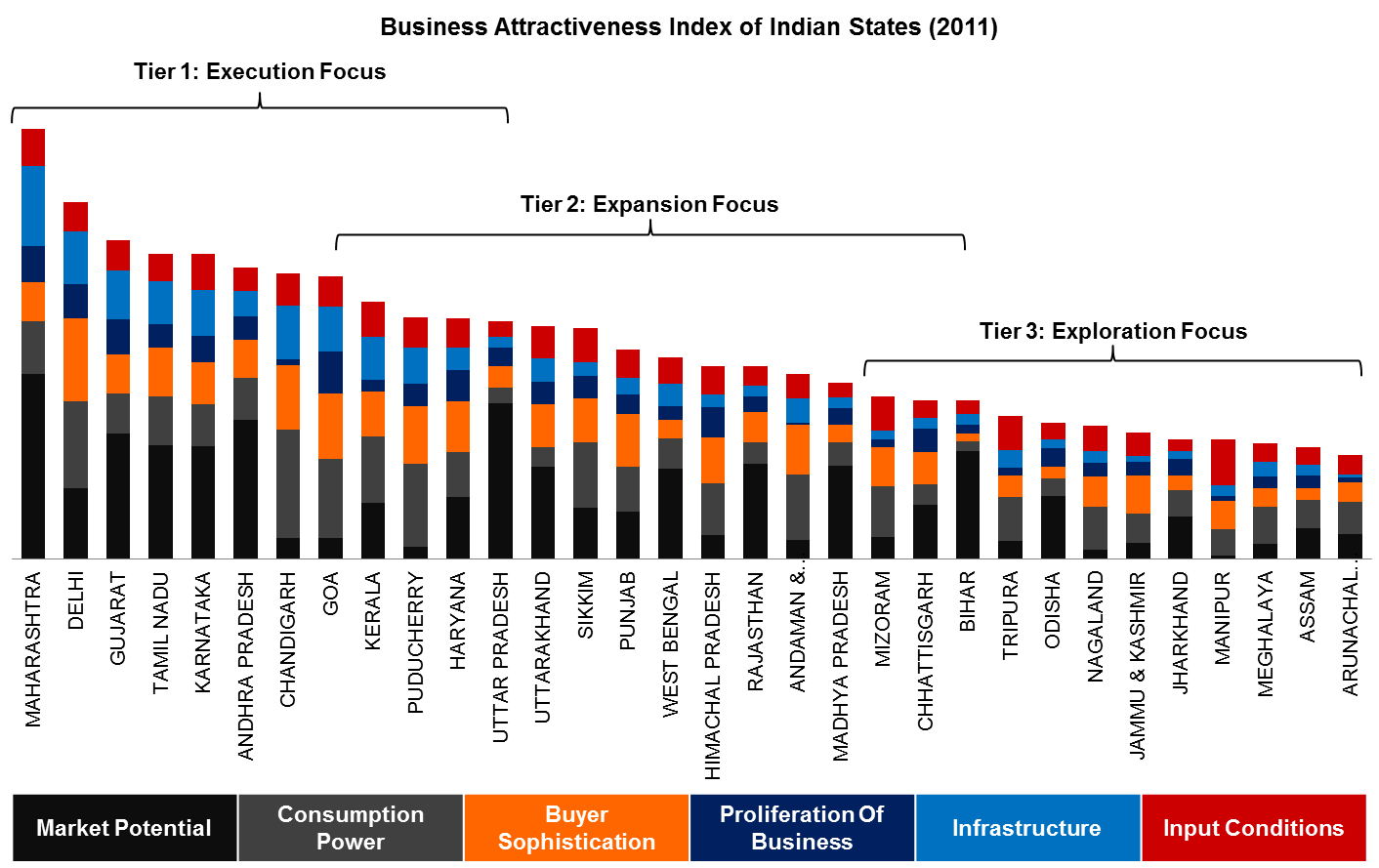
Frontier Strategy Group aggregated critical variables into an index and benchmarked the states in India against each other to understand their structural differences:
- Factors chosen: Six areas of focus were chosen based on factors that are considered imperative for making investments
- Weights: Weights were chosen to favor states that would reveal a long-term attractiveness
- Normalization: Variables were normalized in order to account for the size differences between the states
After ranking the states, we divided them up into three key areas as you’ll note in the chart below (this division would differ from business to business)
- Execution Focus: Established States Where Optimization of Operations is Necessary
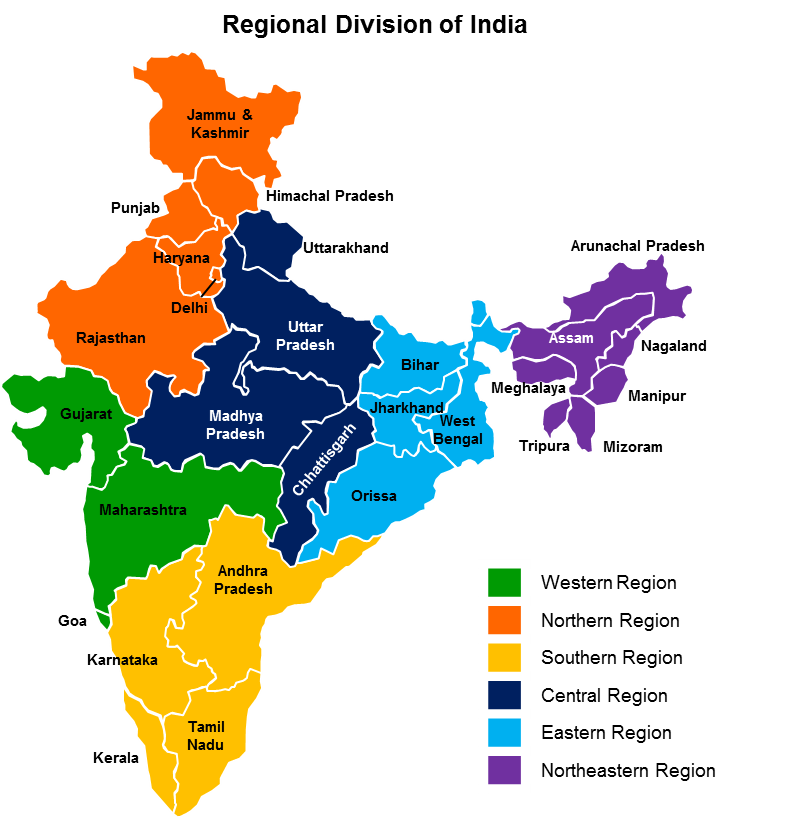
These are states where several MNCs have had a presence for over a few decades, making these markets established and well penetrated, necessitating a pivot in strategy from one that is expansion focused to execution focused - Expansion Focus: Growth Trends are Key Deciding Factor States under this umbrella are those where you currently have a presence or potentially consider creating one. Analysis of these expansion-focus states should not be conducted purely on a size basis, because many of them have grown tremendously over the past decade; a study of change in growth trends is more relevant for gauging true potential
- Exploration Focus: Mostly Eastern, Northeastern, and Central States of IndiaAn exploration focus is needed in states where your firm does not have a presence but would be interested in exploring; especially the top-tier or highly-populated cities in such states. Companies should conduct longer-term comparative studies to judge the true performance of some of these up-and-coming states in the eastern, northeastern, and central parts of India
India’s economic growth story has not been, and will not be, one of coherent national expansion; it will remain one of scattered tales of development. As the country goes through a phase of decade-low growth, companies need to find opportunities in states where there will be sustained growth, wealth creation, and overall development.


Speak Your Mind