China’s Shadow Banks Impact Your Global Business

China is the world’s second-largest economy yet many executives ignore it as a source of systemic risk to their global business. The biggest risk in China surrounds its banks, yet we hear little about the problem. Executives in China are often say that the government will simply bail out the system if there were a problem, but that discounts domestic political constraints as well as economic ones. For example, if the Fed, which can print the world’s reserve currency, could barely contain the US banking crisis, what makes us think that China can? Is this time different?
China GPD

A major shock to the Chinese economy would have a ripple-effect across the globe because of China’s massive demand for commodities and deep trade linkages with Western markets. When China sneezes, the world catches a cold.

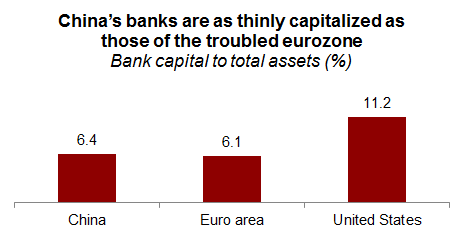
JPMorgan estimates that loans originated by China’s shadow banks may comprise 69% of GDP. With small Chinese businesses unable to secure bank loans, the shadow banking system has flourished. Because of low official deposit rates and restrictions on putting money overseas, savers turn to the shadow banking market to earn higher yields, funding the risky credit cycle, while China’s large banks provide additional leverage via wholesale funding.
China GPD

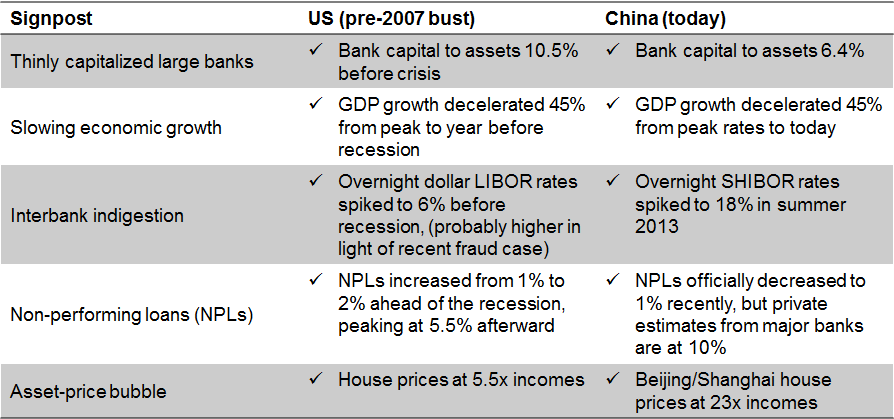
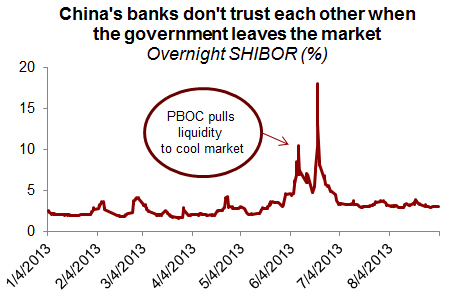
The real risk is not that shadow banks go bad; in fact the Chinese government is actively trying to curb the industry’s growth. Instead the risk is that bad loans in the shadow system bubble up to the systemically important banks that provided wholesale funding, dramatically slowing China’s growth. Officially, non-performing loans are only 1% of total bank loans, but credible private estimates put the number closer to 10% The problem became clear this June when the People’s Bank of China (PBOC, China’s Central Bank) engineered a cash-squeeze to pressure the shadow banks, and the banks stopped lending to each other pushing interbank rates to 13.4% overnight (SHIBOR).
China GPD

Before the 2007-2008 crises in Europe and the United States, similar interbank indigestion was a strong leading indicator of the looming credit bust.

While the Chinese government is taking actions to manage this risk, companies should also take action by building scenario plans into their long-range business plans. Better to build in insurance, even for something perceived as low risk, as economic history has a tendency to repeat itself.
What the US Government Shutdown Means For Emerging Markets

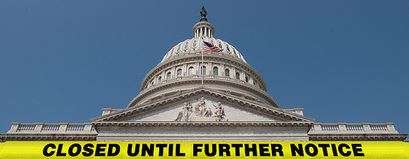
Closed until further noticeThe Fed will delay the tapering of its bond buying program in response to the US government shutdown. For emerging markets this means a slower pace of currency depreciation into year-end, and the potential for limited short-term appreciation in markets that may have over-corrected, like Turkey and Indonesia. With currency depreciation slowing, fourth quarter GDP results may surprise slightly to the upside. The dollar-denominated ETFs that track local Turkish and Indonesian stock markets both increased 4% on the news.

Emerging Markets Are Clouded By Increasing Global Uncertainty

Global Mosaic

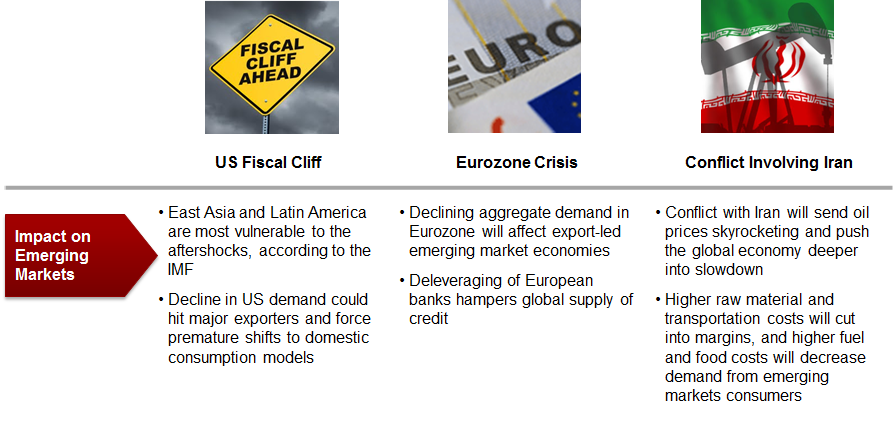
Uncertainty in the global economy, primarily a result of questions surrounding policy decisions in the Eurozone and United States as well as the potential for conflict in Iran, is affecting global economic growth prospects. Growth projections for 2013 continue to fall as worries over fiscal consolidation, financial weakness, and high levels of public indebtedness in advanced economies put downward pressure on global growth. In emerging markets, activity has been slowed by weaker demand from advanced economies, policy tightening in response to capacity constraints, and country specific factors. However, emerging markets are now better positioned to be resilient in the face of crisis compared with 2008, due to policy improvements in the fiscal and monetary space.

As financial markets continue to react to the re-election of Barack Obama, emerging markets globally have a keen eye on the developments surrounding the upcoming US Fiscal Cliff. The impacts of automatic spending cuts and tax increases would be seen worldwide, as declining US demand would affect export-dependent economies across the globe. Lower aggregate demand would also yield downward pressure on commodity prices as global manufacturing decelerates, further damaging economies that are dependent on commodity exports. FSG predicts that emerging market oil exporters could witness drastic reductions in real GDP growth, as much as a .8% decline in 2013.

Even with all of the uncertainty in the global economy, FSG has identified a number of emerging markets countries that nonetheless are expected to exhibit strong growth in 2013. These markets tend to fall into one or more of the following buckets:

Improved political stability

  • E.g. Vietnam, Thailand

Ample fiscal cushion

  • E.g. Angola, Qatar

Relatively insulated from the Eurozone

  • E.g. Philippines, Malaysia

Large domestic populations with a booming middle class

  • E.g. China, India, Indonesia

In my next post, I’ll discuss some of the implications of the Eurozone debt crisis and a potential conflict involving Iran on emerging markets growth prospects for 2013.

Exporters Beware – Potential Impact of a Double-Dip Recession

Crisis GDP

As the Eurozone teeters on the precipice of financial disaster, the global economy lies in wait. Emerging markets countries in particular are acutely aware that the implications of a further slowdown in Europe could have paralyzing macroeconomic effects. The most recent crisis in 2008 put a spotlight on export-dependent countries as the reduction in global trade led to drastic levels of economic contraction.

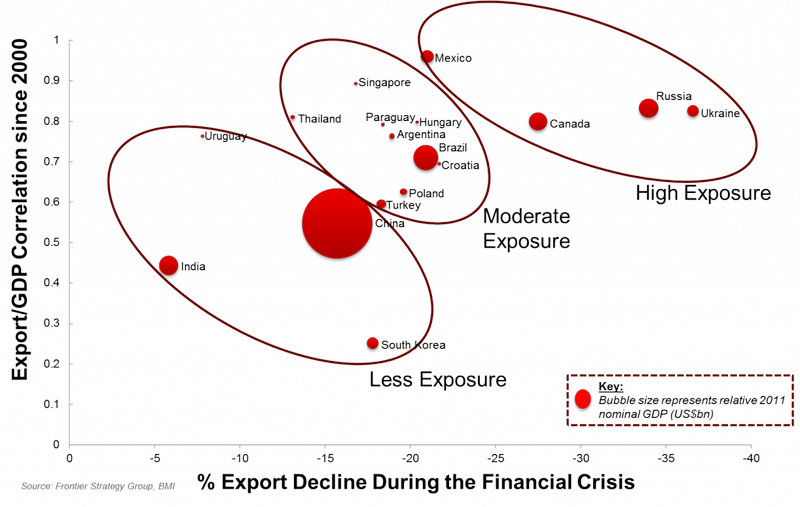
In preparing for a potential double-dip recession, it is important to recognize which countries are most susceptible to another wave of declining global consumption. By analyzing the overall correlation between countries’ GDP and export growth since 2000, as well as the % decline in exports during the 2008 recession, we were able to create a framework for gauging country risk exposure. What we found is that countries generally fall into one of three buckets in terms of exposure, depending on the overall historical relation of export growth to GDP growth and quantity of export decline in 2008.

Some of the results may be intuitive, as geographic proximity would dictate increased levels of trade and reliance on the general economic health of the Eurozone (e.g. Russia, Ukraine).

However, some results may not be as obvious. Even though Latin America is generally viewed as well insulated and a relative safe haven for growth-seekers, Mexico’s extreme GDP and export contraction during the last financial crisis should be a cause for concern. While Mexico is now much more prepared to pursue counter-cyclical policies and in an improved competitive position on the global scale, a sharp decline in global demand could leave the economy reeling.

FSG uses this framework as one of many lenses for understanding the potential consequences of a double-dip recession. Nonetheless, it is vital to incorporate the socio-political and macroeconomic developments to more accurately depict the possible results of another crisis. Nobody has the perfect crystal ball for predicting the future, but with the right analysis, it is possible to make the crystal less opaque.