



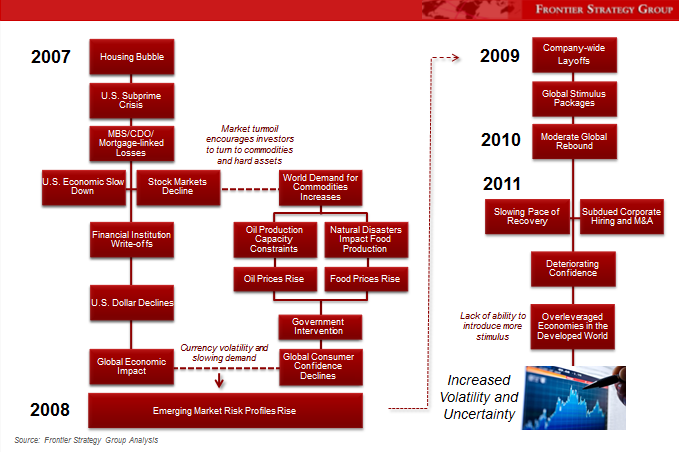
 From the housing bubble of 2007 to increased volatility in 2011, the graphic above breaks down the critical events that led to the current global economic instability.


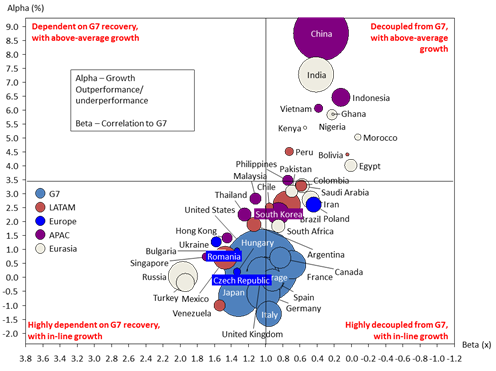
Frontier Strategy Group built a proprietary model in 2008 to test the assumption that “emerging markets are decoupled from western economies (G7)”. We found that certain markets such as Nigeria and Peru were not only decoupled but provided multinationals with consistently high growth opportunities. Conversely, growth in markets such as Turkey, were highly dependent on a recovery in western economies.
Surprisingly, in 2011, our model shifted to indicate that emerging markets are no longer thought to be as decoupled as before. Very few markets such as Morocco and Indonesia provide above average growth opportunities with less dependence on the status of western markets.
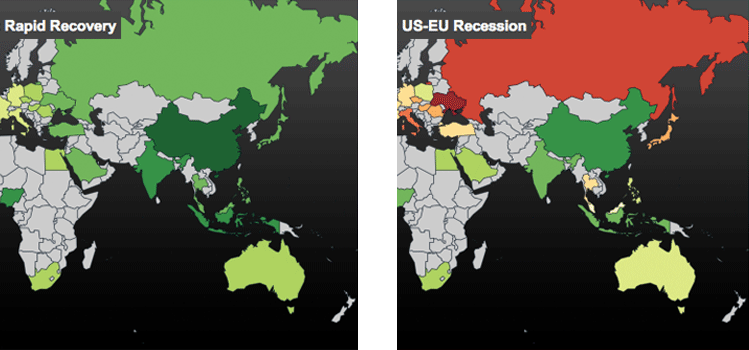
In 2008 we built a model to understand the global impact of a recession:
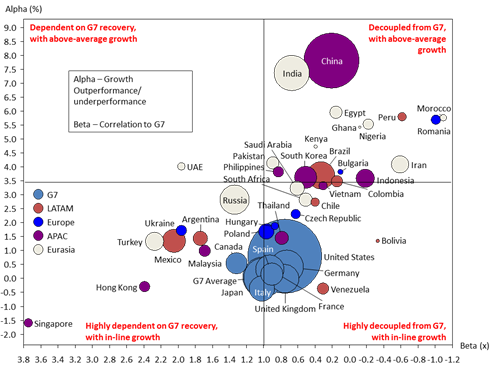
2011 data shows markets are more coupled than before
In a stable year, Q3 is a time MNCs use to adjust strategic plans and finalize budgets for 2012. However, 2011 is not a stable year. Volatility in the global economy has generated significant uncertainty in all planning processes. GDP growth projections for 2012 in Argentina range from 1.2% to 6.5%. For Russia, executives are making decisions based on GDP forecasts that range from -8% to 5.4%. These figures are critical to budget allocation, target setting, and strategic planning for 2012, and will continue to fluctuate in the coming weeks and months.
It will be increasingly difficult for MNCs such as Apple (Nasdaq: APPL) and General Electric (NYSE: GE) that have large exposures to volatile markets to manage through various scenarios. Through working with over 200 of the world’s most progressive multinational firms, Frontier Strategy Group understands what matters most to executives operating in emerging markets. In response to the economic slowdown Frontier Strategy Group launched FSG Monitor, and online resource for senior executives around the world to track the impact of the economic slowdown on their business performance in real-time.
For a limited time, FSG Monitor is available to the public, for anyone to access and view our proprietary intelligence platform.
Click on this link to view FSG Monitor yourself, or contact us for additional information.
On August 11, 2011 Frontier Strategy Group surveyed 52 senior executives on the effects of the S&P downgrade and slowdown in the U.S. and Eurozone on their businesses in emerging markets. Participants provided their predictions for what is to come in the midst of the current economic uncertainty. Below is a sample of the responses we received:
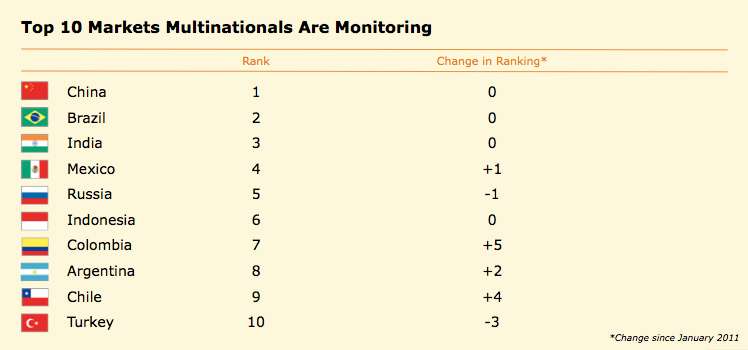
N = 213 multinationals
Global multinationals are increasingly interested in Latin America, according to recently released numbers from The F10, Frontier Strategy Group’s monthly survey of the top ten most tracked emerging markets. While China, Brazil, India, Russia and Mexico have remained the top five most monitored since the beginning of the year, new countries, including Colombia and Chile, have broken onto the list. These rising stars are garnering particular interest from consumer-focused multinationals. Although Vietnam and Thailand have dropped out of the top ten, strong interest remains in both from pharmaceutical and medical devices firms.
Featured Authors
-


