India Aims to Introduce Landmark Goods & Service Tax in H2 2012


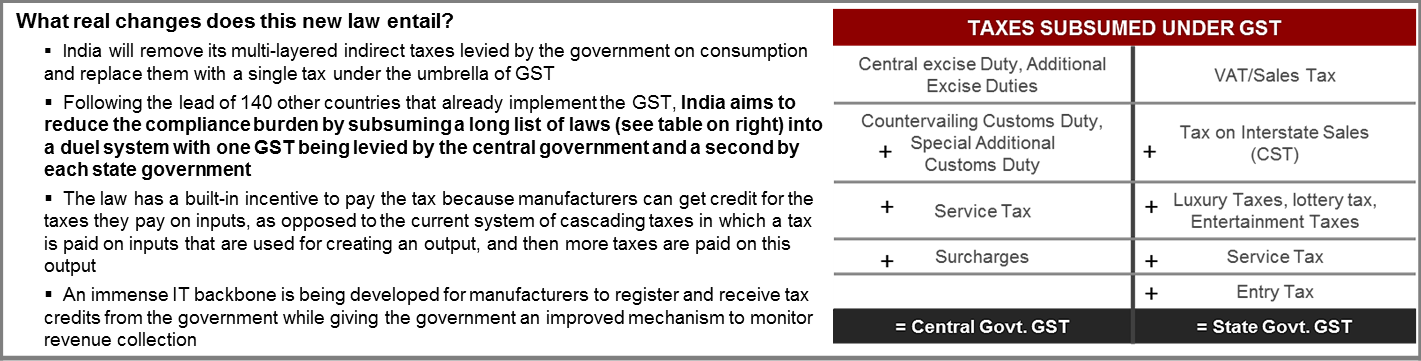
The India government has proposed the launch of the landmark Goods and Services Tax (GST) bill during H2 2012 in order to reduce the compliance burden for companies and meet international consumption tax standards

  • With the law meeting international standards and signaling the government’s attempts to simplify the process of doing business in India, FDI is expected to rise as well
  • Initial studies show that it will add about 1.5% to the GDP due to the lower compliance burden, more competitive exports, and higher tax revenues

Frontier Strategy Group View:

Companies can expect the law to be delayed due to the bargaining that will take place between the state and central governments in terms of revenue sharing and level setting

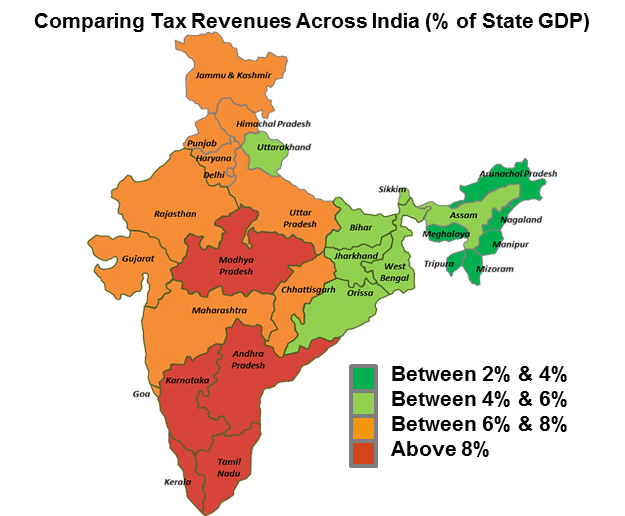
The 28 state governments have vastly differing interests; those with higher revenues are more unlikely to share their wealth with the central government (see map below)

While the reform is headed in the right direction, companies will bear the cost of inefficient resource allocation and more expensive logistics as the differing state GSTs will continue to divide the Indian market into several sub-markets.

India Map

India Policy


Brazil’s Bumpy Road Ahead


Brazil

Brazil’s recovery from the previous quarter’s economic slowdown has proven more difficult than multinationals expected, and the road to growth appears to be very bumpy. FSG clients reported underperforming sales growth during the first half of the year with many considering a slowdown as a viable threat to overall sales in 2012. Regardless, FSG clients are looking to capitalize on growth opportunities in the second half of the year by introducing new products into local markets.

The weakening real is providing some aid to exporters, but recent efforts by the government to stimulate consumer credit have failed to engender sustainable growth as consumers’ appetite for credit wanes. Brazil’s complex tax system is adding even further strain to multinationals’ business operations, yet FSG clients have reported scarcely allocating resources towards strengthening tax compliance teams. FSG surveys indicate that 35% of clients foresee a significant increase in the tax burden on their profits this year. FSG believes that tax compliance efforts by clients must be ramped up in order to capture cost-saving opportunities and protect profit margins.

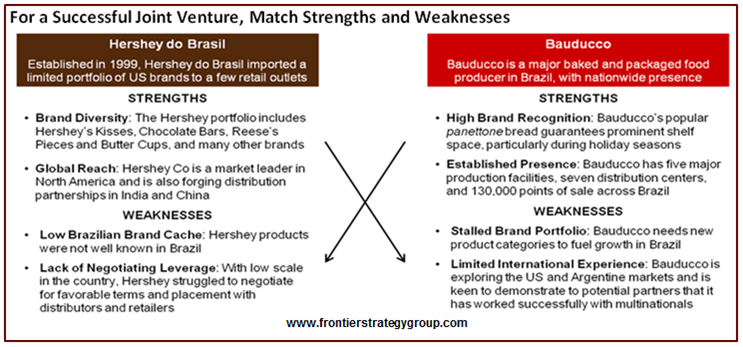
Acquisitions have been a popular strategy for multinationals seeking to capture Brazil’s rising middle-class, but recent obstacles have made joint ventures a cost-effective alternative. Intensifiedcompetition for the “middle of the diamond” along with consumer growth in far-reaching regions and adaptation to regional middle-class preferences has made acquisitions more difficult and more costly. By targeting local companies offering popular products and with established distribution networks, JVs offer a successful alternative strategy to commonly pursued acquisitions.

*Erick Soto contributed to this piece

How prepared is your business for a recession in Russia?


Russia

How prepared is our business for recession in Russia?

This is the key question multinational companies should be asking themselves as they develop strategic plans for their business in Russia.

Multinational companies are increasingly relying on growth in Russia to compensate for dwindling demand as the eurozone recession deepens and much of Central and Eastern Europe slows. And while Russia has performed relatively better than most of CEE – it grew 4.2% in 2011 – this has been mostly on the back of high oil prices.

High oil prices have supported the ruble, funded high government spending, and benefited Russian consumers who in turn have helped boost GDP growth. However, high oil prices have also made Russia a much riskier market to operate in. Russia will balance its budget this year at US$117/barrel oil up from US$37 in 2007. The country’s rainy-day fund is less than half of what it was in 2008 when it helped the country stave off the worst effects of the global financial crisis. And Russia’s economy is as far as ever from true diversification away from energy.

What does this mean for the country’s economy? Standard & Poor’s estimates that if oil prices fall to US$80/barrel, Russia will be in recession; a decrease to US$60/barrel will lead to a 5% economic contraction. This will reverberate through the whole economy, impacting companies across industries. It will also lead to capital flight, currency depreciation, and, unlike in 2008, political instability.

Although Standard & Poor’s estimates the likelihood of these scenarios playing out in the next 2 years to 30%, there are valid reasons why multinational companies should invest resources in planning for this risk. Global oil prices are not supported by supply-demand fundamentals, and will experience significant declines if the eurozone plunges into deeper recession, China’s slowdown continues, and there is an easing of international tensions with Iran. All of these events are, to some extent, already under way.

This makes planning for a significant slowdown or even recession in Russia is not just an exercise in counterfactuals; it’s an essential piece of how MNCs should be thinking about protecting their business in Russia and preparing it to take advantage of the opportunities a recession will no doubt bring about.

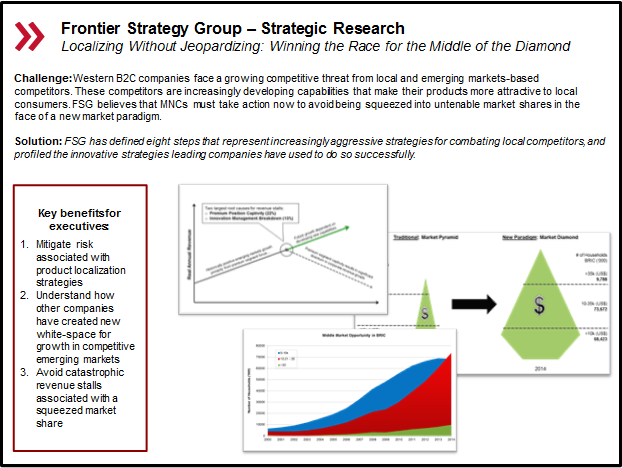
Avoid ‘Premium Market Captivity’: 8 Strategies to Capture the EM Middle Class


Product Localization

Despite the uncertainty surrounding the European debt crisis, geopolitical tensions in the Middle East, slowdowns in China and Brazil, and other external headwinds, multinational executives face aggressive 2012 emerging markets growth targets. Frontier Strategy Group’s clients tell us that their 2012 targets are in line with 2011 performance, despite the fact that 2011 enjoyed more favorable tailwinds.

In the past, Western consumer products companies have been able to rely on higher-income consumers to drive growth. These consumers often have tastes and preferences in line with those of Western consumers, and place a premium on the cachet of Western brands. And, given the relatively early stage of market maturity, there was plenty of white space for first-movers to take advantage of.

Looking into the future, Western companies will face a new paradigm characterized by more competitors fighting for share of a decelerating premium market. White space will shrink as more companies enter and expand in emerging markets in search of growth to offset the slowdown in the West. Concurrently, growth of the premium segment in key markets such as China will plateau. To achieve their targets in such an environment, executives will need to consider more innovative and aggressive strategies.

A new paradigm in emerging market customer dynamics

The changing dynamics of a softening and increasingly competitive premium market demand a new approach in how executives should think about emerging markets. Aggregated across the BRICs, middle tier households (as measured by annual household income) will actually surpass lower-tier households in sheer quantity by 2014. What this means is that the traditional market segmentation of the market pyramid will soon morph into what we like to refer to as the “Market Diamond”. As executives are thinking about emerging markets, the Market Diamond represents the idea that the middle market will be so compelling that both local competitors and multinational companies cannot afford to ignore such a large market opportunity.

A race to the middle

The only way to fight the inevitable market squeeze (competition and lower growth at the top-end, and increased local competition from the bottom-end) is to prioritize product localization strategies and move down the diamond into this huge opportunity. Growing into new market segments is not an easy task, and choosing the right strategies depends in part on executive tolerance for risk.

FSG has identified two key root challenges that are preventing companies and executives from implementing these eight middle market strategies: 1) corporate risk aversion, and 2) organizational misalignment. To provide a framework for overcoming these challenges, FSG has defined eight steps that represent increasingly aggressive strategies for penetrating the middle market, and profiled the strategies and tactics leading companies have used to mitigate the risks associated with each strategy:

  1. Redefine metrics of success
  2. Operational efficiency
  3. Adjusting price
  4. Distribution strategy
  5. Branding strategy
  6. Adapting products
  7. M&A
  8. Reverse innovation

The best companies are acting now

Mounting evidence suggests that emerging market based companies will continue to develop new capabilities and increase in levels of sophistication. Local competitors are increasingly following their current low-income customers into the middle market as those customers’ tastes and preferences evolve, and if multinationals fail to act now, they may find that they are arriving to the game too late. As the world economy continues to globalize, sophisticated emerging market based companies are no longer anomalies, but are more frequently becoming the norm. This trend illustrates that companies we now consider “local competitors”, might soon in the future become just “competitors”.

*Sam Osborn, Senior Analyst at Frontier Strategy Group contributed to this piece.

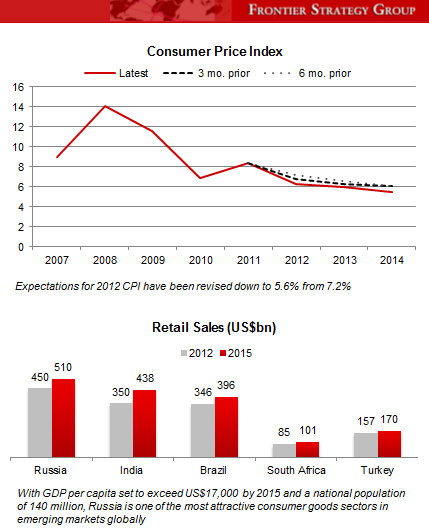
Russia’s Positive Consumer Outlook Will be Hit by Inflation Spike in H2 2012


Consumer spending will remain high through H1 2012, benefiting the consumer goods and technology sectors. However, a struggling industrial sector and a rise in inflation will reverse this trend starting in H2 2012.

Drivers

Historically low inflation, averaging 6.1% in 2011, will support household spending through H1 2012. However, utility and residential tariff hikes scheduled for June will lead to a sharp uptick in consumer prices in the second half of the year.

Unemployment, at 6.1% in December, is at a historic low and is supporting a positive consumer outlook.

High energy prices are supporting the ruble, driving up consumer demand for imported goods.

Frontier Strategy Group View

High consumer spending will buoy demand for consumer goods, pharmaceuticals, consumer electronics, and durable goods through the first half of 2012.

A decline in energy prices remains a downside risk to the broader Russian economy, including to the consumer sector.

Over the next two years, some of the social spending increases promised by Vladimir Putin during his presidential campaign will be carried out, providing support for Russian consumers.

Social spending increases will have the strongest impact on sales of fast-moving consumer goods and out-of-pocket pharmaceuticals.


Russia’s WTO entrance redraws global resource map - MarketWatch


Full article on MarketWatch

Russia’s acceptance into the World Trade Organization last month didn’t just mark an end to nearly two decades of negotiations, but opened a door to free up global trade with a nation that is one of the world’s largest oil producers and home to the globe’s biggest natural gas reserves.

And if the impact on the last large economy to join the organization — China — offers any clue, the outlook for Russian trade and its economy has much improved.

On Dec. 16, the World Trade Organization approved Russia’s membership. WTO trade ministers have said Russia’s accession to the organization will bring the nation more firmly into the global economy and make it a more attractive place to do business.

“Russia took 18 years to complete its WTO negotiations, but in the end it walked away with a great deal,” said Martina Bozadzhieva, senior analyst for Central and Eastern Europe (CEE) & Russia at Frontier Strategy Group. “Over the long term, WTO accession will increase the competitiveness of the Russian economy and [foreign direct investment] inflows.”

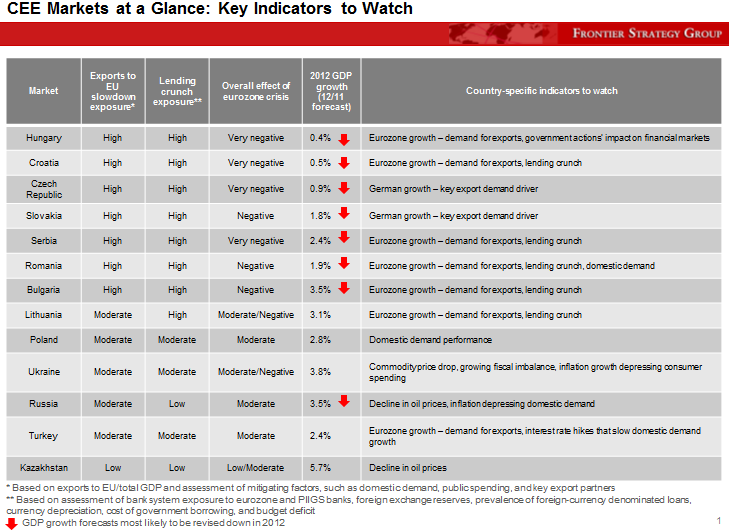
CEE in 2012: Amid Gloomy Outlook, Opportunities for MNCs


CEE Data

The outlook for Central and Eastern Europe is getting gloomier by the day as the eurozone crisis is weakening regional economies. While there is a significant level of volatility and uncertainty around the eurozone’s performance in 2012, there are several clear trends that will impact MNC performance in CEE this year:

  • 2012 GDP growth projections are low across the region and will be revised further down
  • Decreasing exports will hurt local producers
  • Tight lending will limit local companies’ ability to make investments and will dampen consumer demand
  • Austerity measures across the region will slow government and consumer spending but will ease inflation
  • Local currencies will remain volatile and weak against the dollar

MNCs should plan to adapt their product portfolios, purchasing policies, and partner relationships to respond to weaker demand and tighter lending conditions in CEE.

However, not all CEE markets will fare the same – some will be impacted more than others (see table).

This creates opportunities for MNCs that pay attention to the nuances of the different regional economies and zero in on the markets that will outperform the rest of the region. The two most obvious ones are Poland and Turkey. In Poland, resilient domestic demand will sustain growth despite the negative impact of slowing export demand. Turkey will definitely see a slowdown this year, but its macroeconomic fundamentals remain solid and the country offers excellent opportunities for long-term growth. Both countries are presently experiencing currency depreciation, creating opportunities for cheap investment and acquisition of attractive local assets at a discount.

Russia’s Protests: Higher Volatility, New Opportunities Await Multinationals


Putin

(Image from Euronews)

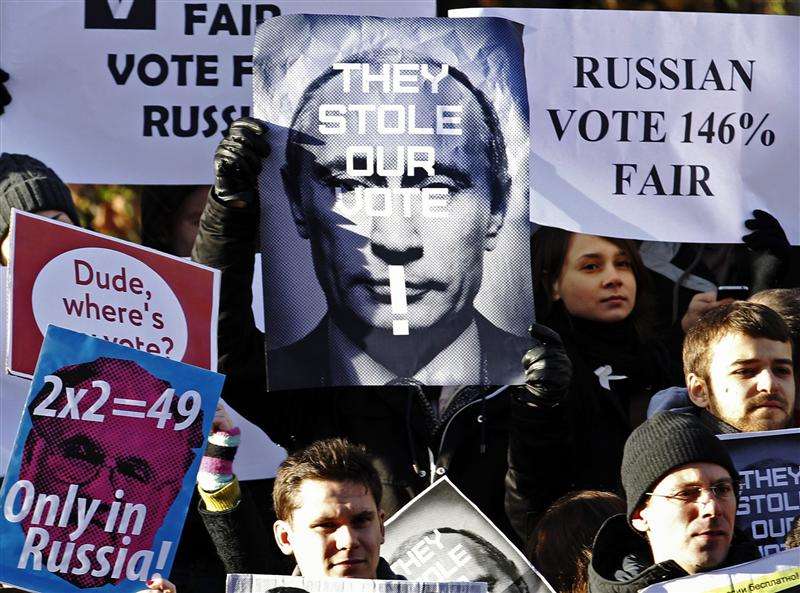
The popular protests following the latest Duma elections revealed a fundamental shift in Russian popular opinion which has been forming for over a year now: as Russians realize that the economic prosperity of the pre-crisis 2000s is slowly but surely turning into long-term stagnation, they are no longer ready to pay for it with their political freedom and sense of personal dignity. Russians feel humiliated by a state they see as increasingly captive to interest groups and corrupt officials. This is bad news for Russia’s political elite, but good news for multinationals.

We are not seeing an Arab Spring in Russia, and neither is any opposition group or personality powerful enough to galvanize the disenchanted voters. Barring a major Black Swan event, Putin will return to the presidency in March for a six-year term. However, the legitimacy of his power has been undermined and will continue to be, making him a weaker leader. As Russians increasingly demand change, he may be able to last through his six-year term, but he is unlikely to be elected for another one. Meanwhile, the power groups that stand behind him may decide an unpopular Putin is a liability they don’t want to bother with. A post-Putin Russia is much more likely to be ruled by a political leader unofficially promoted to national prominence by the established elite, than by an opposition leader who will be an outsider to Russia’s power circles.

For multinationals, this means that the overarching political environment in the country will remain unaffected in the short term, but there will likely be some reshuffles and instability within Russia’s elite, including among high-level state officials. To respond to demands for change, Putin will introduce some new faces to the government after the March elections, and MNCs should be positioned to engage with them through a more nuanced government relations strategy.

The perception of increased political risk will continue to drive capital outflows from Russia, putting downward pressure on the ruble and contributing to rising inflation. Capital markets, already highly sensitive to risk in Emerging Europe as a result of the eurozone crisis, will be cautious at best on Russia, making financing more costly to Russian companies. As a result, MNCs should expect high volatility on the Russian market at least until the outcome of and reactions to the presidential elections in March are clear.

And while MNCs will likely see some of their Russian partners struggle with tighter lending and a weaker ruble, this period will create opportunities as well. We expect high government spending through the March elections as Putin seeks to appease the population. The weaker ruble and higher volatility also make this an opportune time for MNCs interested in pursuing M&A. Even major Russian companies are increasingly struggling to raise money on the global capital markets, creating opportunities for strategic acquisitions by MNCs with a long-term vision for the Russian market.

Putin’s return to the presidency – not all good news


Saturday saw Russia’s biggest political riddle resolved – Vladimir Putin announced he was running for another term as president and offered Medvedev the post of prime minister. What does this mean for Russia’s business climate?

We now have clarity about Russia’s leadership for at least another six years. United Russia is set to win the elections this fall, and there is no doubt Putin will win the presidential elections in March 2012. This implies continuity in current government policies and actors, and will certainly boost investor confidence in Russia. It should at least partially support Russia’s falling currency and weakening stock market. Although the continuing crisis in the euro zone and the falling oil prices will minimize the announcement’s positive effect on the ruble, we can at the very least expect greater capital inflows through the rest of the year as well as an increase in FDI in the country.

In the short-to-medium term, this is good news for MNCs selling and operating in Russia, especially in the context of an unpredictable global economy. However, there are several potential threats down the road companies should watch out for.

First, there is wide consensus that the Russian economy requires fundamental reform away from its dependence on oil prices and high government spending. Such reform would mean reducing government spending on social programs, and will certainly be met with discontent among the population, something that Putin may or may not be ready to face. There is significant inertia in the Russian government and Putin is if anything a symbol and perpetuator of the status quo. Should oil prices remain high, Russia will hum along well enough. However, a prolonged fall in oil prices will bring about a very serious crisis in Russia, and the country is nowhere nearly as well prepared to weather it now than it was in 2008.

Second, while Russians still see no political alternative to Putin, there is a growing sense of stagnation – political, social, and economic within Russia that Putin is increasingly beginning to symbolize. Russians may vote for Putin, but that doesn’t mean they actively support him and his policies. In the short-to-medium term this has few implications. In the long term, however, it’s the stuff of social upheaval. Russia is inevitably headed into a major political transformation, and it’s now clear its current political leadership is not ready to steward the country through to it.

To sum it up, MNCs will benefit from a relative improvement in Russia’s business climate in the short term, will need to watch carefully for whether and what economic reforms the government undertakes after March 2012, and expect that in the long term, the rules of the game in Russia will change.

What drives private consumption in Russia?


The World Bank’s latest report on the Russian economy made headlines because of the Bank’s revision of its 2011 GDP growth forecast for Russia to 4%, down from 4.4%. However, a less conspicuous piece of analysis in the World Bank’s report carries particular importance for MNCs operating in Russia.

World Bank economists ran an analysis of the drivers behind consumer spending in Russia. The three most important factors were, not surprisingly, the level of economic activity, the external environment (price of oil, etc.) and labor market conditions.

The interesting discovery was in the effect of labor market conditions on consumption in Russia. The Bank’s estimates show that the level of unemployment has a strong negative impact on consumption, while short-term fluctuations in incomes do not translate into significant changes in consumption. For every 1% rise in the unemployment rate in Russia, private consumption falls by 2%, according to the Bank’s model.

The real-life logic behind this is that Russian businesses adjust to negative shocks mostly by lowering salaries, rather than firing employees. As a result, Russians have adjusted their consumption patterns to reflect more volatile wages, mostly seen as a temporary condition. Unemployment, on the other hand, is perceived as a much more permanent state, and directly affects Russian consumers’ choices.

The good news here is that the unemployment rate in Russia has been on a largely downward trajectory and was relatively low at 6.5% in July, a slight increase from June’s 6.1%. Coupled with a strong ruble, and a rise in consumer credit, MNCs can expect this trend to support a strong performance in Russia through the rest of 2011.


« Previous Page