Trend
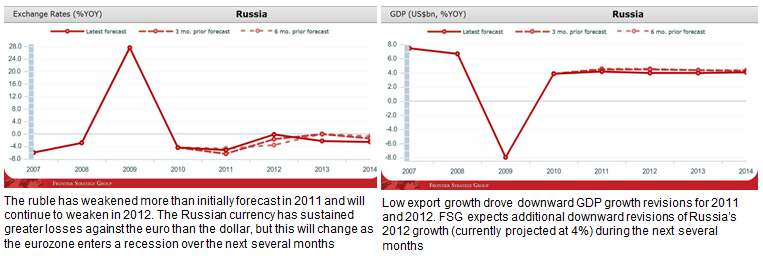
The ruble is depreciating against the dollar as markets anticipate Russia will run a deficit in 2012. We expect the Russian government to intervene in the foreign exchange market in Q1 2012, but a significant decline in oil prices could lead to rapid ruble depreciation as Russia would lose the hard currency necessary to support the ruble
Drivers
- The eurozone crisis is driving investors away from emerging markets currencies, including the ruble. The result is a stronger dollar which will put downward pressure on oil prices. Low oil prices will in turn weaken the ruble in H1 2012
- Weak exports combined with Russian demand for imports (see Trend #2) are also contributing to a weaker ruble
- Large capital outflows, expected to reach over US$70 billion for 2011, are putting downward pressure on the ruble. The outflows will continue to impact the exchange rate at least through the March 2012 elections
FSG View
- We expect the ruble to remain weak through H1 2012 and to depreciate significantly when the eurozone crisis leads to a decline in oil prices
- The Central Bank of Russia is able and willing to intervene to keep the ruble from depreciating significantly and will do so increasingly as elections draw near. However, it does not have the firepower to offset the effects of a sharp decrease in oil prices
- A weak ruble will contribute to the gradual deterioration of Russian consumer outlook in late Q1 2012 and negatively impact B2C companies and MNCs importing into Russia. Companies producing locally will be well-positioned to take advantage of consumers switching to cheaper, domestically-produced goods
- The weaker ruble will strengthen the position of Russian exporters but will not compensate for the decrease in demand from European markets
- MNCs need to factor a weaker ruble and higher volatility in their planning for 2012 and consider forward-pricing and hedging strategies to limit the impact of a weaker ruble on their business
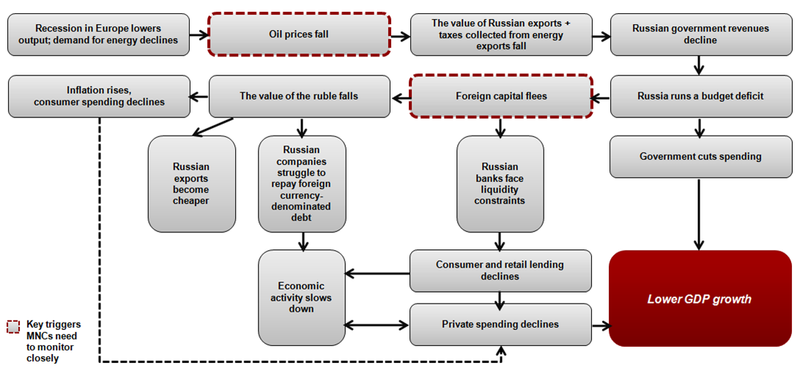
As Western Europe continues to struggle with the sovereign debt crisis and currency depreciation, declining exports, and lower 2012 growth prospects engulf Central and Eastern Europe, the outlook for Russia seems surprisingly solid. Despite a slow downward revision of 2012 growth forecasts from earlier this year, Russia is still projected to grow at about 4% in 2012.
However, the 2008-2009 crisis made it painfully clear that Russia is not and cannot be an island of stability when European and potentially global markets are in turmoil. Since 2009, Russia has grown even more dependent on energy exports, with its 2012 budget balancing at oil price of over $110 per barrel.
In the short term Russia is growing on the back of strong consumer demand, but this in no way eliminates the significant downside risk of an oil price decline. With the Eurozone already heading into a mild recession and the possibility of global financial market contagion, a significant decline in oil prices is a real possibility. A drop in oil prices could unleash a chain reaction (see graph) that would undermine Russia’s economy and, at best, depress Russia’s GDP growth.
For MNCs, this means having contingency plans for a significant downturn in Russia over the next 6-8 months to address ruble depreciation and declining demand on the domestic market.
On the positive side, MNCs should also be prepared to take advantage of M&A opportunities as attractive local assets will be priced at a discount.
In the long term, the Russian market continues to hold significant opportunity for foreign companies, especially after the country joins the WTO later this year. However, MNCs need to account for the significant risk the Eurozone crisis is posing to Russia’s performance in 2012 and be prepared to respond to rapid changes in the market.
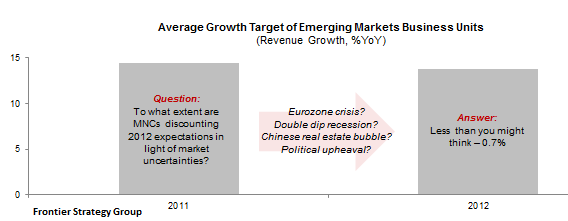
Despite the uncertainty and volatility surrounding the 2012 economic environment, corporate expectations for emerging market business units remain high, across regions and industries. Companies such as Heinz (NYSE: HNZ-P) and BlackRock (NYSE: BLK) are expecting emerging markets to continue to drive growth, but Frontier Strategy Group has observed two potential red flags that emerging markets executives should consider as they look to 2012:
1.Expectations are aggressive, but strategies are conservative
–Profitable growth is the priority in 2012. Most executives are emphasizing conservative methods for expansion over riskier and more resource-intensive options
–Companies are expecting to achieve targets by taking market share, rather than entering new markets, launching new products, or M&A
2.Strategies may be undermined by the tactics used to implement them
–Despite the emphasis placed on profitability, a majority of companies plan to compete on price, lowering the prices of their existing products developed for Western markets, rather than adjusting product features, which would allow them to reduce costs while increasing value
–Margins will be further squeezed if deteriorating market conditions cause customers to be increasingly price sensitive
FSG has surveyed senior executives running emerging markets business units to collect detailed insights into growth targets and strategies, hiring, salaries, organizational structure, and more.