


Latin America Starts 2012 with New Leaders and Laggards


LATAM January 2012

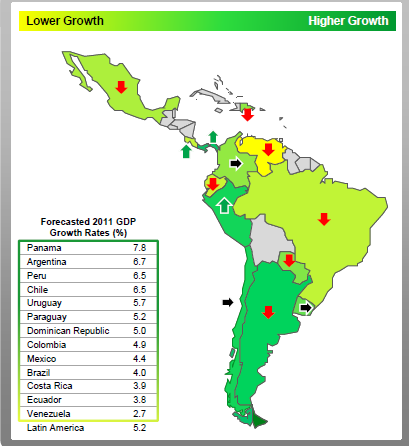
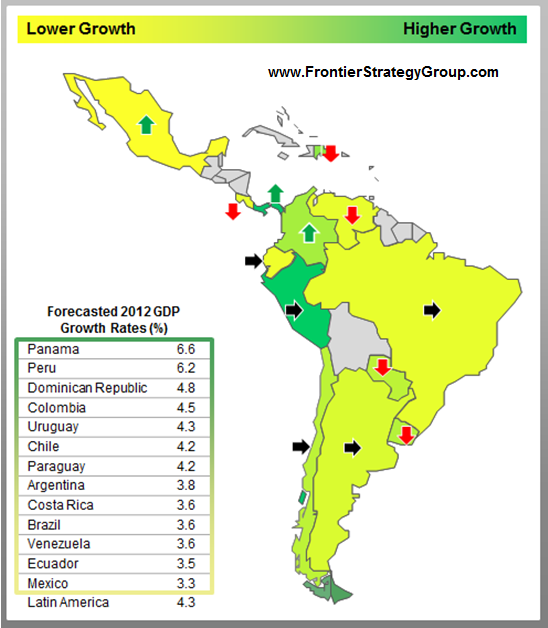
2011 year-end growth figures and new forecasts for 2012 demonstrate continued, but slower, growth, and the emergence of new risks and opportunities in LATAM. Brazil’s growth will subdued, by recent standards, and Argentina is preparing for a potentially painful economic restructuring. While larger regional economies slow, robust Chile, Peru, and Colombia increase in relative importance.

  • Argentina: High inflation and a yawning budget deficit are forcing Argentina to lower spending, but trade and capital restrictions remain in place
  • Brazil: Brazil faces a rapidly slowing economy, and government authorities are pushing for monetary easing and higher government spending
  • Chile: The Piñera administration faces political and economic headwinds going into 2012 but Chile’s fundamentals continue to shine
  • Colombia: Growing recognition of the long-term potential of the Colombian economy is quickly eclipsing investor fears of violence and instability
  • Costa Rica: Fragile public finances and a weakening economy have led the government to raise taxes, imperiling future foreign direct investment
  • Dominican Republic: Economic decline in Europe and new immigration laws will have adverse effects on the tourism, agriculture, and mining industries
  • Ecuador: Government spending and stable commodity prices will support growth in 2012, but overexposure to oil continues to present risks
  • Mexico: Mexico enters 2012 with confidence earned from economic resilience and hopes for a smooth political transition in July
  • Panama: Panama’s economy boosted by trade agreement with the US, but political uncertainty clouds the prospects for Martinelli’s reform agenda
  • Paraguay: Contrary to previous expectations, Paraguay will see lackluster growth due to weakening external demand and supply shocks at home
  • Peru: Protests are hurting President Humala’s political standing, but the economy remains strong despite growing political uncertainty
  • Uruguay: Uruguay is at the mercy of economic developments in Argentina and Brazil, with current trends pointing to a slowdown in 2012
  • Venezuela: New socialist legislation makes it harder to turn a profit and easier to run afoul of the law in Venezuela


Higher-value Manufacturing is New Mexican Growth Engine


Multinationals can count on increased consumer spending as the evolution of the Mexican economy toward higher value manufacturing supports a more resilient and prosperous Mexican middle class. Companies servicing the automobile and heavy machinery sectors are set to benefit the most from the continued diversification of the Mexican economy.

Getting Government Engagement Right in Latin America


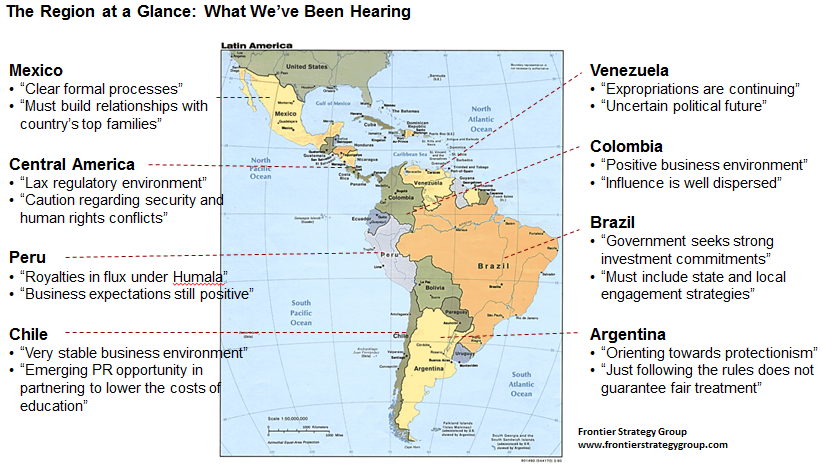
Country and regional heads at Frontier Strategy Group client companies are increasingly turning their attention to their government engagement function, and for good reason. It is evident that government decisions often hold the key to significant risks and opportunities, from regulatory issues to government sales, that can deeply impact the bottom line.

Clients express that they are wrestling with a variety of questions when it comes to running successful government engagement functions. These questions can be broken down into three principle challenges:

  • Ensure the company invests the right amount in government engagement. MNCs struggle to quantify the function’s contribution to business objectives, which often leads to a crisis-response approach to investment.
  • Generate positive engagement when government actors are initially unreceptive. This is particularly challenging because governments typically hold all the power in any given interaction and the panoply of government actor interests is much more diverse and complex than the typical business partner’s interest in increasing profitability.
  • Capitalize on the abilities of third parties without putting the company at risk. This is particularly challenging because the same reasons that lead government engagement offices to turn to third parties – lack of internal staff presence on the ground, expertise, or connectedness – are the very elements that make it difficult to monitor third parties and make sure they are not engaging in wasteful or unethical practices on one’s behalf.

In response to these challenges, the government engagement function often resorts to a reactive, problem-solving approach. However, Frontier Strategy Group’s cross-industry research reveals that to succeed, the government engagement function should reframe traditional ROI evaluations to embrace the broader goals of government engagement, thus creating a proactive decision framework. This new ROI approach applies to each of the three major challenges companies face:

  • Justify Your Investment – First understand how to tailor your investments to the realities presented by each country’s business and political environment. Then size up the “R” in ROI by taking a value at stake approach to determining which issues the government engagement function should prioritize, well in advance of the development of serious problems.
  • Earn Your Influence – Make sure you time the “I” well in ROI. Provide direct value to key contacts in government before you need their assistance, for instance by offering research on a topic where your company has expertise or by partnering to help a government sector operate more efficiently. Build political support by building domestic companies into your supply chain.
  • Discipline Your Delegates – Do not take short cuts with third parties. A low “I” does not guarantee high ROI if the “R” turns out to be negative. If you decide to hire a consultant, lobbying agency, or legal firm, you must first invest in sufficient due diligence to be sure they will not indirectly involve you in a scandal by association with other clients, or by hiring unauthorized fourth parties. Second, invest in helping third parties to really understand your industry so that they can better serve you.

Companies Have Little to Fear from a Very Likely PRI Victory Next Year


Violence Affects Consumption in Mexico


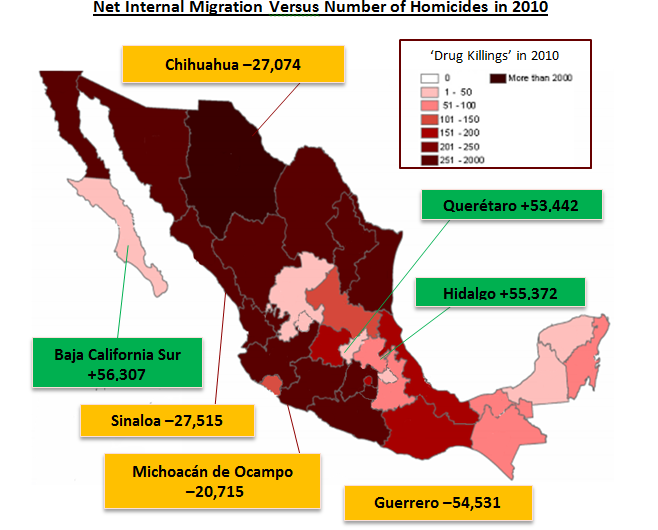
The recent headlines out of Mexico paint a seemingly dichotomous picture: violence is at an all-time high, yet multinationals continue to pour money into the country, with over $22 billion in foreign direct investment expected this year. The implication is that the knock-on effect to multinationals from the government’s war on the drug cartels has been slight. However, this interpretation of the facts belies the impact that violence-induced migration is beginning to have on many multinationals in the country. Recently, while in Mexico City, we heard over and over again of the many ways in which violence is changing demographic realities as workers and consumers move away from areas plagued by high levels of cartel activity.

As Calderón’s war against the cartels drags on, violence-induced migration is accelerating, creating a new set of challenges for multinationals. States with the highest levels of violence, such as Chihuahua, Sinaloa, and Guerrero, are seeing a net loss of citizens to more peaceful states like Querétaro and Hidalgo. According to Frontier Strategy Group Expert Advisor Leon Kraig, “many companies are starting to feel the impact of white collar flight from Monterrey” finding themselves unable to find entry- and mid- level managers. “Asking employees with families to move there is very difficult, and many based in Monterrey are asking to be transferred. Companies looking at alternative locations are primarily considering Mexico City, or possibly Guadalajara or Querétaro”, says Kraig.

In addition to tightening the labor market, violence is also changing the behavior of consumer markets. It is estimated that 230,000 people have been displaced in Mexico due to cartel violence, a tragedy that is shifting the demographic composition of many cities. Additionally, consumption patterns are changing as many individuals grow reluctant to frequent public venues such as restaurants and markets that could be targeted by cartels. According to a senior executive of a major global alcohol distiller, “Nobody is going out to bars and restaurants at night, so our business is suffering significantly in Monterrey, because consumers don’t compensate by entertaining more at home.”

One of the major drivers behind the decision of many Mexicans to relocate away from violent areas is the government’s lack of any viable near-term solution for dealing with the cartels. Indeed, violence has steadily increased with each new phase of the government’s war on organized crime, with the number of homicides growing by 15% year-on-year during the first half of 2011 alone. Given that only long-term efforts to strengthen judicial and police institutions are likely to have any major impact on the security situation, an adjustment to the government’s current strategy is unlikely over the near term. Many Mexicans therefore feel unable to wait out the increased violence as they have previously.

As the violence in Mexico continues, multinationals should expect to see skilled labor markets in the northern parts of the country tighten, driving up costs for companies seeking to efficiently manage their manufacturing operations. Additionally, B2C companies must keep an eye on how the violence is affecting demographic trends and consumption patterns. It is our belief that the companies that can adapt their strategies to these changing dynamics will see the least impact from continued violence.

Impact of potential slowdown in Latin America less than 2008


Fear over a stalling global economy stalks the region as volatility returns to the local bolsas. Frontier Strategy Group expects the overall impact of a slowdown to be smaller than in 2008 as Latin America has grown less reliant on global trade flows than other regions. Mexico has the most to fear, given its dependence on the US economy, while Brazil and Colombia could actually benefit from a currency depreciating financial flight to quality.

Transferring Production Across Emerging Markets


(Source: Foxconn Website)

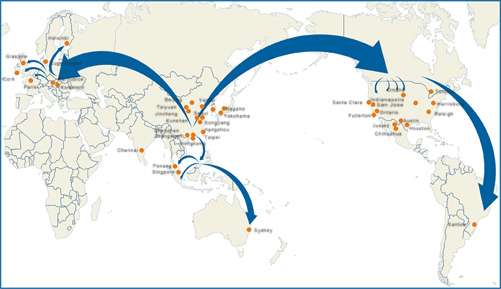
Foxconn is one of the most well-known emerging-markets based manufacturers. With labor prices increasing along with a string of suicides in it’s Chinese factories - the Taiwanese firm is looking to Latin America for new production capacity. The following is a cross-post from the China and Latin America blog which details Foxconn’s recent push into Brazil.

On August 6th, the Financial Times featured an article on Taiwan electronics firm, Foxconn (富士康科技集團), and its founder, Terry Gou. Foxconn controls close to half of the world’s outsourced technology products, including a number of Apple favorites (iPads, iPhones, etc).

According to the article, Mr. Gou recently announced a plan to place one million robots on Foxconn’s production lines. Automated production, he believes, will generate growth – the company made $80 billion in revenue last year, but is finding it hard to expand its market share.

Before Terry Gou ever announced his fondness for robo-employees, Foxconn was already seeking greater efficiency and market access through global expansion. In addition to production facilities in “greater China” (where it employs nearly one million people), Foxconn also operates in Europe, Australia, the United States, and Latin America. The company’s relatively new Latin American ventures (currently limited to Brazil and Mexico) provide greater access to local markets and close proximity to North American consumers.

Foxconn is now contemplating an additional investment of $12 billion in Brazil, which was first announced by President Dilma Rousseff during her visit to mainland China in April of this year. The company already operates at a limited capacity in the South American country, but the proposed investment would significantly expand production capabilities. New investments would offer Foxconn direct access to Brazil’s market and a means of avoiding the country’s notoriously high tariffs.

If the deal goes through, it would be Foxconn’s largest global investment. But the company’s leadership has hesitated in recent months. Mr. Gou expressed concern about a culture in which “there’s all that dancing” and “as soon as they hear ‘soccer,’ they stop working.” Foxconn has asked the Brazilian government for certain labor and infrastructure guarantees and may eventually reduce the amount it is willing to invest.

Foxconn’s Mexico production is based near Ciudad Juarez. Its massive facility employs approximately 8,000 workers from nearby towns. The company’s presence was warmly welcomed by politicians in both Chihuahua and New Mexico, but faced controversy after a disgruntled worker set fire to the facility’s activities center.

Further expansion into Latin America – though certainly welcome – isn’t guaranteed. Foxconn’s founder seems to prefer Chinese manufacturing, even despite rising labor costs and the recent Shenzhen tragedy. Chinese laborers are thought to be very skilled, to tolerate more, and to work longer hours than many of their foreign counterparts. Mr. Gou believes that rising labor costs can be offset by a move to China’s cheaper inland provinces.

China’s remarkable distribution network is yet another advantage – shipments from China to the US are generally cheaper even than shipments from Brazil.

But as Foxconn and other firms look to expand market share, Latin America’s emerging markets are bound to receive more attention. Although fresh foreign investment in the country’s stock market has slowed (especially in the investor exodus this week), foreign direct investment in Brazil has increased steadily over the past year. As one of the fastest growing BRICS countries, its consumer market is attractive to investors. The country’s Mercosur affiliation also allows for tax-free export of certain goods to other member countries.

Mexico, for its part, boasts proximity to the US and a skilled labor force. Its manufacturing sector grew thirty percent in the first three months of this year and its share of US imports is also on the rise.

As for Mr. Gou’s cultural bias: if he ultimately decides to replace many of Foxconn’s workers with robots, futebol (fútbol) fanaticism and a proclivity for dancing should no longer be of tremendous concern.

The original post is titled: “Mr. Gou Goes to Latin America” and can be found here

Latin America Insulated from Global Shocks


« Previous Page