



Risks Looming Over Russia’s 2012 Outlook


As Western Europe continues to struggle with the sovereign debt crisis and currency depreciation, declining exports, and lower 2012 growth prospects engulf Central and Eastern Europe, the outlook for Russia seems surprisingly solid. Despite a slow downward revision of 2012 growth forecasts from earlier this year, Russia is still projected to grow at about 4% in 2012.

However, the 2008-2009 crisis made it painfully clear that Russia is not and cannot be an island of stability when European and potentially global markets are in turmoil. Since 2009, Russia has grown even more dependent on energy exports, with its 2012 budget balancing at oil price of over $110 per barrel.

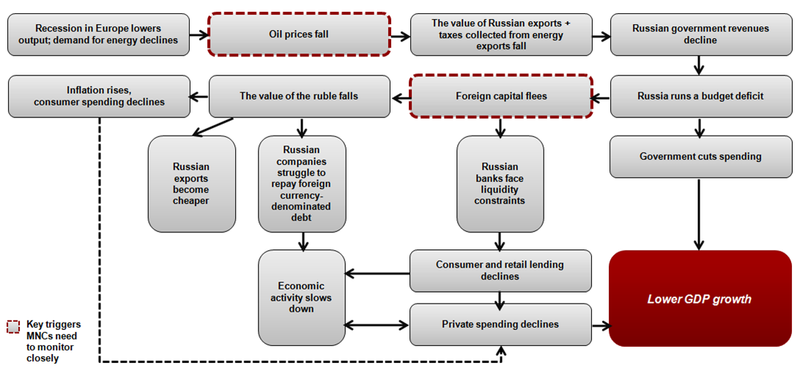
In the short term Russia is growing on the back of strong consumer demand, but this in no way eliminates the significant downside risk of an oil price decline. With the Eurozone already heading into a mild recession and the possibility of global financial market contagion, a significant decline in oil prices is a real possibility. A drop in oil prices could unleash a chain reaction (see graph) that would undermine Russia’s economy and, at best, depress Russia’s GDP growth.

For MNCs, this means having contingency plans for a significant downturn in Russia over the next 6-8 months to address ruble depreciation and declining demand on the domestic market.

On the positive side, MNCs should also be prepared to take advantage of M&A opportunities as attractive local assets will be priced at a discount.

In the long term, the Russian market continues to hold significant opportunity for foreign companies, especially after the country joins the WTO later this year. However, MNCs need to account for the significant risk the Eurozone crisis is posing to Russia’s performance in 2012 and be prepared to respond to rapid changes in the market.

The Sovereign Debt Crisis in Emerging Markets (Part I)


What happened?

In 2008, banks stopped lending as they were forced to use capital to absorb losses from deteriorating investment portfolios. When lending dried up, business struggled, industrial production contracted, and jobs were lost.

Job loss drove the consumer into a deep recession. When the consumer lost its means to spend, banks found themselves in more trouble. Consumer-related debt securities holding everything from mortgages to credit cards to auto loans began to default, driving the deepest recession since the 1930s.

Governments stepped in as lenders of last resort to break the vicious cycle, but many governments were already overleveraged. As bad credit worked its way through the system, markets ultimately turned on indebted governments believing that governments would not be able to repay debt.

Enter the sovereign debt crisis

Markets revolted first against governments on the periphery of Europe because it was clear that those governments would run into solvency issues with no credible plans for economic growth. Ireland, Greece, and Portugal subsequently received bailouts but are still in trouble. Italy is on the brink and there is not bailout package on the table large enough to solve that crisis. Spain is next.

The crisis is not a Greek problem or an Italian problem. The crisis is a problem that impacts all of Europe as well as markets globally. Leading European banks based in Germany and France hold tremendous amounts of bad sovereign debt as well as derivatives on that debt. Much of this is not marked to market, so banks currently do not have to recognize losses. However, the event of a technical default will force banks to recognize losses that they are not capitalized to absorb.

A technical default is the worst-case scenario because it will disrupt the banking system, dragging Germany, France, and the broader global economy into recession. The only way to mitigate the impact of an EMU breakup is if the European Central Bank (ECB) preemptively recapitalizes banks, something Germany is opposed to because it fears inflation.

Regardless of the scenario that plays out, Europe is headed for recession and a breakup of the EMU. The only potential solution is a massive debt monetization program that would be led and funded by Germany through the ECB. However, this is becoming increasingly unlikely as policy heads the opposite way. On Monday, November 14th, German Chancellor Merkel’s party voted to allow EMU members the right to remain in the EU free trade zone; even they left the monetary union. This is a critical first step in preparing the mechanisms necessary to support a breakup of the EMU.


Sovereign Debt Crisis in Greece - What it Means for EMEA Emerging Markets


Austerity measures are not a solution to structural problems in Greece. What is at the root of the sovereign debt crisis? What are the risks? How will it impact emerging markets? Frontier Strategy Group Practice Leader, Matt Lasov answers these questions and more in an interview with EMEA analyst Martina Bozadzhieva.