



Cisco Systems is reinventing itself. The company is currently making headlines for slashing costs, announcing plans to lay off 6,500 employees, and selling off non-core product lines such as Flip video recorders and television set-top boxes. Behind the scenes, however, Cisco is making strategic moves designed to accelerate the company’s growth and profitability. A revamping of the channel strategy stands out as a key priority, with the company opting to “go deep” with a select number of preferred channel partners and reduce confusion by doubling down on five key product categories (versus 30 previously).
Incentives (especially non-monetary incentives) for channel partners are certainly something that Cisco will be evaluating. Non-monetary incentives in particular are playing an important role for vendors, as they are seen as a strategy for protecting margins and preventing damaging price competition. However, many vendors also believe that non-monetary incentives yield greater returns in enhancing performance since they represent specific investments in distributors’ capabilities. Cash payouts, on the other hand, may or may not be properly re-invested by the distributor in their business.
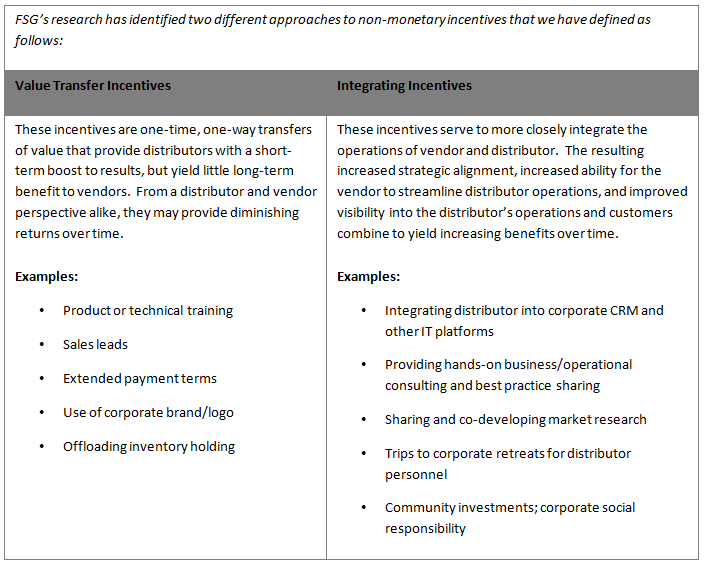
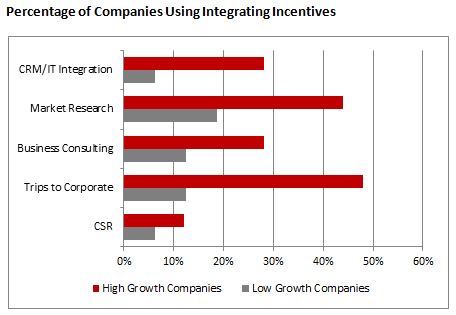
However, FSG’s research has discovered that not all non-monetary incentives are created equal. We have identified two distinct types of non-monetary incentives: 1) Integrating, and 2) Value Transfer. High growth companies are much more likely to turn to Integrating Incentives. These are non-monetary incentives that provide the vendor with increased visibility into and control over the operations of their distributors. These Integrating Incentives can act as a sort of Trojan Horse for vendors seeking to gain increased control over distributors in a way that does not cause their partners to put up defensive barriers.
In my next post, we will take a closer look at the “tough love” approach that high growth companies are taking in managing their relationships with channel partners.


No related posts.


