



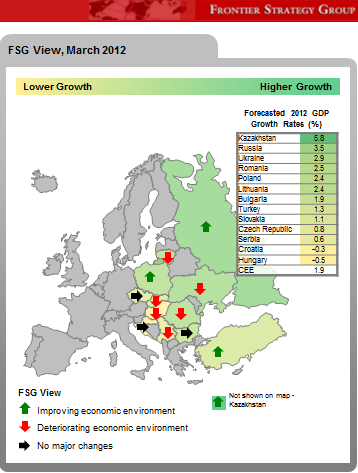
As regional economies continue to slow down, CEE governments seek privatizations and public sector restructuring in order to increase revenues and attract foreign investment. Russia, Turkey, and Poland remain the region’s most resilient economies and offer opportunities for MNCs, particularly in the consumer goods sector
Bulgaria: Despite a slowdown in growth in 2012, Bulgaria remains one of the region’s most macro-economically and politically stable markets
Croatia: Croatia is in for a challenging year that will bring austerity measures, pain for local consumers, and possibly a recession
Czech Republic: As growth continues to slow, the government plans to support local producers exporting to non-eurozone markets
Hungary: The government’s disagreements with the EU negatively impact its ability to stabilize the economy
Kazakhstan: Plans for new infrastructure building and technical upgrades create opportunities for B2B MNCs
Lithuania: As eurozone export demand declines and the Lithuanian government seeks to cut spending, the economy will grow more slowly this year
Poland: Positive economic sentiment and a stabilization of the currency improve the outlook for Poland; credit crunch remains a downside risk
Romania: Despite the change in government, Romania still has to implement painful austerity measures this year
Russia: High energy prices and consumer confidence sustain solid growth
Serbia: The government will struggle with a deteriorating macroeconomic environment and pre-election pressures through H1 2012
Slovakia: The consumer outlook remains negative through 2012 as any new government would have to cut public spending
Turkey: Turkey’s growth remains resilient on strong consumer demand and public investment plans
Ukraine: The government will continue to avoid prudent economic policies that could cost it the elections this fall


No related posts.


