



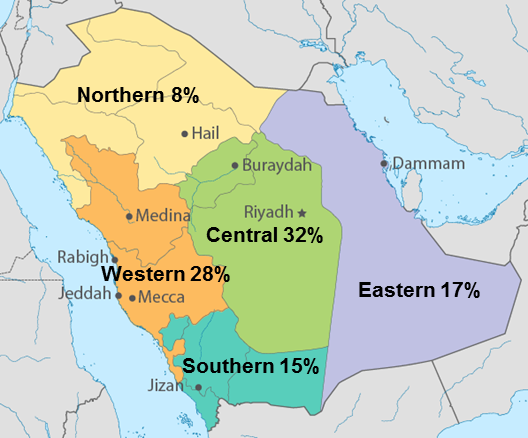
Photo: Regional cement demand demonstrates opportunity across Saudi Arabia
The Saudi government is spending more than US$300 billion on major infrastructure projects through 2014. Development projects are dispersed throughout the country to create jobs, raise the standard of living, and attract foreign investment in less-developed areas. As a result, companies should no longer expect to capture the full potential of the Saudi market if they are only based in tier 1 cities like Dammam, Jeddah, and Riyadh. Expanding outside of Saudi’s major cities allows companies to reach more customers in the country’s population centers, where major public investment is targeted. Government funds will support rapid growth and these cities are likely to grow faster than the core markets, because they are starting from a lower base.
Concentrate on western Saudi Arabia in the medium term
The Saudis are pouring in money to develop various cities in the western region, which accounts for nearly 40% of construction activity through next year. Public expenditure is driven by education, healthcare, housing demand, and religious tourism in the region. The spending trends are attracting foreign investment to Rabigh, Mecca, and Medina.
- Rabigh: importance is tied directly to the construction of nearby King Abdullah Economic City (KAEC), which is already attracting investments from major foreign multinationals like pharmaceutical company Sanofi and chocolate manufacturer Mars. Both companies plan to invest at least US$60 million in manufacturing facilities. Rajhi Steel is building a US$4 billion heavy steel complex as part of KAEC. The plant will have a capacity of 1.8 million tons per year and will play an important role in future development in the city and region.
- Medina: benefits from infrastructure development related to religious tourism and construction plans for Knowledge Economic City (KEC). CBH Real Estate Development plans to build a shopping mall in Medina with an initial budget of US$530 million to accommodate the growing demand for retail space due to religious tourism. The Saudi government has allotted US$8 billion for Medina’s Knowledge Economic City, which is expected to be completed in 2020.
- Mecca: religious tourism drives infrastructure development. An estimated US$40 billion will have to be spent in Mecca within the next decade to meet rising demand for hotel accommodations. The number of pilgrims is expected to double to 13.8 million by 2019, requiring 82,000 rooms. There are currently an estimated 50,000 rooms in Mecca.
Frontier and service cities offer long-term opportunities
The Saudi government aims to develop the country’s north and south in order to raise the standard of living and promote stability. Government spending priorities provide companies with opportunities in frontier cities as a result. Expanding into frontier cities such as Hail and Jizan is a way to capture long-term ROI with an Economic City being built in each location. Buraydah is becoming increasingly important as a trade corridor for Riyadh, which will continue to attract government investment in public sector and IT projects.
- Buraydah: location means it will play a critical part in the US$5 billion North-South Railway. The rail project is meant to connect the northern mineral-rich region with Riyadh via Buraydah. The national budget allocates US$183 million to establish and equip hospitals in Qassim Province. Much of the money will be directed to Buraydah due to the city’s role as commercial center of the province. Al Baik Food Systems, a Saudi-based fast food restaurant chain, has announced plans to open two outlets in Buraydah by 2014.
- Hail: attracts investment as part of the country’s strategy to increase industrial activity in the north. Alfanar Construction Company is upgrading the Hail -2 Power Plant to extend electrical capacity. The US$120 million project was delayed by a year, but it is expected to be completed this year. Saudi Arabia’s Health Ministry approved US$400 million in projects in Hail Province. The new projects include the establishment of two 300-bed hospitals with a total cost of more than US$140 million.
- Jizan: development is tied to the government’s desire to create jobs and increase the standard of living in the southern region. Bids are set to be accepted next quarter for King Abdullah Bin Abdulaziz Airport, which will be an important component of future development in Jizan and the rest of the southern region. After several delays, KBR Inc. is building a refinery in Jizan for Saudi Aramco. The facility will refine up to 400,000 barrels of oil per day when it is completed in 2015.


No related posts.


