



Nigeria in 2013 will provide a mixed picture for investors. While the government’s 2013 budget promises to open new investment opportunities, challenges lie ahead. Renewed fuel subsidy reductions will impact consumer purchasing power while the security situation in Nigeria’s hot spot regions is likely to deteriorate.
Trend #1: The Proposed 2013 Budget Creates Investment Opportunities
The Federal Government submitted the budget proposal to the National Assembly for approval. An increase in spending means opportunities in sectors that have received budget allocations or investment incentives. Focus areas for the economy in 2013 are security, education, infrastructure and healthcare. The 2013 budget aims to create long-term macroeconomic stability through continued investment in capital expenditures, deficit reduction, and the development of non-oil revenue sources.
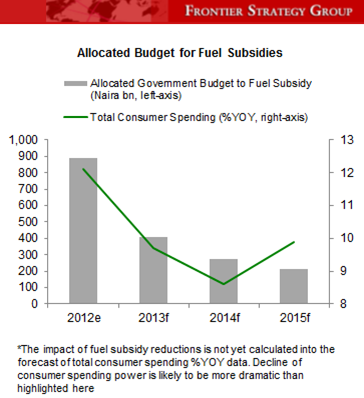
Trend#2: New Fuel Subsidy Reductions will Impact Consumer Purchasing Power
The government launched a new campaign to remove the fuel subsidy in the medium-term, a year after the attempted removal caused widespread protests. New plans will see the fuel subsidy gradually reduced through 2015. Consumers will be hit hardest by the fuel subsidy reduction as purchasing power for non-essential goods is likely to decrease. This comes after consumers were strained in 2012 when fuel subsidies were reduced for the first time. The initial impact of the subsidy reduction will be felt in early 2013. As a result, renewed protests are likely to hit the country once the new reductions are announced. Companies have to reach new customers to compensate for any potential decrease in consumer purchasing power.
Trend #3: The Security Situation is Likely to Worsen
The government allocated the lion’s share of the budget (668.51 billion Naira) to security, indicating that tackling Nigeria’s many security challenges is a key priority. However, companies should prepare for increasing insecurity in hot spot regions as violence is likely to increase if the budget is spent on recruiting more personnel into badly managed security forces that crack down brutally on dissent rather than on investing in better management and training.
Nigeria’s security challenges include bombings by Boko Haram and ethno-religious clashes in the northern and central areas, kidnapping, oil theft and piracy in the Niger Delta, and kidnappings in the Southeast. But the violence is about Nigeria’s acute social disadvantages and widening wealth gap.
- Boko Haram: The group’s frequent attacks cannot simply be attributed to Islamist militancy, but rather longstanding socio-economic grievances and skyrocketing unemployment. The group is fighting the government which it blames for the precarious economic situation. As a result, the group wants to install Sharia law because it believes secular law is too corrupt and only religious law can establish order. The security forces’ vehement crackdowns and resulting civilian casualties contribute to an expanding base for recruitment.
- Niger Delta: Similar to the situation with Boko Haram, unemployment and poverty is driving crime in Nigeria’s main oil producing region. In 2009 the government issued an amnesty to all militants with the failed promise to create employment. Instead, criminal activity has increased, specializing in oil theft (150,000 b/d, worth US$7bn annually) and kidnappings.
Having a contingency plan allows companies operating in these regions to manage risks and seize opportunities as they materialize.
*Editors Note: Don’t miss Anna Rosenberg’s latest article on managing distributors in sub-Saharan Africa


No related posts.


