





Featured Emerging Markets Insights

Russian ruble taps two-year low on Kremlin shift


From MarketWatch

The Russian ruble fell to a more than two-year low versus the U.S. dollar Monday, under pressure after the nation’s Finance Minister Alexei Kudrin resigned over a policy dispute with President Dmitry Medvedev.

Kudrin resigned Monday as Russia’s finance minister and deputy prime minister, citing differences with the president on economic policies, the state-run RIA-Novosti reported.

Putin to return as Russian president

WSJ’s Richard Boudreax looks a how Vladimir Putin’s return as Russian president could hamper U.S. efforts to advance arms-control and trade agreements.

Some investors had seen Kudrin as a guarantor of the country’s financial stability, the news agency said.

“It is difficult to see how Mr. Kudrin’s resignation can be anything but market-negative,” said Neil Shearing, chief emerging market economist at Capital Economics, in a note to clients.

The ruble weakened following the news, with one U.S. dollar (ICAPC:USDRUB) buying 32.48 rubles, up 1.5% from Friday. It traded as high as 32.55 rubles earlier, a more than two-year high for the dollar, according to data on FactSet Research, which tracks closing levels.

Medvedev on Saturday endorsed Vladimir Putin’s return as president. Kudrin has reportedly refused to join Medvedev’s government should Putin become the new president after elections in March and appoint Medvedev as prime minister.

“For all Mr. Medvedev’s warm words on the need to progress market reforms, Mr. Kudrin has arguably been more influential in rebuilding Russia’s balance sheet from the ashes of the 1998 ruble crisis,” said Shearing.

And “with oil prices starting to slide and financial markets still jittery, now is not a good time for the government to lose its arch-fiscal hawk and one of its most influential liberal voices,” he said. “It is unlikely that Mr. Kudrin’s replacement will share his predecessor’s credentials and clout.”

Ruble, equities risks

For now, the Russian markets will likely take their cue from events in the global economy and the outlook for commodity prices in particular, Shearing said.

And the risks to the ruble and Russian equities “lie firmly on the downside,” given Capital Economics’s view that the euro-zone crisis is likely to deepen, Group of Seven growth will grind to a halt in 2012 and oil prices will fall further, he said. Crude-oil futures prices (NMN:CL1X) have fallen by around 15% year to date.

Matt Lasov, director of global research at Frontier Strategy Group, said the negative impact on Russia’s market from Kudrin’s resignation won’t be enough to change market fundamentals.

But “Russia will still struggle with an over-reliance on oil in an environment where European demand is set to drop, impacting Russia’s revenues and growth trajectory,” he said.

It wasn’t clear if news of Kudrin’s resignation came before or after the stock market’s trading session ended. The ruble-denominated Micex stock index closed 1.5% higher on Monday at 1,346.86 points, according to the Micex Group’s Web site. Year to date, the index is down 20%.

At Moscow’s other stock exchange, the dollar-denominated RTS stock index (RTG:RU:RTS) fell 0.1% to finish at 1,315.25 points. Competition authorities earlier this month approved merger plans for RTS and the Micex Group.

Putin’s return to the presidency – not all good news


Saturday saw Russia’s biggest political riddle resolved – Vladimir Putin announced he was running for another term as president and offered Medvedev the post of prime minister. What does this mean for Russia’s business climate?

We now have clarity about Russia’s leadership for at least another six years. United Russia is set to win the elections this fall, and there is no doubt Putin will win the presidential elections in March 2012. This implies continuity in current government policies and actors, and will certainly boost investor confidence in Russia. It should at least partially support Russia’s falling currency and weakening stock market. Although the continuing crisis in the euro zone and the falling oil prices will minimize the announcement’s positive effect on the ruble, we can at the very least expect greater capital inflows through the rest of the year as well as an increase in FDI in the country.

In the short-to-medium term, this is good news for MNCs selling and operating in Russia, especially in the context of an unpredictable global economy. However, there are several potential threats down the road companies should watch out for.

First, there is wide consensus that the Russian economy requires fundamental reform away from its dependence on oil prices and high government spending. Such reform would mean reducing government spending on social programs, and will certainly be met with discontent among the population, something that Putin may or may not be ready to face. There is significant inertia in the Russian government and Putin is if anything a symbol and perpetuator of the status quo. Should oil prices remain high, Russia will hum along well enough. However, a prolonged fall in oil prices will bring about a very serious crisis in Russia, and the country is nowhere nearly as well prepared to weather it now than it was in 2008.

Second, while Russians still see no political alternative to Putin, there is a growing sense of stagnation – political, social, and economic within Russia that Putin is increasingly beginning to symbolize. Russians may vote for Putin, but that doesn’t mean they actively support him and his policies. In the short-to-medium term this has few implications. In the long term, however, it’s the stuff of social upheaval. Russia is inevitably headed into a major political transformation, and it’s now clear its current political leadership is not ready to steward the country through to it.

To sum it up, MNCs will benefit from a relative improvement in Russia’s business climate in the short term, will need to watch carefully for whether and what economic reforms the government undertakes after March 2012, and expect that in the long term, the rules of the game in Russia will change.

Threats and Opportunities Await MNCs in Turkey


Explosive deterioration of its relationship with Israel. A trip of the post-Arab Spring Middle East. Turkey’s foreign policy is generating quite a lot of attention in the Middle East these days.

Beyond its political implications; however, the policy of courting key Middle Eastern countries like Egypt also has a serious domestic driver: Turkey’s economy is charting precarious waters.

Turkey has been struggling with a rising current account deficit driven by strong domestic demand. The rise in household consumption has been financed by capital from Europe, making Turkey increasingly vulnerable to an outflow of short-term capital as European economies continue to struggle.

The other pillar of Turkey’s economy – exports, is also threatened by the potential of a Eurozone recession. With over 50% of Turkish exports going to the EU, Turkey is particularly vulnerable to a drop in demand from such key countries as Germany, Italy, and Spain. FSG Monitor estimates that a US-EU recession would lead to a 2% drop in Turkey’s GDP in 2012. The projected decline may not be as dramatic as in other countries in the region, but compared to Turkey’s Q1 2011 11.6% GDP growth, followed by 8.8% for Q2 2011 (Turkey had the highest H1 2011 GDP growth in the world), it’s very significant.

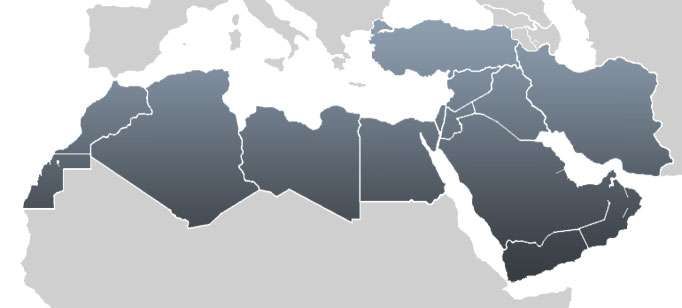
In this unstable environment, the Turkish government has announced it will seek to promote export-oriented domestic production. But this strategy will only work if there is enough demand for Turkey’s increased exports. With the European economy in a shaky state, Middle Eastern markets will be increasingly instrumental to Turkey’s economic stability. Currently, the Middle East is the second biggest regional market for Turkish exports, accounting for 20% of the country’s exports, plus another 4.9% of exports going to North Africa.

Turkish businesses are clearly seeing the writing on the wall and are aggressively seeking expanded influence in the Middle East, as evidenced by Prime Minister Erdogan’s large business delegation on his recent trip to Egypt and his promise to increase trade between the two countries to US$5 billion.

In this context, MNCs should expect Turkish competitors to aggressively pursue opportunities in the post-Arab spring markets. As we already discussed, MNCs with overly risk-averse strategies in the region can fall behind regional competitors with a greater risk appetite. It also means, however, that MNCs with Turkish partners can use these relationships in support of strategic expansion in the MENA region, benefitting from the good will Turks are enjoying among the region’s populations and leadership.

In this context, the role of Turkey as a manufacturing hub for the Middle East and North Africa region is becoming increasingly attractive, not just to MNCs but also to the Turkish government itself. As a result, MNCs with local production facilities meant for export to the region are well-positioned to lobby the Turkish government for additional incentives and support.

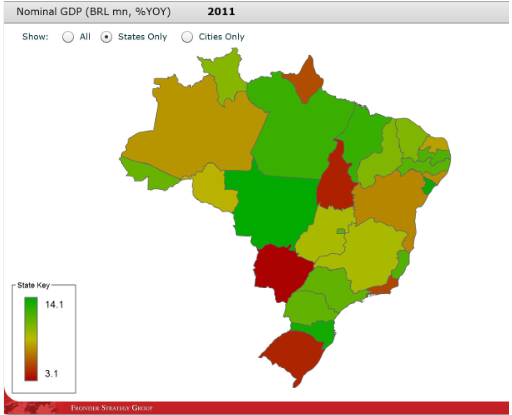
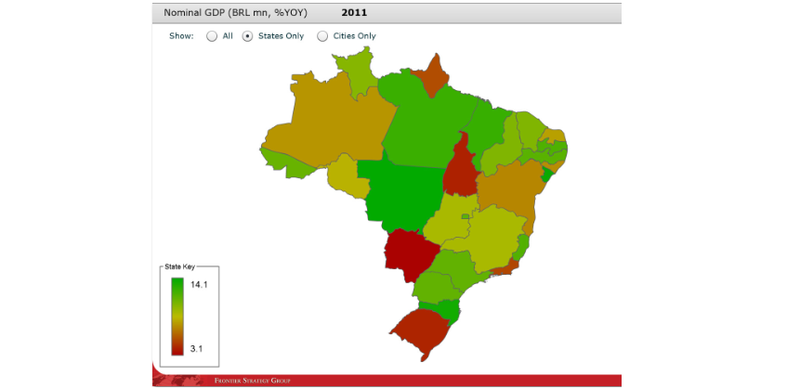
Growth in Brazil Presents a Double-edged Sword


As developed economies continue to muddle through an increasingly tenuous economic recovery, the need for multinationals to find new sources of growth in emerging markets is becoming ever more important. This is a trend that Frontier Strategy Group has been tracking for some time across our client base, and one that is particularly apparent in Latin America, where renewed focus on the region has led to average growth targets in excess of 20% for 2011. In order to meet these growth targets, executives are adopting a combination of strategies that includes expansion into new geographies and consumer segments as well as implementation of aggressive M&A plans.

One country where multinationals have seen a tremendous amount of growth over the past two years is Brazil. In the first half of 2011 Frontier Strategy Group member companies averaged 27% YoY growth in Brazil despite a cooling economic environment. These types of results are capturing the attention of corporate centers; however, the stellar performance of Brazilian business units presents a serious conundrum for many heads of region.

The conundrum stems from the fact that as regional heads are seeing more and more of their top-line growth in Latin America come from Brazil, they are experiencing a narrowing of bottom-line margins. The cost of doing business in Brazil, or Custo Brasil as it is known locally, is so high that business units there contribute significantly less to overall profitability than they do in other countries. For executives tasked with maintaining current levels of profitability while achieving unprecedented growth targets, the challenge posed by Custo Brasil is particularly daunting.

For this reason, Frontier Strategy Group is undertaking an effort to help multinationals diagnose and quantify Custo Brasil. The output from this effort will give executives the tools to identify and mitigate some of the more pernicious effects of Custo Brasil in their cost structures and determine which costs are due to local conditions as opposed to organizational structure and execution. By finding ways to narrow the gap in profitability between Brazilian business units and the rest of Latin America, Frontier Strategy Group is looking to ensure the continued success of multinationals in O País do Amanhã.

If you are interested in participating in this effort, please take a moment to fill out the following survey by clicking here (go to survey) or pasting the following link into your web browser: (http://vista-survey.com/survey/v2/survey2.dsb?ID=5131690207).

S&P lifts Turkish lira rating to investment grade


From MarketWatch

Standard & Poor’s Ratings Services raised its local-currency sovereign ratings on Turkey to investment grade at BBB- from BB+ on Tuesday.

In a statement, it attributed the local-currency upgrade to its “view of continuing improvements in Turkey’s financial sector and the deepening of local markets,”

The news briefly shocked traders more than it should have.

Some news agencies mistakenly reported that it was the nation’s sovereign rating that was lifted to investment grade, instead of the local currency rating, which temporarily added to strength in Turkish stocks, according to The Wall Street Journal.

The Turkey ISE 100 index XX:XU100 had climbed by as much as 6.5% Tuesday, then eased to post a gain of 5.1% for the session.

Still, the S&P move is certainly a promising one. “S&P is simply confirming what smart investors and leading multinationals already knew,” said Matt Lasov, director of global research at Frontier Strategy Group — that “Turkey looks a lot more credit worthy than many investment grade markets in Western Europe.”

The local-currency rating upgrade also strengthened the Central Bank of the Republic of Turkey’s “hand for further policy easing,” as pressures on the lira are more likely to recede with the investment grade, analysts at BNP Paribas, said in a report.

Given that, they expect the central bank to cut its policy rate by 50 basis points till the year end, if the Federal Reserve introduces another round of quantitative easing.

In recent trading a dollar USDTRY bought 1.78 Turkish lira, compared with around 1.72 lira at the beginning of September.

The War for Talent in Emerging Markets


“When it comes to engaging and retaining top talent in emerging markets, multinational companies are often their own worst enemies.”

An executive running Asia for a major industrials company shared this comment during Frontier Strategy Group’s Shanghai Executive Round Table last week. The event brought together more than 20 executives from a range of different companies that shared a common pain point: high attrition among key local talent is a major impediment to achieving the aggressive growth expectations that have been set for companies not just in Asia, but in high-growth emerging markets globally.

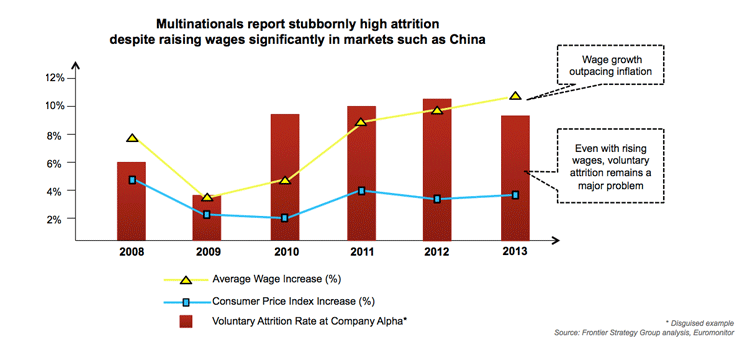
Demand for local talent is increasing as more companies expand their local teams, and supply remains limited. This imbalance has created a seller’s market. Those with the most highly sought after skills are aggressively recruited and offered 20, 30, even 40% of more increases in compensation to leave their current firm. To address this dynamic, most companies have attempted to fight fire with fire. They offer big pay increases to their key talent in hopes of convincing them to stay with the firm for just a bit longer. However, what our clients have observed is that this type of tactic is not only unsustainable, it is also not working. Wage costs are skyrocketing, but attrition remains high.

A great deal of ink has been spilled on this topic (a Google search for “emerging markets war for talent” returns over 2.3 million hits), but I think we hit on a few breakthrough ideas during our discussion in Shanghai. We surfaced dozens of different tactics that our clients have deployed to chip away at this stubborn challenge, but a common thread among the most successful companies was that they had taken steps to resolve a critical misalignment that continues to characterize most Western multinationals’ talent strategies. The misalignment is a result of companies decentralizing their talent, yet centralizing their talent management and human resources (HR) organizations. Put another way, most companies have recognized that moving decision-making further away from customers has a negative impact on growth, but many companies have failed to take a similar approach to managing their own talent.

Companies that have been most successful in combating attrition in emerging markets have resolved this misalignment by focusing on doing three things:

  1. Building local HR capacity and moving HR decision-making closer to the “customer” (i.e., talent)
  2. Reallocating resources from “one to one” wage increases for individuals to “one to many” investments in localized talent engagement initiatives
  3. Dedicating senior management time on an ongoing basis to drive continuous innovation and improvement in HR strategy and tactics; they recognize that today’s innovative engagement strategy will lose its differentiation and impact over time

Success in these three areas will yield significantly greater return on investment than outsized wage increases in the form of improved development programs (which, in turn, yield more effective and capable local talent), higher employee engagement (which results in more productive and motivated talent, with lower turnover of high performers), and a more stable and capable local team. Put together, these benefits will allow executives to decentralize more decision-making and further empower their local teams, which FSG’s research has shown is highly correlated with accelerated growth.

We’ll unpack and explore some of these concepts and share a few examples of successful engagement strategies in future posts.


Indonesia’s Workers Demand Higher Wages


Indonesia’s increased demand for workers calls for creative solutions and higher salaries. There is a limited pool of skilled workers in Indonesia, especially for positions that require English language proficiency or technological skill. Liberalizing investment policies and increasing FDI will continue to put pressure on the pools of both skilled and unskilled workers. MNCs are struggling to retain the talent that will be key to long-term growth in Indonesia.

In Frontier Strategy Group’s view:

  • MNCs need to launch rigorous training programs for both skilled and unskilled employees. Partnerships with local universities, trade schools, and government institutions should be set up to build a pipeline of qualified new hires.
  • Creative incentive packages are the key drivers of talent retention. Selected examples FSG has observed include co-signing of car loans or mortgages and provision of scholarships for children study at foreign universities.
  • MNCs fearful of wage increases in China who are looking to relocate operations to South East Asia need to consider the long-term implications of high demand for skilled and unskilled workers in Indonesia.


What drives private consumption in Russia?


The World Bank’s latest report on the Russian economy made headlines because of the Bank’s revision of its 2011 GDP growth forecast for Russia to 4%, down from 4.4%. However, a less conspicuous piece of analysis in the World Bank’s report carries particular importance for MNCs operating in Russia.

World Bank economists ran an analysis of the drivers behind consumer spending in Russia. The three most important factors were, not surprisingly, the level of economic activity, the external environment (price of oil, etc.) and labor market conditions.

The interesting discovery was in the effect of labor market conditions on consumption in Russia. The Bank’s estimates show that the level of unemployment has a strong negative impact on consumption, while short-term fluctuations in incomes do not translate into significant changes in consumption. For every 1% rise in the unemployment rate in Russia, private consumption falls by 2%, according to the Bank’s model.

The real-life logic behind this is that Russian businesses adjust to negative shocks mostly by lowering salaries, rather than firing employees. As a result, Russians have adjusted their consumption patterns to reflect more volatile wages, mostly seen as a temporary condition. Unemployment, on the other hand, is perceived as a much more permanent state, and directly affects Russian consumers’ choices.

The good news here is that the unemployment rate in Russia has been on a largely downward trajectory and was relatively low at 6.5% in July, a slight increase from June’s 6.1%. Coupled with a strong ruble, and a rise in consumer credit, MNCs can expect this trend to support a strong performance in Russia through the rest of 2011.


A Guidebook To Strategic Planning in Emerging Markets


The following three posts are an essential resource to assist senior executives in their strategic planning process for emerging markets:

1) Is the traditional strategic planning process too reliant on faulty assumptions or incomplete data in emerging markets?

2) Do companies adopt a strategic planning process that is too industry-specific that fails to account for the rapidly changing economic environment in emerging markets?

3) Are mid- and lower-level managers placing enough priority on strategic planning, and am I doing enough to improve their planning capabilities?

Middle Management’s Role in Strategic Planning


In recent posts, we’ve taken a look at two critical questions senior executives need to be asking themselves as they undertake the strategic planning process in emerging markets. First, we questioned whether the planning process may be too reliant on faulty assumptions or incomplete data. Second, we challenged the traditional industry-specific and insular planning processes that fail to take into account the rapidly changing external market and macro environment. Today, we wrap up this series of posts by posing a third critical question: Are mid- and lower-level managers placing enough priority on strategic planning, and am I doing enough to improve their planning capabilities?

Senior emerging markets executives are likely managing a very different team than just a few years ago. Companies have sharply reduced the percentage of expatriate managers in their emerging markets organizations and shifted more decision-making to local teams. A recent survey of Frontier Strategy Group’s clients indicated that more than one in ten of their mid-level managers were expats two years ago. Two years from now, our clients expect this number to be reduced by one third. The same survey data has also shown us that decentralizing decision-making around setting prices, developing marketing strategies, and managing human resources is highly correlated with more rapid growth. However, decentralization and local empowerment can come at the cost of so-called “corporate DNA” and can loosen ties between front-line management and corporate or regional headquarters.

For senior emerging markets executives, the strategic planning process presents an opportunity to leverage the front-line teams’ local knowledge for strategic advantage in the market, but it also requires executives to spend more time and energy ensuring that local teams are bought into and aligned with the strategy. The challenge, of course, is that time and resources are precious commodities, and asking the team to spend more time on planning could be interpreted as asking them to spend less time on execution.

Many companies have therefore looked to external consultants as a way to lighten the load. Unfortunately, FSG’s clients report mixed results at best after spending hundreds of thousands of dollars to outsource strategic planning to well-respected consultancies. At the conclusion of these engagements, executives inevitably recognize that they cannot outsource areas of their own teams’ core competencies, such as deep knowledge of customers, products, and markets. These executives have told FSG that external consultants add the most value when they provide the methodology and rigor necessary to ensure that the team is spending its time in the most efficient and effective way possible to bring these competencies to bear.

Consultants can also play an instrumental role in ensuring that individuals and planning committees are being held accountable for hitting key delivery milestones. One company that FSG works with in the consumer healthcare space used an external consultant to help define the framework for the strategic planning process, but then to ensure that its internal teams were following through on execution, the company built milestone-based KPIs into the incentive structure for managers, thus ensuring that managers felt personally accountability for executing on the plan. One aspect of the planning framework is an 18-month rolling planning cycle. Compensation is tied to setting and achieving milestones in the 12-month time horizon, and the remaining 6-months of the 18-month time horizon are intended to allow for a more strategic and forward looking perspective.

In summary, strategy and execution are not mutually exclusive.

A common view among executives is that time spent on planning is time taken away from execution. What we have seen among the most successful companies stands in stark contrast to this view: leading companies have demonstrated that prioritizing strategic planning results in superior execution in emerging markets. Leveraging the perspective of front-line teams, overcoming the scarcity of hard data, securing buy-in and alignment from organizational stakeholders, and holding individuals accountable for delivery are hallmarks of a successful strategic planning process and directly translate into improved results.


« Previous PageNext Page »