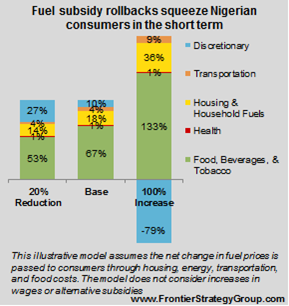
Nigeria’s government must walk a tightrope to successfully implement its reform agenda and satisfy angry citizens who are feeling the pain of fuel subsidy rollbacks. However, a resolution to the current political impasse is likely so any major changes to your strategy is a mistake
- Fuel subsidy rollbacks caused gasoline prices to rise by more than 100% to US$0.94 per liter. As a result, Nigeria’s two largest unions called indefinite strikes that could threaten the economy if a compromise is not reached and work stoppages spread to the oil sector
- President Goodluck Jonathan is framing the rollbacks as critical for the economy, which was burdened by the recurrent costs that total more than US$6 billion annually or roughly 25% of the budget
- The government claims it will reallocate the cost savings to spend on education, healthcare, and the energy infrastructure. However, the public is skeptical due to past wasteful spending and a draft budget that allocated more money to security than health, education, and energy combined
Three ways you can respond to the latest developments in Nigeria
- Diversify your production toward more high-margin products
- Leverage Frontier Strategy Group’s making the case materials and city-level data to quantify ROI in Nigeria
- Consider forward-buying key imported raw materials with cash-flow management tools as price pressure is likely to maintain upward momentum
Three ways fuel subsidy rollbacks impact Nigeria’s investment climate in 2012
- More competition for the purse: B2C companies will face more cross-sector competition to capture discretionary spending from cash-strapped Nigerian consumers
- The rollbacks will stoke food and fuel inflation, which impacts most Nigerians whom live on less than US$2 per day
- Heightened price sensitivity may cause consumers to trade down for value in the short term
- Difficulty in making the case: Nigeria’s medium-term growth potential remains the best among African peers, but negative headlines will raise doubt among some risk-averse corporate centers
- The strikes coupled with a recent spike in sectarian violence will scare away some investors
- Higher cost of doing business: All companies with local operations should brace for higher costs as instability weakens the naira and increases the likelihood of a currency devaluation
- Strikes amid ongoing sectarian violence, mid-teens inflation growth, and depleted currency reserves raises the specter of a devaluation
- A silver lining of a currency devaluation would be to make Nigeria a more attractive regional export hub
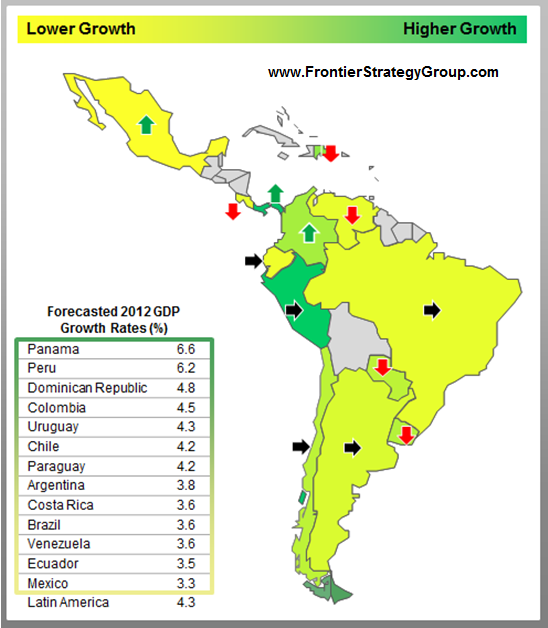
2011 year-end growth figures and new forecasts for 2012 demonstrate continued, but slower, growth, and the emergence of new risks and opportunities in LATAM. Brazil’s growth will subdued, by recent standards, and Argentina is preparing for a potentially painful economic restructuring. While larger regional economies slow, robust Chile, Peru, and Colombia increase in relative importance.
- Argentina: High inflation and a yawning budget deficit are forcing Argentina to lower spending, but trade and capital restrictions remain in place
- Brazil: Brazil faces a rapidly slowing economy, and government authorities are pushing for monetary easing and higher government spending
- Chile: The Piñera administration faces political and economic headwinds going into 2012 but Chile’s fundamentals continue to shine
- Colombia: Growing recognition of the long-term potential of the Colombian economy is quickly eclipsing investor fears of violence and instability
- Costa Rica: Fragile public finances and a weakening economy have led the government to raise taxes, imperiling future foreign direct investment
- Dominican Republic: Economic decline in Europe and new immigration laws will have adverse effects on the tourism, agriculture, and mining industries
- Ecuador: Government spending and stable commodity prices will support growth in 2012, but overexposure to oil continues to present risks
- Mexico: Mexico enters 2012 with confidence earned from economic resilience and hopes for a smooth political transition in July
- Panama: Panama’s economy boosted by trade agreement with the US, but political uncertainty clouds the prospects for Martinelli’s reform agenda
- Paraguay: Contrary to previous expectations, Paraguay will see lackluster growth due to weakening external demand and supply shocks at home
- Peru: Protests are hurting President Humala’s political standing, but the economy remains strong despite growing political uncertainty
- Uruguay: Uruguay is at the mercy of economic developments in Argentina and Brazil, with current trends pointing to a slowdown in 2012
- Venezuela: New socialist legislation makes it harder to turn a profit and easier to run afoul of the law in Venezuela
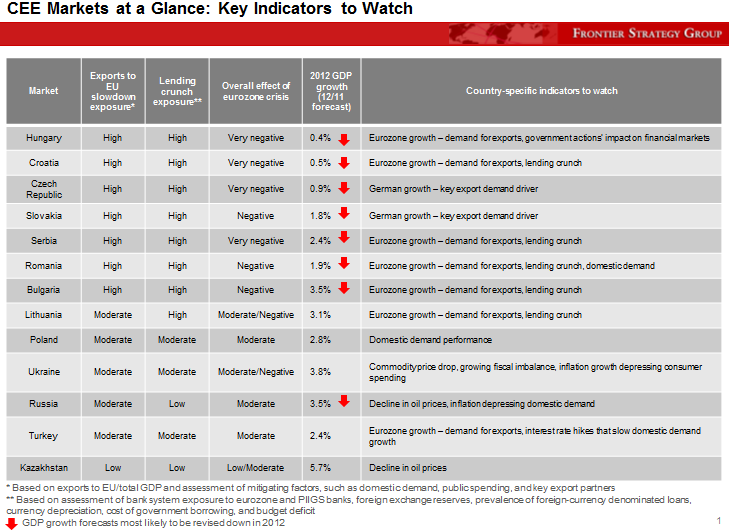
The outlook for Central and Eastern Europe is getting gloomier by the day as the eurozone crisis is weakening regional economies. While there is a significant level of volatility and uncertainty around the eurozone’s performance in 2012, there are several clear trends that will impact MNC performance in CEE this year:
- 2012 GDP growth projections are low across the region and will be revised further down
- Decreasing exports will hurt local producers
- Tight lending will limit local companies’ ability to make investments and will dampen consumer demand
- Austerity measures across the region will slow government and consumer spending but will ease inflation
- Local currencies will remain volatile and weak against the dollar
MNCs should plan to adapt their product portfolios, purchasing policies, and partner relationships to respond to weaker demand and tighter lending conditions in CEE.
However, not all CEE markets will fare the same – some will be impacted more than others (see table).
This creates opportunities for MNCs that pay attention to the nuances of the different regional economies and zero in on the markets that will outperform the rest of the region. The two most obvious ones are Poland and Turkey. In Poland, resilient domestic demand will sustain growth despite the negative impact of slowing export demand. Turkey will definitely see a slowdown this year, but its macroeconomic fundamentals remain solid and the country offers excellent opportunities for long-term growth. Both countries are presently experiencing currency depreciation, creating opportunities for cheap investment and acquisition of attractive local assets at a discount.
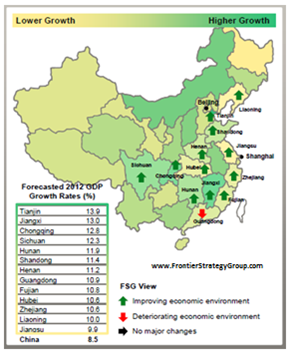 Although exporters in places like Guangdong are beginning to feel the impact of rising volatility in the global economy, gross fixed investment numbers remain strong across the country. Local governments in Chongqing, Hubei, Sichuan, and Zhejiang continue to invest heavily in infrastructure projects in an effort to outdo one another and boost their attractiveness to potential investors.
- Chongqing: Government commitment to increase Chongqing’s commercial attractiveness will continue to bolster its position with foreign investors
- Fujian: Xiamen may offer significant opportunities for multinationals looking to tap into China’s growing software and IT industries
- Guangdong: While retail sales remain strong, a slowdown in demand can be expected as Guangdong is heavily dependent on foreign trade
- Henan: A flurry of Korean investments foreshadows the growth potential of Henan as a manufacturing hub in inland China
- Hubei: Hubei’s infrastructure investments will allow it to strengthen its position within inland China and continue to attract foreign investments
- Hunan: Companies whose products contain rate earths should explore whether they can benefit from a plan to establish a new industrial cluster
- Jiangsu: Suzhou should continue to thrive as a trading hub due to the strength of its industrial base, FDI, and government support
- Jiangxi: Government efforts to curb electricity consumption amid a national drive for energy savings and efficiency will increase costs for companies
- Liaoning: Liaoning will continue to strengthen its logistical infrastructure as it aims to position itself as the “Gateway to North East Asia”
- Shandong: Jinan’s strategic investment into the high-tech industry will allow it to create a competitive advantage in the manufacturing industry
- Sichuan: Sichuan will see strong growth as it embarks on a large infrastructural improvements while also seeing investments from multinationals
- Tianjin: Tianjin will continue to remain a favorite for investors due to its growing local wealth and strong industrial development programs
- Zhejiang: Zhejiang can expect strong growth as SMEs are given more support and the government continues to make strategic investments
While political instability dominated headlines in the Middle East, the Iranian rial quietly devalued by 35% against the dollar at local currency exchange bureaus during a four-month period. Continued devaluation increases the likelihood of further instability in the region
- Iran’s fragile economy will bend rather than break for the time being, but the devalued rial will place pressure on consumers that are already struggling to afford staple goods as a result of high inflation rates
- The Iranian rial’s steep depreciation is a result of effective sanctions preventing hard currency from flowing into Iran, exacerbating the current account deficit
- The result is more pressure on the system, which increases the likelihood of instability in Iran and the Middle East
Sanctions and political tensions underline a dreary economic outlook
- Increasing trade isolation: Iranian officials are finally admitting the toll of sanctions on the economy. An EU crude embargo and tighter US sanctions will worsen the situation
- Rising political tensions: The alliance of bazaar merchants, hard-line clerics, and Revolutionary Guard commanders will continue to marginalize Ahmadinejad and his allies ahead of the parliamentary elections in March 2012
- Dwindling foreign currency reserves: While the size of Iran’s foreign currency reserves is unclear, money in circulation increased by 20% in the 2H 2011. This is an indication that Iran is struggling to fund monthly cash payments to citizens that are meant to soften the blow of subsidy rollbacks
- Accelerating inflation growth: CPI is officially 20%, but prices are likely increasing by much more especially food and fuel prices due to the subsidy rollback initiative and tightening sanctions
- Eroding consumer and private sector confidence: Typically resilient Iranian consumers and merchants appear to be losing patience with the current economic conditions
- The government was forced to halt all direct official sales of gold as customers queued in long lines to swap their hard currency
- The rising cost of raw materials will further damage confidence in the economy
Iran’s economic volatility has regional and international implications for 2012
- Iran’s foreign policy will remain erratic: Ahmadinejad’s recent flirtation with conciliatory rhetoric will stand in stark contrast to Supreme Leader Ayatollah Ali Khamenei’s strategy to meet a “threat with a threat”
- Escalating tensions with Gulf Arab countries: Saudi Arabia and other GCC countries blame Iran for stoking popular unrest in the region. Their support for tougher Western sanctions will escalate tensions
- Danger of regional conflict: The fall of Syria’s regime, a key Iranian ally, would upset the regional status quo and could set off a proxy war in Syria or Lebanon
- Oil price volatility: More effective international sanctions would place upward pressure on global oil prices, though further deterioration in the eurozone could act as a counterbalance
Original article in MarketWatch
“Over the past few quarters in Brazil, we have seen the emergence of a two-speed economy, with manufacturers, agricultural goods, and industrials suffering from a decline in external demand and increased internal competition from exports,” said Clinton Carter, director for Latin America at Frontier Strategy Group. Even so, “both employment and wages have remained high, so consumer sectors have performed relatively well. he said.
Now, “we see a slightly improved outlook for capital intensive industries, as the cost of capital has fallen with recent interest rate cuts, and a cheaper local currency has improved the competitiveness of domestic manufacturers in the short-run,” he said.
Original Article in MarketWatch
Matt Lasov, director of global research at Frontier Strategy Group, said the emerging markets’ performance in 2012 depends on their relationship to the euro zone.
“The euro zone is in a recession that is likely to get worse,” Lasov said. “We see a two in three chance that there is a breakup of the euro zone in 2012 — most likely Greece leaving.”
And “success for emerging markets will be determined by linkages to the euro zone,” he said.
“The clear outperformers in the short term are India, Indonesia, and Sub-Saharan Africa,” according to a research note from Frontier Strategy Group, referring to those markets as having “low linkage” to the euro zone. “These markets are characterized by rapidly growing domestic demand and diversifying economies that are creating middle class growth” and they have limited trade relationships with Europe.
The Middle East and Latin America are linked to Europe because of trading in commodities, the note said, referring to these markets as having “medium linkage” to the euro zone. “Reduced European demand for oil will impact state revenues, but most markets have more than enough reserves to weather a crisis.”
Russia, meanwhile, is “positioned to be the biggest underperformer,” the note said. “Oil exports to Europe are driving Russia GDP growth more than ever before,” and as oil prices fall below the $110 per barrel built into the Russian budget, “Russia will enter deficit.”