Trend
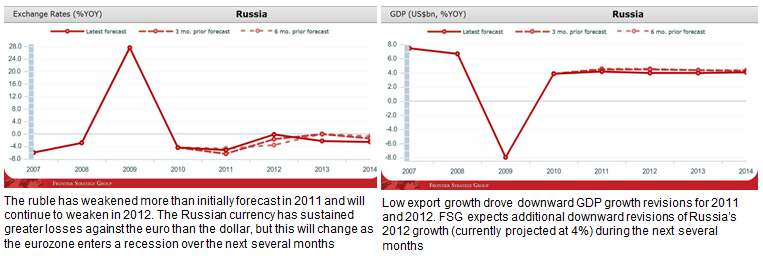
The ruble is depreciating against the dollar as markets anticipate Russia will run a deficit in 2012. We expect the Russian government to intervene in the foreign exchange market in Q1 2012, but a significant decline in oil prices could lead to rapid ruble depreciation as Russia would lose the hard currency necessary to support the ruble
Drivers
- The eurozone crisis is driving investors away from emerging markets currencies, including the ruble. The result is a stronger dollar which will put downward pressure on oil prices. Low oil prices will in turn weaken the ruble in H1 2012
- Weak exports combined with Russian demand for imports (see Trend #2) are also contributing to a weaker ruble
- Large capital outflows, expected to reach over US$70 billion for 2011, are putting downward pressure on the ruble. The outflows will continue to impact the exchange rate at least through the March 2012 elections
FSG View
- We expect the ruble to remain weak through H1 2012 and to depreciate significantly when the eurozone crisis leads to a decline in oil prices
- The Central Bank of Russia is able and willing to intervene to keep the ruble from depreciating significantly and will do so increasingly as elections draw near. However, it does not have the firepower to offset the effects of a sharp decrease in oil prices
- A weak ruble will contribute to the gradual deterioration of Russian consumer outlook in late Q1 2012 and negatively impact B2C companies and MNCs importing into Russia. Companies producing locally will be well-positioned to take advantage of consumers switching to cheaper, domestically-produced goods
- The weaker ruble will strengthen the position of Russian exporters but will not compensate for the decrease in demand from European markets
- MNCs need to factor a weaker ruble and higher volatility in their planning for 2012 and consider forward-pricing and hedging strategies to limit the impact of a weaker ruble on their business
Multinationals can count on increased consumer spending as the evolution of the Mexican economy toward higher value manufacturing supports a more resilient and prosperous Mexican middle class. Companies servicing the automobile and heavy machinery sectors are set to benefit the most from the continued diversification of the Mexican economy.
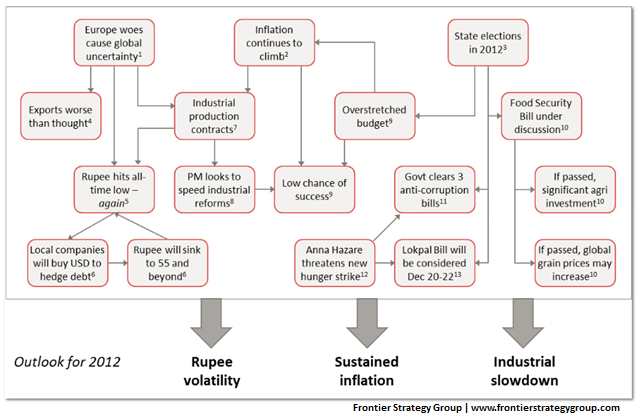
If you’ve been focusing on end-of-year business performance this week instead India’s macroeconomy, you’ve missed a lot. This flowchart highlights key events of the past week and the ultimate drivers: Global uncertainty, inflation, and upcoming state elections.
Frontier Strategy Group’s prognosis for India’s economy in 2012 is relatively grim. However, we continue to hear from clients that India is a critical growth market. A “grim” outlook for India still means 7.7% GDP growth in 2012, compared to 3.5% in Brazil and Russia.
- FSG is monitoring ongoing developments in Europe and its impact on key emerging markets like India
- In November inflation slowed to its slowest in a year, but still missed expectations. The expected wholesale price index was 9.02%; the actual was slightly higher at 9.11%.
- Seven states will go to the polls in 2012 to elect their legislative assemblies, among them Uttar Pradesh, Gujarat, and Punjab, some of the most important political states in the country.
- News on December 9 showed export data was overstated by about 5% across 2011, due to misclassification and errors in the Commerce Ministry.
- The rupee closed at an all-time low of 53.7 to the dollar on Wednesday, spurred by European debt concerns, a flight to the dollar, and bad news on industrial production.
- The rupee is likely to fall lower in the next month, as local companies buy up dollars to hedge their exposure from dollar-denominated debt.
- India’s Index of Industrial Production (IIP) contracted 5.1% percent in November, its steepest fall in over two years.
- In response to the IIP contraction, the Prime Minister is asking key ministries like power, coal, and steel to submit a wish list of legislation that is currently stuck in committee, with the intent of hastening implementation.
- Discussions around the Food Security Bill at the beginning of this week were inconclusive, and iIt is likely to be discussed during the next Cabinet meeting on December 18. The Bill gives 64% of the population the legal entitlement to subsidized food grain, and would expand the government’s food grain procurement by 20%.
- The Union Cabinet just cleared 3 bills on judicial accountability, protection of whistleblowers, and a Citizens’ Charter for grievance redressal.
- Anna Hazare is threatening a hunger strike starting December 27 if the Lokpal Bill does not pass.
- The Lokpal Bill is building up to a vote in the next two weeks. The government has an ambitious agenda: December 19, the Cabinet clears the bill; December 20, the bill is introduced in the Lok Sabha; and on December 21, the bill is introduced in Rajya Sabha. December 22 is the end of the winter session.
(Image from Euronews)
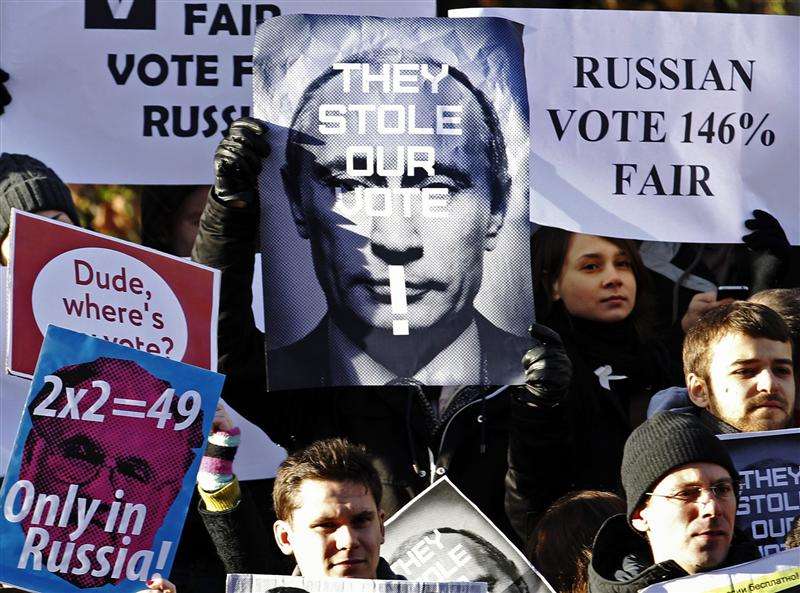
The popular protests following the latest Duma elections revealed a fundamental shift in Russian popular opinion which has been forming for over a year now: as Russians realize that the economic prosperity of the pre-crisis 2000s is slowly but surely turning into long-term stagnation, they are no longer ready to pay for it with their political freedom and sense of personal dignity. Russians feel humiliated by a state they see as increasingly captive to interest groups and corrupt officials. This is bad news for Russia’s political elite, but good news for multinationals.
We are not seeing an Arab Spring in Russia, and neither is any opposition group or personality powerful enough to galvanize the disenchanted voters. Barring a major Black Swan event, Putin will return to the presidency in March for a six-year term. However, the legitimacy of his power has been undermined and will continue to be, making him a weaker leader. As Russians increasingly demand change, he may be able to last through his six-year term, but he is unlikely to be elected for another one. Meanwhile, the power groups that stand behind him may decide an unpopular Putin is a liability they don’t want to bother with. A post-Putin Russia is much more likely to be ruled by a political leader unofficially promoted to national prominence by the established elite, than by an opposition leader who will be an outsider to Russia’s power circles.
For multinationals, this means that the overarching political environment in the country will remain unaffected in the short term, but there will likely be some reshuffles and instability within Russia’s elite, including among high-level state officials. To respond to demands for change, Putin will introduce some new faces to the government after the March elections, and MNCs should be positioned to engage with them through a more nuanced government relations strategy.
The perception of increased political risk will continue to drive capital outflows from Russia, putting downward pressure on the ruble and contributing to rising inflation. Capital markets, already highly sensitive to risk in Emerging Europe as a result of the eurozone crisis, will be cautious at best on Russia, making financing more costly to Russian companies. As a result, MNCs should expect high volatility on the Russian market at least until the outcome of and reactions to the presidential elections in March are clear.
And while MNCs will likely see some of their Russian partners struggle with tighter lending and a weaker ruble, this period will create opportunities as well. We expect high government spending through the March elections as Putin seeks to appease the population. The weaker ruble and higher volatility also make this an opportune time for MNCs interested in pursuing M&A. Even major Russian companies are increasingly struggling to raise money on the global capital markets, creating opportunities for strategic acquisitions by MNCs with a long-term vision for the Russian market.
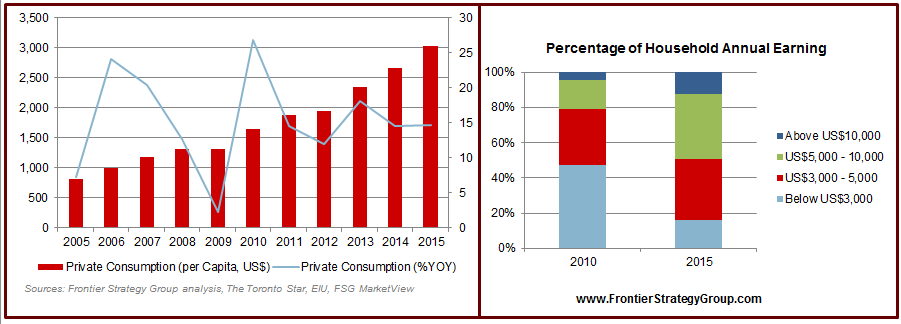
Indonesia is the fourth largest country in the world in terms of population. Fast growing consumption, powered by growing affluence of the middle class, is the main driver of Indonesia’s economic growth
Favorable Demographic Profile
- With a total population of 238 million, Indonesia is the fourth most populous country in the world after China, India, and the US
- Indonesia has a favorable demographic profile with 60% of population aged below 40
Consumption Driven Economy
- Private consumption is the biggest driver of Indonesia’s economic growth, representing 56% of total GDP output
- Private consumption per capita is expected to double from its current level of US$1,500 to US$3,000 in 2015
Indonesia’s Growing Middle Class
50 million households in Indonesia have a disposable income of US$3,000 or more, and this number is expected to reach 150 million by 2015
- 8 million scooters, a favored form of transportation among urban residents, were sold in 2010, compared to 1.7 million in Thailand
For MNCs, this could mean:
- Consumer goods companies should look at Indonesia seriously as the consumer spending boom is just getting started
- Despite various operating difficulties in doing business in Indonesia, MNCs should establish on-the-ground presence, either through wholly owned subsidiaries or partnerships, to catch this growth opportunity at its onset
Multinationals are increasingly considering developing R&D facilities in Brazil in order to support localization of their products and improve government relations
- Over 50% of companies surveyed are considering establishing R&D facilities in Brazil
- However, investments in R&D are limited by the human capital constraints, which prevent Latin America from being a global innovation center
- FSG members invest less than 1% of total capital in R&D activities in Latin America
Location of R&D Facilities: FSG experts continue to see São Paulo as the center of R&D development in Brazil, with over 90% reporting the city as the best choice for facility placement
- Sao Paulo remains the largest local market, and has the greatest availability of human capital and highest quality of local research institutions
- However, a growing number of multinationals, including Google and Fiat, are beginning to expand R&D development to Minas Gerais
- There are over 25 technology parks in Brazil, largely concentrated in the South and Southeast, with a growing number in the Northeast
Key Challenges: While Brazil has made important gains in terms of technological advancement and human capital development, important challenges remain:
- Productivity gains through innovation are lagging in Brazil in nearly all industries except agribusiness
- The labor market for engineers and scientists remains undersupplied, particularly outside the major metropolitan centers
- Outside of the areas of biofuels and agriculture, government spending on R&D remains weak
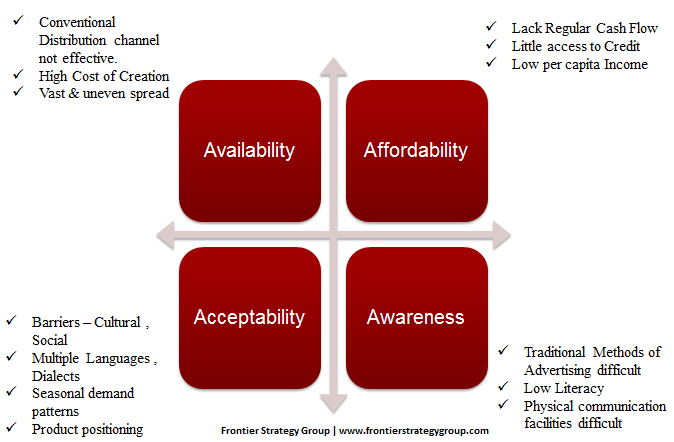
On Wednesday, India’s government suspended its plans to open up its massive retail sector to foreign MNCs like Wal-Mart and Carrefour. Western consumer-focused companies are growing impatient as they seek out the opportunity to sell their products both in India’s major cities as well as to consumers in rural areas. Companies should proceed with caution when marketing their products to India’s rural consumers (see graphic below):