




Featured Emerging Markets Insights

Getting Government Engagement Right in Latin America


Country and regional heads at Frontier Strategy Group client companies are increasingly turning their attention to their government engagement function, and for good reason. It is evident that government decisions often hold the key to significant risks and opportunities, from regulatory issues to government sales, that can deeply impact the bottom line.

Clients express that they are wrestling with a variety of questions when it comes to running successful government engagement functions. These questions can be broken down into three principle challenges:

  • Ensure the company invests the right amount in government engagement. MNCs struggle to quantify the function’s contribution to business objectives, which often leads to a crisis-response approach to investment.
  • Generate positive engagement when government actors are initially unreceptive. This is particularly challenging because governments typically hold all the power in any given interaction and the panoply of government actor interests is much more diverse and complex than the typical business partner’s interest in increasing profitability.
  • Capitalize on the abilities of third parties without putting the company at risk. This is particularly challenging because the same reasons that lead government engagement offices to turn to third parties – lack of internal staff presence on the ground, expertise, or connectedness – are the very elements that make it difficult to monitor third parties and make sure they are not engaging in wasteful or unethical practices on one’s behalf.

In response to these challenges, the government engagement function often resorts to a reactive, problem-solving approach. However, Frontier Strategy Group’s cross-industry research reveals that to succeed, the government engagement function should reframe traditional ROI evaluations to embrace the broader goals of government engagement, thus creating a proactive decision framework. This new ROI approach applies to each of the three major challenges companies face:

  • Justify Your Investment – First understand how to tailor your investments to the realities presented by each country’s business and political environment. Then size up the “R” in ROI by taking a value at stake approach to determining which issues the government engagement function should prioritize, well in advance of the development of serious problems.
  • Earn Your Influence – Make sure you time the “I” well in ROI. Provide direct value to key contacts in government before you need their assistance, for instance by offering research on a topic where your company has expertise or by partnering to help a government sector operate more efficiently. Build political support by building domestic companies into your supply chain.
  • Discipline Your Delegates – Do not take short cuts with third parties. A low “I” does not guarantee high ROI if the “R” turns out to be negative. If you decide to hire a consultant, lobbying agency, or legal firm, you must first invest in sufficient due diligence to be sure they will not indirectly involve you in a scandal by association with other clients, or by hiring unauthorized fourth parties. Second, invest in helping third parties to really understand your industry so that they can better serve you.

Despite Flooding and Property Market Declines - Asia Outlook still Bright


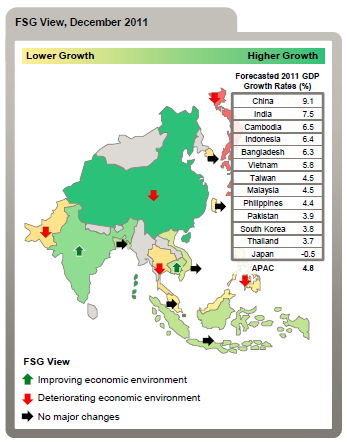
Asia’s outlook has darkened over the last month as flooding in Thailand disrupted regional supply chains and declines in the Chinese property market injected uncertainty into the region’s growth forecasts. While these developments will require active monitoring, multinationals should keep them in perspective. Asia is still better positioned to weather a global downturn than most other regions.

APAC Outlook

Risks Looming Over Russia’s 2012 Outlook


As Western Europe continues to struggle with the sovereign debt crisis and currency depreciation, declining exports, and lower 2012 growth prospects engulf Central and Eastern Europe, the outlook for Russia seems surprisingly solid. Despite a slow downward revision of 2012 growth forecasts from earlier this year, Russia is still projected to grow at about 4% in 2012.

However, the 2008-2009 crisis made it painfully clear that Russia is not and cannot be an island of stability when European and potentially global markets are in turmoil. Since 2009, Russia has grown even more dependent on energy exports, with its 2012 budget balancing at oil price of over $110 per barrel.

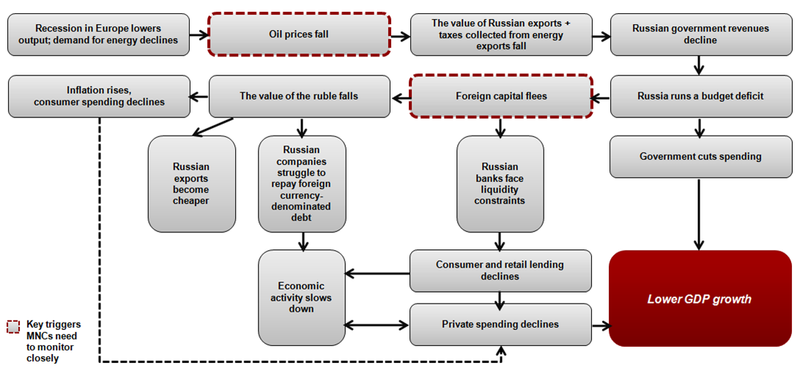
In the short term Russia is growing on the back of strong consumer demand, but this in no way eliminates the significant downside risk of an oil price decline. With the Eurozone already heading into a mild recession and the possibility of global financial market contagion, a significant decline in oil prices is a real possibility. A drop in oil prices could unleash a chain reaction (see graph) that would undermine Russia’s economy and, at best, depress Russia’s GDP growth.

For MNCs, this means having contingency plans for a significant downturn in Russia over the next 6-8 months to address ruble depreciation and declining demand on the domestic market.

On the positive side, MNCs should also be prepared to take advantage of M&A opportunities as attractive local assets will be priced at a discount.

In the long term, the Russian market continues to hold significant opportunity for foreign companies, especially after the country joins the WTO later this year. However, MNCs need to account for the significant risk the Eurozone crisis is posing to Russia’s performance in 2012 and be prepared to respond to rapid changes in the market.

Companies Have Little to Fear from a Very Likely PRI Victory Next Year


Are corporate growth expectations for 2012 unrealistic?


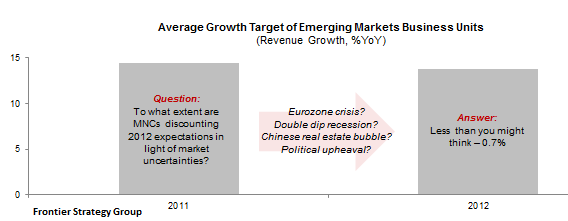
Despite the uncertainty and volatility surrounding the 2012 economic environment, corporate expectations for emerging market business units remain high, across regions and industries. Companies such as Heinz (NYSE: HNZ-P) and BlackRock (NYSE: BLK) are expecting emerging markets to continue to drive growth, but Frontier Strategy Group has observed two potential red flags that emerging markets executives should consider as they look to 2012:

1.Expectations are aggressive, but strategies are conservative
–Profitable growth is the priority in 2012. Most executives are emphasizing conservative methods for expansion over riskier and more resource-intensive options
–Companies are expecting to achieve targets by taking market share, rather than entering new markets, launching new products, or M&A
2.Strategies may be undermined by the tactics used to implement them
–Despite the emphasis placed on profitability, a majority of companies plan to compete on price, lowering the prices of their existing products developed for Western markets, rather than adjusting product features, which would allow them to reduce costs while increasing value
–Margins will be further squeezed if deteriorating market conditions cause customers to be increasingly price sensitive

FSG has surveyed senior executives running emerging markets business units to collect detailed insights into growth targets and strategies, hiring, salaries, organizational structure, and more.

Exclusive Teleconference - M&A in Emerging Markets November 30


Your Name (required)

Your Company (required)

Your Title (optional)

Your Email (required)

Subject

Your Message

The Sovereign Debt Crisis in Emerging Markets (Part II)


What can your business do?

Most companies react to crises by cutting costs and strengthening cash positions. These companies fail to separate from the pack during the inevitable recovery that follows every crisis. Leading companies:

  1. Plan opportunistically – Build acquisitions target lists ahead of downturns. Companies that want to be in emerging markets for the long term correctly identify environments with low valuations and favorable exchange rates as strategic entry points. Other companies pursue Greenfield strategies to the same ends. Going local can mitigate currency risk and pricing strategy disruptions as both inputs and outputs are denominated in one currency. Companies that go local during downturns, inorganically or organically, capture market share from competitors who import into the market because depreciating local currencies price local customers out of the market for imported goods.
  2. Mitigate risk while positioning for recovery – Selectively extend financing to suppliers and distributors to ensure that ecosystems remain liquid and can survive a downturn. Rebuilding supply chains and indentifying new distribution partners is more expensive than providing support during tough times.
  3. Prioritize markets to identify winners – Rigorous data-driven prioritization is paramount when there is increased competition for investment dollars. Leading companies quantify the size of the opportunity, the growth trajectory of the opportunity, as well as the individual risks present in the marketplace before making the case for resource allocation.

Identifying emerging markets winners

We can determine the emerging markets that will outperform and underperform by the level of trade exposure a market has to the center of the crisis. Broadly, emerging markets can be broken into three groups: markets that have a high linkage, a medium linkage, and a low linkage to the center of the crisis.

Low linkage:

The clear outperformers in the short term are India, Indonesia, and Sub-Saharan Africa. These markets are characterized by rapidly growing domestic demand and diversifying economies that are creating middle class growth. These markets have limited trade relationships with Europe. As a result, multinationals are gearing up investment plans across these regions, hoping that ensuing growth makes up for losses in Europe.

China is an exception. It is linked to the crisis in Europe but has built enough savings to weather a downturn in manufacturing exports. However, China has a domestic credit bubble that makes its economic outlook less clear. That said, multinationals will continue to invest in China as historic performance has been robust.

Medium linkage:

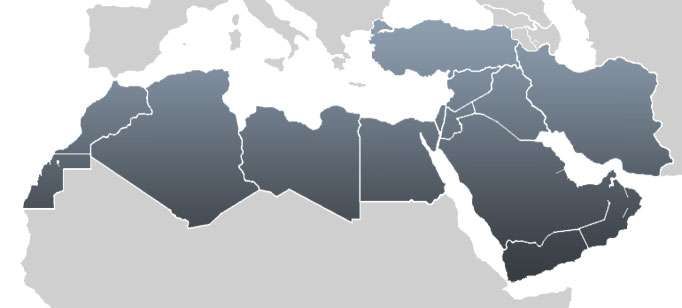
The Middle East and Latin America are linked to Europe because of trade in commodities: oil from the Middle East and foodstuffs from Latin America. In the Middle East, reduced European demand for oil will impact state revenues, but most markets have more than enough reserves to weather a crisis. As a result, we expect Middle Eastern markets to continue to grow and invest in long-term projects that will help maintain stability and diversify the economy.

While commodities play a role in Latin America, the real driver of growth there is domestic consumption and a growing middle class. A slowdown in Europe may shave a few points off growth in the region, but it will not stop the secular trend of robust middle class growth that is driving the market.

High linkage:

Russia is positioned to be the biggest underperformer. Oil exports to Europe are driving Russian GDP growth more than ever before. Russia emerged from the 2008 crisis weakened as much of its hard currency reserves were spent placating the population while no meaningful diversification of its economy was achieved. As oil prices fall below the $110 per barrel built into the Russian budget, Russia will enter deficit. It has already borrowed from capital markets for the first time in years.

Turkey will be another underperformer, although the demographic and economic fundamentals in Turkey are so strong that a downturn there will create excellent buying opportunities for companies planning to be in Turkey for the long term. The crisis is already impacting the lira, which has depreciated rapidly against the dollar as Turkish exports to Europe slow.

Central and Eastern European (CEE) markets will suffer for the same reason as Turkey – increased reliance on manufactured exports to Europe. In CEE, Poland stands out as the strongest market.

Contingency planning is key

The crisis will create risks and opportunities for businesses. Leading companies will distill the fundamentals, develop contingency plans, and communicate those plans throughout their organizations ahead of the crisis.


The Sovereign Debt Crisis in Emerging Markets (Part I)


What happened?

In 2008, banks stopped lending as they were forced to use capital to absorb losses from deteriorating investment portfolios. When lending dried up, business struggled, industrial production contracted, and jobs were lost.

Job loss drove the consumer into a deep recession. When the consumer lost its means to spend, banks found themselves in more trouble. Consumer-related debt securities holding everything from mortgages to credit cards to auto loans began to default, driving the deepest recession since the 1930s.

Governments stepped in as lenders of last resort to break the vicious cycle, but many governments were already overleveraged. As bad credit worked its way through the system, markets ultimately turned on indebted governments believing that governments would not be able to repay debt.

Enter the sovereign debt crisis

Markets revolted first against governments on the periphery of Europe because it was clear that those governments would run into solvency issues with no credible plans for economic growth. Ireland, Greece, and Portugal subsequently received bailouts but are still in trouble. Italy is on the brink and there is not bailout package on the table large enough to solve that crisis. Spain is next.

The crisis is not a Greek problem or an Italian problem. The crisis is a problem that impacts all of Europe as well as markets globally. Leading European banks based in Germany and France hold tremendous amounts of bad sovereign debt as well as derivatives on that debt. Much of this is not marked to market, so banks currently do not have to recognize losses. However, the event of a technical default will force banks to recognize losses that they are not capitalized to absorb.

A technical default is the worst-case scenario because it will disrupt the banking system, dragging Germany, France, and the broader global economy into recession. The only way to mitigate the impact of an EMU breakup is if the European Central Bank (ECB) preemptively recapitalizes banks, something Germany is opposed to because it fears inflation.

Regardless of the scenario that plays out, Europe is headed for recession and a breakup of the EMU. The only potential solution is a massive debt monetization program that would be led and funded by Germany through the ECB. However, this is becoming increasingly unlikely as policy heads the opposite way. On Monday, November 14th, German Chancellor Merkel’s party voted to allow EMU members the right to remain in the EU free trade zone; even they left the monetary union. This is a critical first step in preparing the mechanisms necessary to support a breakup of the EMU.


In Nigeria Oil is King, but the Consumer is a Restless Prince


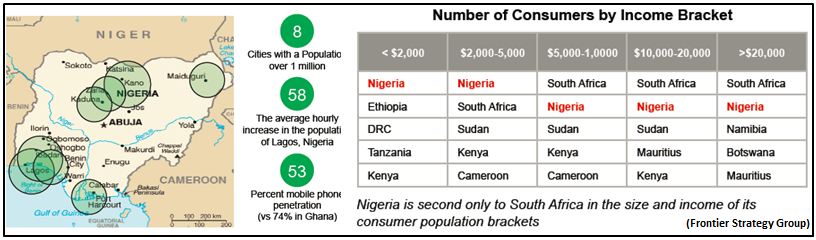
Nigeria consumer

Growth Beyond Oil

  • Real GDP growth is projected at 7.4% in 2011. At this rate, Nigeria’s economy will double in the next 10 years
  • Nigeria depends on oil exports for more than 80% of government revenue and 95% of foreign-exchange income. The government has recently announced a 10-year plan to cut oil dependence
  • Nigeria’s non-oil sector continues to be a major driver of the economy, largely driven by improved activities in wholesale and retail trade, finance and insurance, telecommunications, and building and construction. The non-oil sector is projected to grow at 8.8% in 2011 compared to 8.5% in 2010

Nigeria’s Bullish Consumer

  • Plentiful: Nigeria is the world’s 8th largest country by population. In the next 5 years, Nigeria will increase its population by the size of Romania
  • Urban: Lagos (GDP $37bn), Kano (GDP $5.5bn), and Ibadan (GDP $9.5bn) are three of Africa’s largest cities
  • Optimistic: Nigeria is ranked as the most optimistic consumer market in Africa

FDI in Nigeria

  • Recent FDI in Nigeria includes investments by NSN, Google, Diageo, and Nestle (US$94.4m plant) as well as the construction of the Lekki Free Trade Zone (LFTZ)


Argentina Faces Looming Economic Challenges in 2012


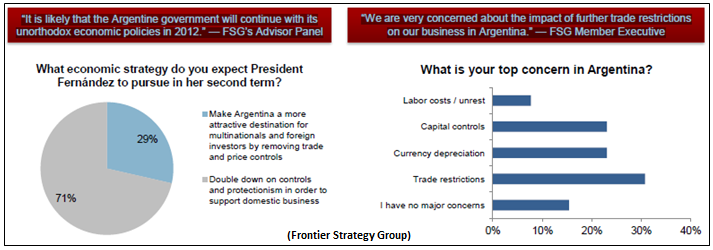
Argentina economyArgentina’s economy is at a crossroads with high inflation, an overvalued currency and an increasingly unfriendly policy regime. The greatest risks to the business environment come from capital controls, trade restrictions, and currency devaluation. The situation is unsustainable, making a reckoning likely in 2012.

Signposts for a Reckoning:

  • President Fernandez’s selection for Economic Minister
  • Inability of the government to reign in spending
  • Labor unrest and discord between the unions and government
  • Worsening capital flight

According to Frontier Strategy Group’s on-the-ground advisers, the majority believe that the business environment will worsen during President Fernandez’s second term. They also feel that trade restrictions, capital controls, and currency depreciation are of top concern for multinational corporations operating in Argentina.

« Previous PageNext Page »