



What do disgruntled Chinese bachelors and unemployed Indian call-center workers have to do with sub-Saharan Africa? At the moment, not much: A recent UN report shows that the continent at present accounts for a meager 1% of the world’s total manufacturing output. However, the same demographic and wage inflation trends that are currently raising questions about the long-term sustainability of Asian countries’ hard-won reputation for offering manufacturing firms a plentiful and cheap supply of labor do point to an opportunity for Africa — if a number of important constraints can be overcome.
Demographic trends are in Africa’s favor
The attractiveness of China as a low-cost manufacturing destination is dimming as its demographic profile changes. Due to the single child policy, the Chinese workforce will decline by around 100 million (from 72% of total population to 61%) between 2010 and 2050, with associated upward wage pressures. India is often characterized as entering a period of ‘demographic dividend,’ with a younger workforce capitalizing on a more expensive Chinese labor force.
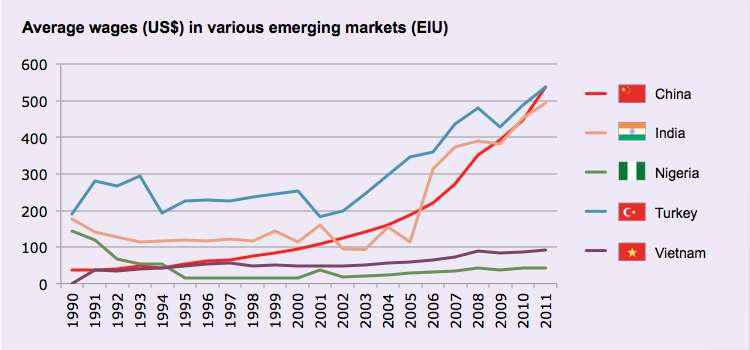
Likewise, in Sub-Saharan Africa, the workforce will grow to 1.1 billion people by 2040. With its own demographic dividend paying off, Africa will become an increasingly attractive destination for manufacturing.
A long road with a lot of potholes
Despite the demographic and pricing trends in its favor, Africa has a long way to go if it is to become a global manufacturing destination of choice. The continent’s reputation for rampant corruption and almost permanent political instability may be a generalization — both trends are broadly improving across most of the continent — but infrastructure constraints (in particular the reliability of electricity and water) and skills shortages are both more ubiquitous, and arguably more intractable. Red tape impeding new investment, opaque tax laws, burdensome employment regulations and vexed labor relations present further obstacles in many markets.
The more enlightened African governments are aware of these impediments, and have made adding local value to the continent’s multiple natural resource exports a key priority from a foreign exchange generation and job creation perspective. Several are among the world’s most active business environment reformers; infrastructure improvement projects are proliferating around the continent. Skills enhancement and overcoming corruption are more systemic transformations that will take longer to achieve. Meanwhile, Africa is also seeking to capitalize on its competitive advantages of labor costs, availability and proximity to key markets by creating a wave of tax-efficient industrial development zones. Over 20 countries in the region offer such incentives, including Kenya, Nigeria, Ghana and Tanzania.
A sign of things to come?
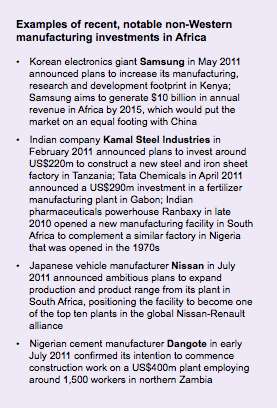
Perhaps the most telling long-term indicator of Africa’s future manufacturing potential is the growing trend of Asian and other emerging market-headquartered companies placing facilities into Africa. Emirati, Japanese, Chinese, Korean and Indian companies have all announced major manufacturing investment plans in various African countries in recent months. Western companies are currently waking up to Africa’s consumer potential, in many cases several debilitating steps behind their Eastern competitors. Frontiers Strategy Group advises them to track a parallel trend to manufacture as well as sell their goods locally.
Frontier Strategy Group launched its new AfricaVantage service, designed to give global companies the data tools, strategic insights and high-level networking opportunities they need to capitalize on the growing African opportunity. Look out for new posts on the region in the next few weeks.


No related posts.


China is protesting because the Dalai Lama is formally meeting President Obama soon. The Chinese don’t want any publicity for Tibet. Why not? Because the Tibetan plateau, if you look, controls a great deal of China’s water supply. Some large rivers start up there and run from there down into China, irrigating a lot of it. If the Tibetans dammed those, China would have big trouble on its hands. President Obama, we might assume, is well aware of this. Soon, he’s meeting the Dalai Lama, Tibet’s spiritual leader. Coincidence, of course