Qatar’s royal succession puts Saudi Arabia’s unresolved leadership question back into the spotlight. While it is unlikely the next king will alter Saudi Arabia’s path, it is important for companies to be prepared given the prominence of the market in their portfolio.
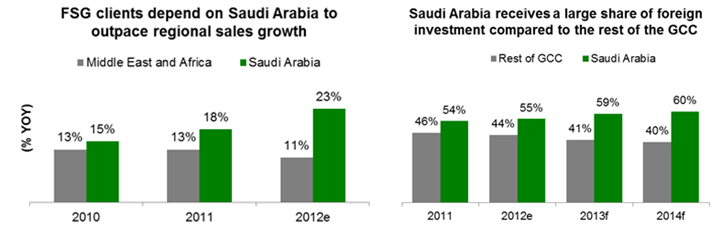
A survey conducted last year revealed that FSG clients count on Saudi Arabia to deliver sales growth rates than are more than double the overall average in the Middle East and Africa region. In addition, Saudi Arabia is forecast to receive 60% of FDI directed to the GCC by 2014, indicating a heavy reliance on the Saudi market among foreign investors.
While a smooth transition is more likely than a botched one, the lack of political certainty will keep senior executives up at night. To understand why a smooth transition is important to business, consider how the king’s role has evolved during the past several decades. King Abdullah is essentially the CEO of one of the largest corporations in the world.
Four ways the king manages Saudi Arabia, Inc.
- Messaging to the board: The Saudi state’s legitimacy is built on support from religious conservatives, and the king must ensure they are satisfied with the direction of the country
- Keeping employees motivated: The king manages royal family rivalries by appointing new princes to positions of importance. Princes are motivated to remain loyal based on the prospect of increasing power that is laid out by this policy. The king also allocates generous allowances to more than 25,000 royal family members in exchange for support
- Setting the corporate vision / strategy: King Abdullah’s cautious reform agenda is slowly improving the investment climate and aims to promote sustainable growth. While the king cannot control all of the implementation, his vision plays a key role in the shaping the direction of the kingdom
- Portfolio Management: As part of the king’s power to set a strategic agenda, he sets the tone for which sectors and sub-regions benefit the most from public spending
Just as corporate entities are vulnerable to a lack of clear succession planning, so is Saudi Arabia Inc. King Abdullah has done much to alleviate these concern in recent years, positioning young princes in key ministerial and gubernatorial posts, and ensuring the princes that are next in the line roughly share his vision for the country. Still, doubts will likely persist until Saudi Arabia is able to successfully move to the next generation of leaders.
In preparation for changes in Saudi Arabia, companies can take actions now to protect their business:
- Establish and maintain government contacts on multiple levels: ministerial, regional, and municipal. This will promote cohesive relationships during a leadership transition
- Extend receivables for key customers and buy long-dated oil futures if you are concerned about a sustained disruption to the business landscape
- Do not alter or reduce investment plans in Saudi Arabia, particularly in social sectors like education and healthcare
- Communicate to corporate that you have a plan in the event of a royal succession



Speak Your Mind