Syria Intervention Impacts Your MENA Business

Syria USThere are growing indications that the US is readying for a military intervention in Syria after last week’s suspected chemical weapons attack, which killed up to 1,000 people in a rebel-held Damascus suburb. This post highlights three business challenges likely to arise from an intervention and three suggested actions for multinational companies operating in the MENA region.

Business impact:

  1. Higher Energy Prices: Anticipate a spike in oil prices that could last for days or weeks. Oil analysts are estimating that Brent Crude could exceed US$120 per barrel as a result of a military strike. In extreme circumstances, Société Générale envisions prices climbing up to US$150 per barrel in the short term. A sustained spike in energy prices could lead to increased cost of production and less discretionary income available for households.
  2. FX volatility: Higher energy prices could place significant pressure on currencies in import-dependent countries. Several countries are near 10-year lows in currency reserves (Tunisia, Morocco, Jordan, and Lebanon) and they could have trouble covering the cost of imports during a sustained conflict. Currency depreciation is possible as reserves run low, putting further pressure on imports.
  3. Supply-chain disruptions: It is unlikely that military intervention will impact supply chain through key ports in the GCC or cargo traffic through the Suez Canal. However, even the threat of disruptions to shipping routes through Lebanon’s Port of Beirut could increase insurance rates and lengthen travel times for goods destined for other parts of the Levant, Eastern Mediterranean, Iraq, and Europe.

Suggested actions:

  1. Lend dollars to top customers and partners: In MENA countries that are impacted by Syrian spillover, provide liquidity to partners and customers to help them maintain local operations in case of a liquidity crisis. Lending can be used to build loyalty and extract concessions.
  2. Educate your team on the impact of FX volatility: Factor currency depreciation into next year’s strategic plans for import-dependent countries that are vulnerable to commodity price shocks. Use our quarterly report on FX volatility to align your team and adjust your strategy.
  3. Anticipate higher transportation costs: Hold inventories in several locations to ensure goods can reach customers. Protect your staff and products by identifying secure facilities away from areas that could be targeted in the event of spillover from the Syrian conflict.

Frontier Strategy Group Continues Food Security Partnership With Syngenta in Asia

Rice Bowl IndexWASHINGTON, DC-(Marketwired - Aug 27, 2013) - Frontier Strategy Group (FSG), a leading information and advisory partner to emerging market executives, continues its collaboration with Syngenta Asia Pacific on the Rice Bowl Index for a second year.

Launched concurrent to the World Economic Forum in Bangkok in May 2012, the Rice Bowl Index has been instrumental in advancing dialogue regarding food security in Asia. The 2012-2013 annual update expands on the concept of “system robustness”: a country’s ability to withstand disruptions to its food security system by having a balanced capacity in making food available, ensuring that production is sustainable, providing the necessary infrastructure and policies to support domestic production and promote trade, while managing food demand and affordability.

Key findings and year-on-year trends include:

  • The Index highlights that a focus on self-sufficiency may negatively impact the achievement of food security robustness
  • The region’s Policy and Trade environment has become more volatile
  • Since Index launch, 13 countries experienced an improvement in overall food security robustness and two declined

“We are pleased to continue our partnership with Syngenta on such a critical issue as food security in Asia,” remarked Richard Leggett, RBI Advisory Board member and CEO of FSG. “In addition to the obvious humanitarian concerns, food insecurity in Asia and across emerging markets has the potential to disrupt global economic activity over the medium- to long-term. It is imperative that we take a proactive approach to improve food security capabilities at this time. The Rice Bowl Index contributes to this effort by focusing on possible solutions, instead of merely describing problems.”

The Update shows that the Policy and Trade environment has become more volatile over the May 2012-May 2013 period, exerting a greater impact on food security robustness, in contrast to its generally benign effect over the past decade. This outcome highlights the importance of taking both short and long term views of a country’s food security robustness, as in the longer term, other rubrics could also be critical to sustaining robustness.

“Given the increasing complexity of food security and the pressing challenges posed by an increasing population, rapid urbanization and climate change, there is a need to minimize volatility and ensure a balance between the four rubrics,” said Andrew Guthrie, Regional Director, Syngenta Asia Pacific. “With balance comes stability, underpinning the need for a system-wide approach to food security.”

Since the publication of the first white paper in May 2012, food security strength has generally improved across the Asia-Pacific Region, with 13 countries experiencing an improvement and two experiencing a decline. The Update highlights that in many countries, the shifts in overall robustness were marginal, with minor outliers. Over the past year the Index observed significant movement in three of the four variables — Policy and Trade, Demand and Price, and Farm-Level Factors — while the impact of Environmental Factors showed little change.

The Index is designed to facilitate dialogue, collaboration and action between governments, the private sector and other key stakeholders in the area of food security. It is managed by an advisory board whose members include: Bruce Blakeman, Vice President Corporate Affairs, Cargill; Marcel van Doremaele, CEO Rabobank Singapore & Representative Markets; Andrew Guthrie, Regional Director, Syngenta Asia Pacific; Hans Joehr, Head of Agriculture, Nestle; Richard Leggett, CEO, Frontier Strategy Group; Dr. Andrew Powell, CEO, Asia BioBusiness; David Shearer, Director, Corporate, Australian Centre for International Agricultural Research; and Prof. Paul Teng, Senior Fellow (Food Security), Rajaratnam School of International Studies, Nanyang Technological University, Singapore.

Reminder of India’s Potential: Three Experiences Almost Not Possible Five Years Ago

India SunriseAs one spends time in India at a point when the economy seems to be falling apart, it is easy to forget the advances this generally slow moving country has made on several fronts over the past few years. Though growth has moved off its high trajectory, having seen average GDP growth of almost 8% between 2002 and 2008, the underlying story of its great potential in the long run remains intact. The country has an immense domestic consumption base which is young and has yet to experience the level of income boom seen by China and other large developing countries; India’s private consumption per capita remains below that of most Southeast Asia countries and is 2.5 times smaller than China’s, 5 times smaller than South Africa’s, and most than 7 times smaller than that of Brazil.

Three simple experiences from my trip to India where I spent substantial time with executives in Mumbai and Delhi, which would have been nearly impossible five years ago, quickly reminded me of the potential that many companies continue to see in India and the changes they are bringing to the way the country is going to develop over the next decade.

  1. Rise of E-Commerce – Success of Flipkart: Items purchased = six best-selling novels in paperback, Amount paid = US$67, cost of delivery = US$0, mode of payment = Cash on delivery. It is not hard to understand how Flipkart.com, one of India’s largest e-commerce platforms, has become so successful, so quickly. Launched in 2007 by two ex-Amazon employees, the firm recently raised US$200 million (putting its valuation at roughly US$2.5 billion) to, “ to spruce up Flipkart’s technology capabilities, logistics chain and staff strength as it shifts to a marketplace business model, where retailers use the online platform to sell brands to customers directly,” said Chief Executive Sachin Bansal. Companies such as Flipkart are likely to become more popular in India as E-commerce is on the rise. We are already seeing interesting concepts being launched, such as Easy Fix, a service that provides professional repairmen for household needs in Delhi. According to recent report by McKinsey, India is on the threshold of a digital revolution. Driven by cheaper mobile handsets and the spread of wireless data networks, the number of Internet users in India is expected to nearly triple from 125 million in 2011 to 330 million by 2016- E-Commerce has to become an integral part of everyone company’s strategy.
  2. Proliferation of Luxury Brands in India - Starbucks: After its failed attempt to enter India as early as 2007, the global coffee shop chain finally opened-up its first outlet in the country in October 2012, with a focus on the urban mega-centers of Mumbai and Delhi. Operating in a joint-venture format with the Tata Group, Starbucks sees great potential in the rising upper-middle-class of India, which has a large propensity to consume luxury products. The company currently operates about 15 stores but plans on having a total of 50 stores by the end of just this year. This large consumption appetite coupled with the opening of sectors to foreign investments, such as the passing of the single- and multi-brand retails bills, should only lead to more such luxuries being available over the next decade. As of May, 18 single brand retailers have been given approval to invest into India with the total value of investments at US$173 million.
  3. Execution of Mega Projects – New Delhi Airport: Finally, sitting at the swanky new airport in Delhi, one is forced to question the general pessimism associated with India’s ability to execute on mega projects, especially those associated with infrastructure development. The Indira Gandhi International Airport (terminal 3), inaugurated in 2010, was built at a record pace of 37 months, compared to 76 months taken for Singapore’s Changi Airport T3 and 60 months taken by both Heathrow’s T5 and Beijing’s T3, highlighting the capability of India’s private sector to manage and execute large scale construction projects (US$2.7 billion) in a sector which is generally known for corruption, bureaucracy, and delays. With the increased focused from the government towards attracting private players and structuring PPP (public-private-partnership) type construction projects, it would not be a surprise to witness a quicker pace of development in the infrastructure space over the next decade.

Same Problem, New Name: India’s growth prospect has been hampered purely by the lack of political will and inability to enforce the market reforms that are necessary to bring the country back on track. The utter sluggishness in policy making has had many different names (impacts) over the past few years; high inflation, policy logjam, high fiscal deficit, high current account deficit, and now, currency devaluation. It would not be a stretch to assume that conditions are likely to remain uncertain and without much improvement until the elections of 2014, but this lull-period by no means foreshadows the longer term growth trajectory of this country. Domestic consumption has always been part of India’s growth story and can be revived easily; the government simply needs to get its act together and work on reviving the much needed investments to get out the current mess.

Emerging Market View: What Our Analysts Are Reading

EM View

Microsoft Bribe Probe Reaches Into Pakistan, Russia Deals - The Wall Street Journal

“Allegations of bribery against Microsoft in several emerging markets, including Russia, highlight the continuing corruption risk multinationals face when operating in emerging markets and the importance of effective controls for both the local team and any local partners. For examples of how to reduce corruption risk to your Russia operations, FSG clients can access the report on Managing Compliance in Russia by clicking here.”
-Martina Bozadzhieva, Associate Practice Leader for Central and Eastern Europe Research

.

China Manufacturing Grows as Europe Recovery Signs Build - Bloomberg

“HSBC’s flash PMI in China has unexpectedly entered expansionary territory in August, indicating the slowdown in manufacturing is being stabilized.”
- Shijie Chen, Director for Asia Pacific Research

.

The Emerging Markets Are Getting Smoked by the ‘Emerging Markets of the Future’ - Business Insider

“Some of the “frontier” emerging markets are exhibiting strong fundamentals for growth in the medium term. While the large BRIC markets stagnate, many leading companies are reconsidering their expansion strategies for some of the more uncharted emerging economies.”
- Sam Osborn, Senior Analyst for Global Analytics

Increasing Need for Regional Analysis in India

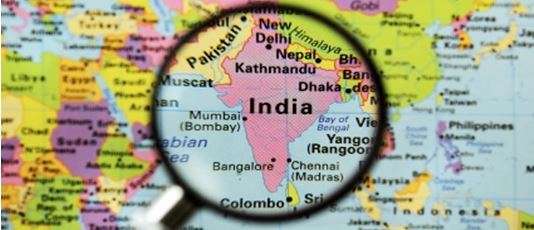
Magnify India

My colleague Shijie Chen recently wrote about the need for provincial analysis to uncover new business opportunities in China. Regional analysis is also needed for India since a study of the parts is more revealing than a study of the whole. Comparative performance analysis of the Indian states has become more prominent than studies of national strategies, as state-based reforms will likely be one of the key drivers of higher national growth in the future. Here are four things to consider:

  1. Divergence in development: India’s economic growth story has not been one of coherent national expansion—it has been one of scattered tales of development, making the study of its individual parts highly important
  2. Above average states: At a time when the country is going through a slowdown, companies need to find the opportunities in states where there has been sustained high growth; in 2011, 75% of the states grew above the national average, and 25% experienced a double-digit economic expansion
  3. Coalition politics lead to regionalism: Because the central government is composed of coalition of parties, economic competition between the states has increased as regional parties vie to distinguish themselves
  4. States with their own policies: State governments are also likely to begin introducing their own economic policies to promote growth. Narendra Modi, chief minister of Gujarat, has introduced a five-year export policy in the state to promote its products on an international level. It is the first of its kind to be adopted in the country

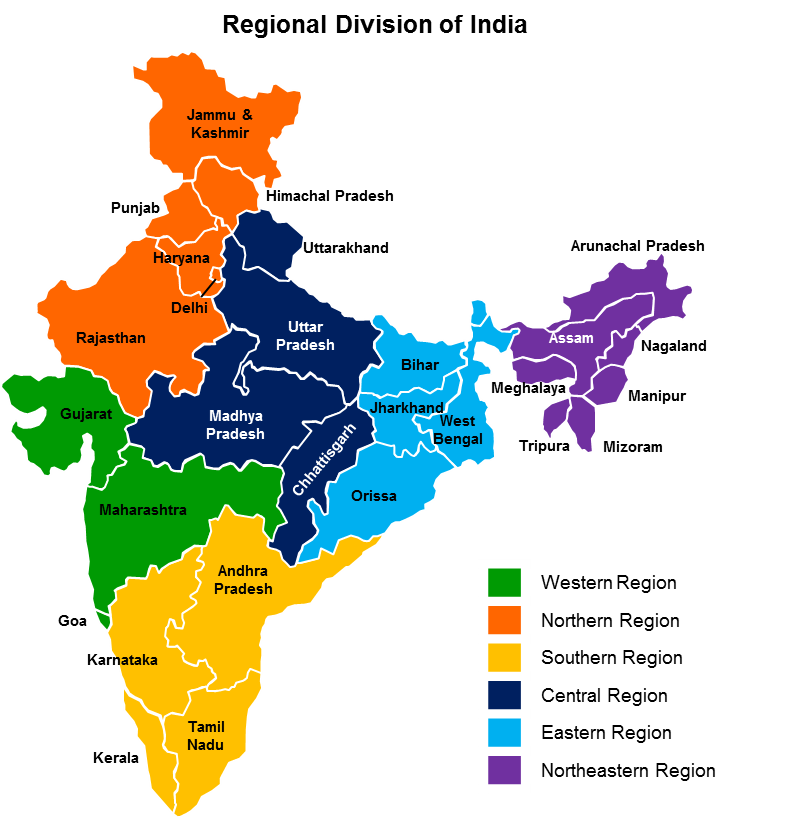
Regional Division of India

Frontier Strategy Group aggregated critical variables into an index and benchmarked the states in India against each other to understand their structural differences:

  • Factors chosen: Six areas of focus were chosen based on factors that are considered imperative for making investments
  • Weights: Weights were chosen to favor states that would reveal a long-term attractiveness
  • Normalization: Variables were normalized in order to account for the size differences between the states

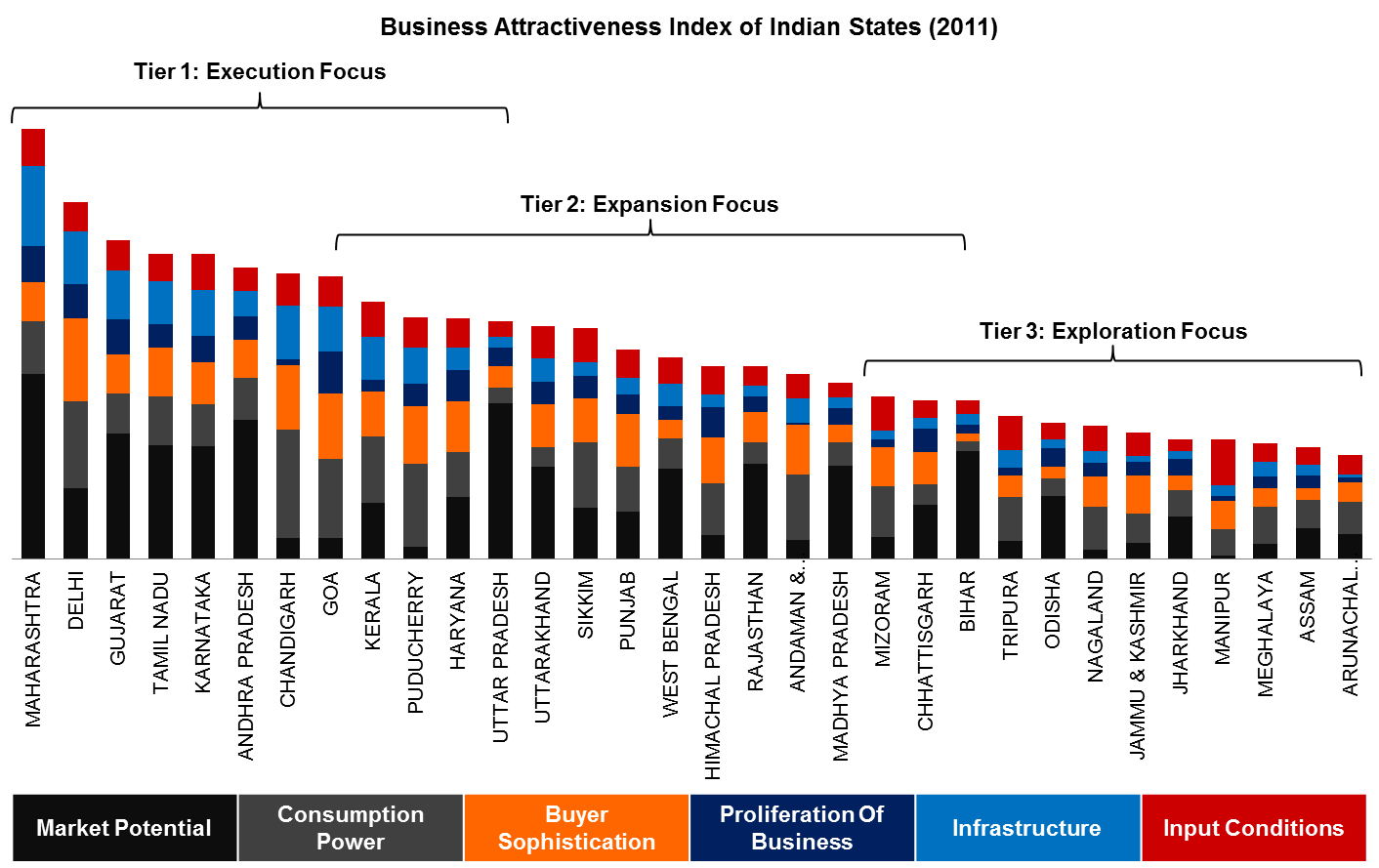
After ranking the states, we divided them up into three key areas as you’ll note in the chart below (this division would differ from business to business)

  1. Execution Focus: Established States Where Optimization of Operations is Necessary
    These are states where several MNCs have had a presence for over a few decades, making these markets established and well penetrated, necessitating a pivot in strategy from one that is expansion focused to execution focused
  2. Expansion Focus: Growth Trends are Key Deciding Factor States under this umbrella are those where you currently have a presence or potentially consider creating one. Analysis of these expansion-focus states should not be conducted purely on a size basis, because many of them have grown tremendously over the past decade; a study of change in growth trends is more relevant for gauging true potential
  3. Exploration Focus: Mostly Eastern, Northeastern, and Central States of IndiaAn exploration focus is needed in states where your firm does not have a presence but would be interested in exploring; especially the top-tier or highly-populated cities in such states. Companies should conduct longer-term comparative studies to judge the true performance of some of these up-and-coming states in the eastern, northeastern, and central parts of India

Business Attractiveness Index of Indian States

India’s economic growth story has not been, and will not be, one of coherent national expansion; it will remain one of scattered tales of development. As the country goes through a phase of decade-low growth, companies need to find opportunities in states where there will be sustained growth, wealth creation, and overall development.

Zimbabwe: Heading to the Polls

FSG View: Early elections will determine the future of the country and could bring turmoil or recovery
(Tsvangirayi Mukwazhi/Associated Press)(Tsvangirayi Mukwazhi/Associated Press)

After several months of uncertainty regarding the election date, President Robert Mugabe set elections to take place with one month’s notice on the 31st of July after a new constitution was signed into law. Critics claim that by calling for early presidential, parliamentary and local elections, Mugabe wants to make sure there would not be enough time for the reforms outlined in the constitution to be implemented.

These speedily arranged and badly prepared elections are not good news for Zimbabwe. They threaten to slow the economy’s growth once again if the country falls back into chaos as it did in the aftermath of the violent and disputed 2008 vote.

But despite its many problems, the tumultuous coalition government between Morgan Tsvangirai’s MDC-T and Robert Mugabe’s Zanu-PF, in power since 2008, had a positive impact on the economy. The economic recovery since 2010 is largely due to the resurgence of the agriculture sector and increasing diamond revenues. The impact of a growing agriculture sector is of particular importance given that it was the country’s main driver of economic growth in the past before the implementation of the widely criticized land reform which saw many white-owned farmers expelled from their lands.

But these elections could threaten Zimbabwe’s economic recovery. Both Mugabe and Tsvangirai will compete once again for the presidency. The rhetoric between the two contestants is heated and raises fears for a return to a political crisis and violence. However, both contestants announced to accept the elections result irrespective of the winner which raises hopes for a peaceful outcome.

The two contestants have very different visions for Zimbabwe. President Robert Mugabe is driving an indigenization policy to bring foreign-owned companies under government control which alienated foreign companies and the international community while Prime Minister Tsvangirai wants to encourage foreign investment.

These elections could mean a return to the turmoil or a continuation of economic recovery depending on the policies implemented by the winner. We must wait and see which path the country chooses…

Podcast: Russia Regional Expansion Strategies

Blog-Podcast-revised

As Russia’s economy slows, companies will have to generate growth by expanding beyond Moscow into Russia’s other regions. The central question of regional expansion in Russia is how to increase sales volume to regional customers while protecting margins.

There are three factors that make this a challenge for multinationals; typically, customers in Russia’s regions:

  • Have lower purchasing power than those in Moscow, depressing margins
  • Are more expensive to serve because of transportation costs and underdeveloped sales infrastructure, depressing margins
  • Are highly fragmented geographically, reducing the maximum volume of sales in any given region. To significantly grow the size of their Russia business through regional expansion, companies need to capture a large number of regional markets

As a result, the majority of multinationals find that a combination of models will serve them best in reaching regional customers profitably. Companies have successfully leveraged distributor and retailer partnerships, franchising, and online sales, as well as some direct presence to capture regional demand without eroding their margins.

In this podcast, Martina Bozadzhieva, Associate Practice Leader for CEE, discusses FSG’s latest research on how companies can resolve this challenge.

Click here to download the podcast or alternatively access the FSG iTunes podcast library here.