Emerging markets – decoupled from the crisis?


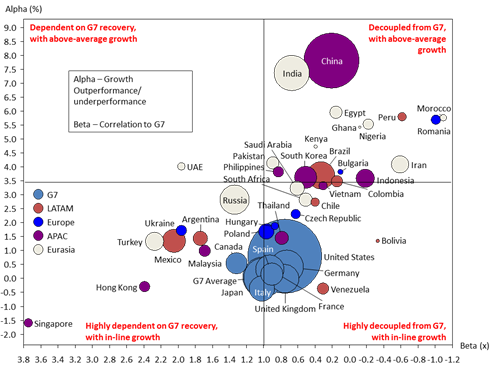
Frontier Strategy Group built a proprietary model in 2008 to test the assumption that “emerging markets are decoupled from western economies (G7)”. We found that certain markets such as Nigeria and Peru were not only decoupled but provided multinationals with consistently high growth opportunities. Conversely, growth in markets such as Turkey, were highly dependent on a recovery in western economies.

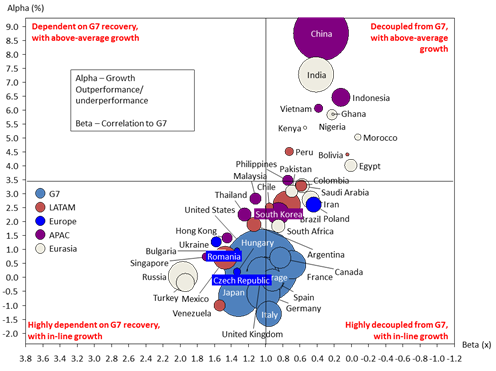
Surprisingly, in 2011, our model shifted to indicate that emerging markets are no longer thought to be as decoupled as before. Very few markets such as Morocco and Indonesia provide above average growth opportunities with less dependence on the status of western markets.

In 2008 we built a model to understand the global impact of a recession:

2011 data shows markets are more coupled than before

Threats and Opportunities Await MNCs in Turkey


Explosive deterioration of its relationship with Israel. A trip of the post-Arab Spring Middle East. Turkey’s foreign policy is generating quite a lot of attention in the Middle East these days.

Beyond its political implications; however, the policy of courting key Middle Eastern countries like Egypt also has a serious domestic driver: Turkey’s economy is charting precarious waters.

Turkey has been struggling with a rising current account deficit driven by strong domestic demand. The rise in household consumption has been financed by capital from Europe, making Turkey increasingly vulnerable to an outflow of short-term capital as European economies continue to struggle.

The other pillar of Turkey’s economy – exports, is also threatened by the potential of a Eurozone recession. With over 50% of Turkish exports going to the EU, Turkey is particularly vulnerable to a drop in demand from such key countries as Germany, Italy, and Spain. FSG Monitor estimates that a US-EU recession would lead to a 2% drop in Turkey’s GDP in 2012. The projected decline may not be as dramatic as in other countries in the region, but compared to Turkey’s Q1 2011 11.6% GDP growth, followed by 8.8% for Q2 2011 (Turkey had the highest H1 2011 GDP growth in the world), it’s very significant.

In this unstable environment, the Turkish government has announced it will seek to promote export-oriented domestic production. But this strategy will only work if there is enough demand for Turkey’s increased exports. With the European economy in a shaky state, Middle Eastern markets will be increasingly instrumental to Turkey’s economic stability. Currently, the Middle East is the second biggest regional market for Turkish exports, accounting for 20% of the country’s exports, plus another 4.9% of exports going to North Africa.

Turkish businesses are clearly seeing the writing on the wall and are aggressively seeking expanded influence in the Middle East, as evidenced by Prime Minister Erdogan’s large business delegation on his recent trip to Egypt and his promise to increase trade between the two countries to US$5 billion.

In this context, MNCs should expect Turkish competitors to aggressively pursue opportunities in the post-Arab spring markets. As we already discussed, MNCs with overly risk-averse strategies in the region can fall behind regional competitors with a greater risk appetite. It also means, however, that MNCs with Turkish partners can use these relationships in support of strategic expansion in the MENA region, benefitting from the good will Turks are enjoying among the region’s populations and leadership.

In this context, the role of Turkey as a manufacturing hub for the Middle East and North Africa region is becoming increasingly attractive, not just to MNCs but also to the Turkish government itself. As a result, MNCs with local production facilities meant for export to the region are well-positioned to lobby the Turkish government for additional incentives and support.


S&P lifts Turkish lira rating to investment grade


From MarketWatch

Standard & Poor’s Ratings Services raised its local-currency sovereign ratings on Turkey to investment grade at BBB- from BB+ on Tuesday.

In a statement, it attributed the local-currency upgrade to its “view of continuing improvements in Turkey’s financial sector and the deepening of local markets,”

The news briefly shocked traders more than it should have.

Some news agencies mistakenly reported that it was the nation’s sovereign rating that was lifted to investment grade, instead of the local currency rating, which temporarily added to strength in Turkish stocks, according to The Wall Street Journal.

The Turkey ISE 100 index XX:XU100 had climbed by as much as 6.5% Tuesday, then eased to post a gain of 5.1% for the session.

Still, the S&P move is certainly a promising one. “S&P is simply confirming what smart investors and leading multinationals already knew,” said Matt Lasov, director of global research at Frontier Strategy Group — that “Turkey looks a lot more credit worthy than many investment grade markets in Western Europe.”

The local-currency rating upgrade also strengthened the Central Bank of the Republic of Turkey’s “hand for further policy easing,” as pressures on the lira are more likely to recede with the investment grade, analysts at BNP Paribas, said in a report.

Given that, they expect the central bank to cut its policy rate by 50 basis points till the year end, if the Federal Reserve introduces another round of quantitative easing.

In recent trading a dollar USDTRY bought 1.78 Turkish lira, compared with around 1.72 lira at the beginning of September.

Monthly Regional Insights - Central and Eastern Europe (September)


Rising concern about the euro zone crisis gathers above the region like a dark storm cloud. While Poland’s economy is positioned to weather the storm, many other countries are quite exposed to regional economic instability, including Bulgaria, Hungary, Romania, and Ukraine. A drop in trade with the EU could squeeze the Turkish economy, which has grown increasingly dependent on Europe for FDI and as an export market. Russia hopes to ride the continuation of a good harvest and strong oil prices for a strong finish to 2011

  • Bulgaria: The economy is gradually recovering but inflation, low investment, and the euro zone crisis will continue to weigh on growth
  • Croatia: Despite welcome news on its EU membership, Croatia continues to struggle with serious economic problems
  • Czech Republic: A surge in foreign investment in the local currency would threaten export growth, which is a critical element to the Czech economy
  • Hungary: Hungary’s economy is intricately tied to the region, which is hurting its short-term economic outlook
  • Kazakhstan: The government decision to block internet sites and ongoing labor unrest taint the investment climate
  • Lithuania: With inflation stabilizing and the economic recovery on track, consumer demand will support growth more actively in H2 2011
  • Poland: While the euro zone crisis is bad news for all of Europe, Poland’s economy looks set to weather the storm better than most
  • Romania: Romania’s strong export figures are leading economic expansion, but the euro zone crisis is a threat to this engine of growth
  • Russia: Decelerating inflation and declining capital outflows underline an improving economic outlook
  • Serbia: Serbia’s arrest of war criminal is offset by rising tensions with Kosovo that are disrupting trade
  • Slovakia: A proposed draft healthcare law, likely to be adopted, will undermine pharma companies in Slovakia
  • Turkey: Government policy and the external environment will likely lead to a moderate economic slowdown
  • Ukraine: The local economy continues to recover, but euro zone crisis could derail this year’s progress


Making the case for investment in Turkey


Making the case for investment in Turkey

  • Youngest population in Europe (average age 27)
  • Strong domestic demand and large domestic market (78 million people)
  • Key geographic location and free trade agreements with EU, Middle Eastern neighbors
  • Strong manufacturing sector

The AK Party’s victory means a continuation of pro-foreign investment policies

■ The AK Party victory in the parliamentary elections ensures general continuity in the government’s economic policy

■ MNCs can expect the business environment to be very open to foreign investors in Turkey

However, internal and external challenges remain in Turkey

■ Domestic politics will remain contentious over the coming months, but this will not impact foreign investment

■ There is potential for a moderate deterioration in security emanating from the southeast due to an increase in activity by the PKK, the Kurdish militant group, as well as unrest in Syria

■ MNCs planning capital investments over the next six months should take these factors into consideration, but the overall business climate is not expected to be impacted

■ Turkey’s external environment is highly unstable. Events in Europe, the Middle East, and North Africa could impact export demand negatively and dampen the growth outlook for 2011. MNCs should carefully monitor the following key signposts:

  • A deterioration of the euro zone crisis and a renewed recession in Europe
  • Continued unrest in the Middle East and North Africa
  • Positive momentum on the unification of Cyprus
  • A freeze in EU-Turkey talks if (Greek) Cyprus takes over EU presidency in July 2012

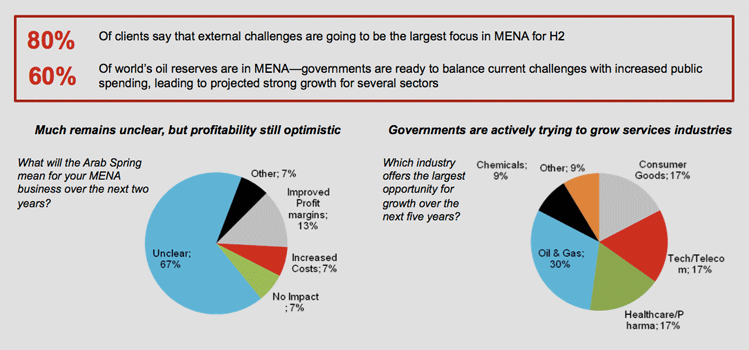
Huge potential for MENA investment despite regional uncertainty


  • Regional Spending - There are two key trends driving outlook in MENA:
    • MENA’s oil exporters are increasing spending of public funds to expand infrastructure and social stablility
    • Oil importers are not so lucky, and struggle with their fewer resources to keep unrest at bay
  • Business Strategy - Takeaways:
    • Instability will continue to dominate the regional narrative
    • Slow government transition should not scare away investors
    • MENA’s volatility necessitates an external strategic focus for foreign MNCs

Monthly Regional Insights: Central & Eastern Europe


Inflation across Central and Eastern Europe (CEE) eases on food prices, improving the outlook for increasing consumer demand in a number of countries in the region. Despite concerns about the impact of the euro zone crisis, investors’ confidence in CEE remains relatively strong, with the notable exception of Turkey where concerns about the country’s growing current account deficit weigh on investor perceptions.

  • Bulgaria: The economy is gradually recovering but inflation, low investment, and the euro zone crisis will continue to weigh on growth
  • Croatia: Despite welcome news on its EU membership, Croatia continues to struggle with serious economic problems
  • Czech Republic: The expected government spending cuts and slowdown in exports to Germany will negatively affect consumer demand
  • Hungary: As inflation eases and Hungary’s economy picks up, we expect a gradual but steady recovery in domestic demand in H2 2011
  • Kazakhstan: An increase in government spending meant to buy popular support for the government will boost consumer demand
  • Lithuania: With inflation stabilizing and the economic recovery on track, consumer demand will support growth more actively in H2 2011
  • Poland: Polish consumers are a key driver of growth and investor interest in the country’s strong domestic
  • Romania: The economy is slowly recovering and the government is seeking more aggressive reform measures
  • Russia: The question of who will run for Russia’s presidency continues to weigh on investor perceptions of the country
  • Serbia: Plagued by high unemployment and rising inflation, Serbia is seeking investors to help boost its economy
  • Slovakia: Expected increases in car production will boost Slovak exports and drive growth for the rest of 2011
  • Turkey: After winning the parliamentary elections, the AK Party will need to address rising consumer spending and inflation aggressively
  • Ukraine: The Ukrainian government is increasingly focusing on cooperation with the EU as a key economic and foreign policy goal


Achieving Growth in EMEA


Turkey’s successfully concluded June elections and the reelection of the pro-business AKP have reaffirmed international investors’ faith in the country as an exciting growth market for both sales and manufacturing. The outlook for its neighbors, however, is far less immediately promising: to the east and north, Greece’s malaise highlights continuing macro-economic uncertainty across Europe; to the south and west (and increasingly directly across its border with refugees fleeing Syria), ferment and repression in the Middle East continue to raise questions about that region’s long-term trajectory. Meanwhile inflation — a unifying theme as well as ubiquitous menace — is placing pressures on consumers and governments’ fiscal and monetary policies across Europe, the Middle East and Africa (EMEA), from Russia to South Africa.

Check out the slides above for tips on converting volatility, sales force and talent-management challenges into opportunities in EMEA.


« Previous Page