Africa’s broadening horizons - Financial Times Feature

Africa

Sub-Saharan Africa’s potential for economic growth is no longer a secret.

Some estimates show Africa having as many middle class households as China by 2020.

The region is expected to set the pace for global growth over the next five years, with economic expansion averaging 6 per cent per year. China increased Africa investment by almost 60 per cent last year, while India pledged to expand trade volume to $90bn (£56bn) by 2015.

Much of this investment will be concentrated in fast-growing sub-Saharan African markets like Angola, Kenya and Nigeria. Multinational corporations are increasingly concentrating resources on these types of markets to make up for economic volatility in Europe and political uncertainty in the Middle East and North Africa.

In a survey conducted last year, 42 per cent of senior executives focused on Europe, the Middle East and Africa (Emea) revealed that they are planning to set up a direct presence in at least one sub-Saharan African country in 2012. More than one-fifth of polled executives said they plan to establish an African managing director role within two years to oversee regional operations.

Multinationals intend to capture average profit margins greater than 10 per cent and returns on capital 60-70 per cent greater than in high-growth markets like China, India and Indonesia.

If multinationals want to capitalise on all that Africa has to offer, then a fundamental shift must take place in the way that companies prioritise markets for resource allocation decisions. Africa is far too big and complex to look at as one market, or even as a portfolio of countries. Companies must look at the African opportunity as a portfolio of cities, targeting the urban areas that offer the best opportunities for their business.

To continue reading the full article, visit the Financial Times website.
LATAM Executives Face Currency Repatriation Challenges in Venezuela

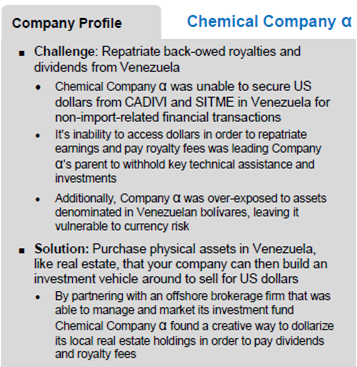
With an estimated US$23 billion in annual unmet demand for dollars, multinationals report that currency repatriation is one of the greatest challenges they face in Venezuela. Foreign exchange controls are unlikely to improve in the short term, regardless of the outcome in upcoming elections. Political instability after the elections could lead to even further shortages of CADIVI and SITME dollars. Given the insufficient supply of US dollars, multinationals have had to find creative ways to source capital in order to keep their operations moving in Venezuela.

The following three strategies are typically followed:

  1. Trade-based repatriation
  2. Dollarization of physical assets
  3. Panama swap

The case study below outlines how Chemical Company Alpha was able to successfully repatriate funds from Venezuela:

The Waiting Game – Launching New Products in China

China Survey

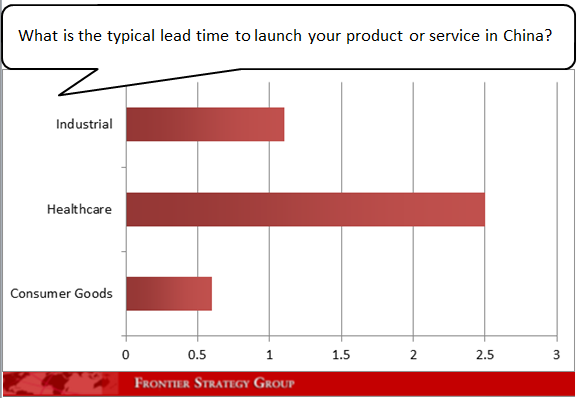
The ability to bring products to market quickly is one of the biggest factors that separates leading multinationals from the rest of the pack. Companies that continuously release innovations in the form of new products and services are able to differentiate themselves as “first-movers,” and gain a key advantage against the competition. In order to better understand the expectations for launching new products in China, Frontier Strategy Group recently conducted a senior executive poll to determine how long it takes for companies to bring new products to market. On average, healthcare companies require roughly two and a half years to bring a new product to market, while consumer goods average just over half of a year. Industrial companies fall close to the middle, averaging just over 1 year. If your company takes longer than the industry average in launching a new product, you could be leaving yourself vulnerable to organizations that are more efficient in new product development.

Also within this research, FSG identified the average revenue and profit contributions by industry within emerging markets and China. As an example, Industrial companies have a far larger percentage of their business in emerging markets than any of their peers, with more than 40% of their current profits derived from emerging markets and an expectation of over 50% in just five years. By analyzing the nature of your industry as it stands right now, compared to the momentum and expectations for the future, you too can have a unique insight into the growth opportunities for your business in emerging markets.


Where does CEE fit into your Emerging Markets strategy?

  • CEE is smaller than other regions, and often does not draw the attention of corporate headquarters
  • As a cluster, CEE is larger in population terms than many markets, from Russia to Mexico to Japan
  • CEE consumer spending power is robust relative to other EM regions
  • At current growth rates, LATAM and APAC personal disposable income per capita will not catch CEE until 2028


Capitalizing on Colombia to Achieve Aggressive Growth Targets

US President Obama’s visit to Colombia signals a significant shift in how Western multinationals are approaching the Colombian market. Juan Carlos Echeverry, Finance Minister, was quoted in a recent article in the Washington Post alongside Clinton Carter, Frontier Strategy Group’s head of Latin America research, about the Colombian miracle:

Clinton Carter, head of Latin America research, said that there is still “an outdated mentality” about Colombia but that it is becoming easier to convince investors of the country’s possibilities. Frontier Strategy Group works with more than 200 Fortune 500 companies, the majority of which have substantial investments in Latin America.

Carter ticked off the advantages of Colombia: a free-trade agreement with the United States, its location in the center of the hemisphere, institutions that are more stable than in some neighboring countries and a well-trained workforce.

“It’s a sophisticated business community that places a premium on education,” Carter said.

ThyssenKrupp Elevator, a division of the German conglomerate, said Colombia is now its fastest-growing market in Latin America. The company is installing elevators and escalators in the country’s airport projects and newly built malls and is bidding on other projects, said Stuart Prior, the Texas-based chief operating officer of ThyssenKrupp Elevator.

“It’s a place we decided 10 or 12 years ago to invest in, and each year it got better and better,” he said. “We saw this coming five or six years ago.”

The full article can be found here:

http://www.washingtonpost.com/world/the_americas/colombian-miracle-takes-off/2012/04/13/gIQAsnEdET_story_1.html

3 Questions Worth Considering When Operating in Turkey

If you are not going direct in Turkey, then you are likely missing out on a tremendous opportunity for your business. In our latest research on the market opportunity in Turkey, Frontier Strategy Group identified three questions you should ask about the state of your operations in Turkey:

  1. Turkey’s M&A market is ripe for acquisitions, but MNCs increasingly have to compete with private equity funds for the best assets. How is your company leveraging acquisitions to grow its presence in the Turkish market?
  2. MNCs leveraging Turkey as a regional sales hub are 9% more profitable in Turkey than the global average for their company. How is your company taking advantage of Turkey’s growing position as a regional hub?
  3. Turkish distributors are 23% cheaper as a percentage of profit margins than the global average. How effective is your company at leveraging distributors to increase market penetration in Turkey?


5 Common Mistakes to Avoid in Emerging Markets

Local Competitors

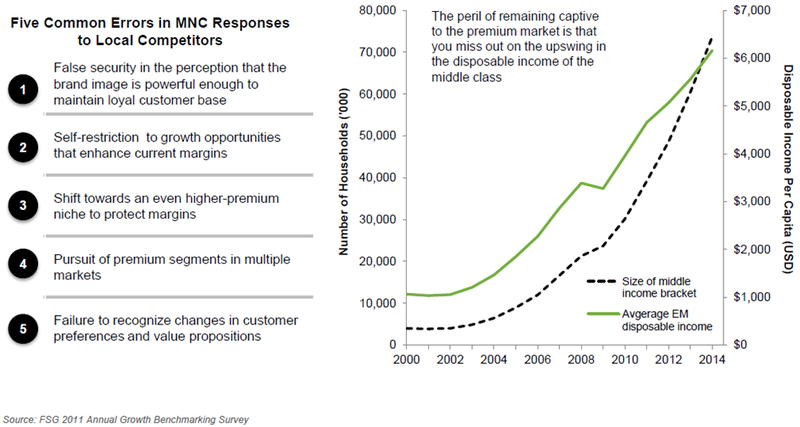
  • Maintaining a steadfast focus on the premium market is the leading cause of significant downturns in corporate revenue growth that many MNCs experience
  • A failure to shift tactics away from the premium segment will prevent you from taking advantage of the increase in disposable income and size of the middle income segment in emerging markets
  • The figure above illustrates the 5 common errors MNCs tend to make when responding to local competition in emerging markets

Executives Continue to Pursue High Growth Targets in Brazil

  • Despite Brazil’s weaker-than-expected performance in 2011, senior executives responsible for Brazil have high growth targets for 2012
  • Brazil saw disappointing growth in 2011 and is likely to see only a slight improvement in 2012
  • FSG is observing a greater slowdown in revenue growth in industrial companies than in consumer goods companies
  • Given ambitious targets and a sluggish economy, FSG executives are pursuing riskier growth strategies in 2012, with almost two-thirds of clients looking to introduce new products and/or deepen their investments in 2nd and 3rd tier markets
  • Our clients expect their best performances to come from established markets in the Southeast, but are increasingly turning their attention to high-growth markets in the Northeast and Central-West
  • Clients see the need for more investments in marketing and human resources in 2012, building on larger investments in sales staff in 2011